Ad Hooks: 15 Templates That Stop the Scroll
Table of Contents
- Why Ad Hooks Matter
- 1. The Curiosity Gap Hook
- 2. The Bold Statement Hook
- 3. The Question Hook
- 4. The Statistic Hook
- 5. The Direct Address Hook
- 6. The Story Hook
- 7. The Pain Point Hook
- 8. The Social Proof Hook
- 9. The How-To Hook
- 10. The Contrarian Hook
- 11. The Urgency Hook
- 12. The Comparison Hook
- 13. The Relatable Scenario Hook
- 14. The Authority Hook
- 15. The Interactive / Poll Hook
- How to Test Your Hooks
- Frequently Asked Questions
Your ad hook is the first thing people see. On Facebook, Instagram, and TikTok, it’s also the only thing people see before deciding to scroll past or stop and engage. A 2025 Meta study found that ads with strong hooks have 73% higher ad recall and significantly lower cost-per-click.

This guide covers 15 scroll-stopping ad hook templates you can use for Facebook, Instagram, and TikTok ads. Each one includes a formula, real examples, and tips for adaptation. Plus, all 15 templates are included in the AdCreativeKit Digital Marketing Bundle — ready to edit and launch.
Why Ad Hooks Matter
On average, users spend 1.7 seconds looking at a Facebook ad. That’s less time than it takes to read this sentence. Your hook — the first line above the fold — is your only chance to earn those extra seconds of attention.
A great hook does three things:
- Stops the scroll — It’s unexpected, intriguing, or emotionally resonant.
- Creates relevance — The viewer knows immediately whether this is for them.
- Promises value — There’s a clear payoff for engaging further.
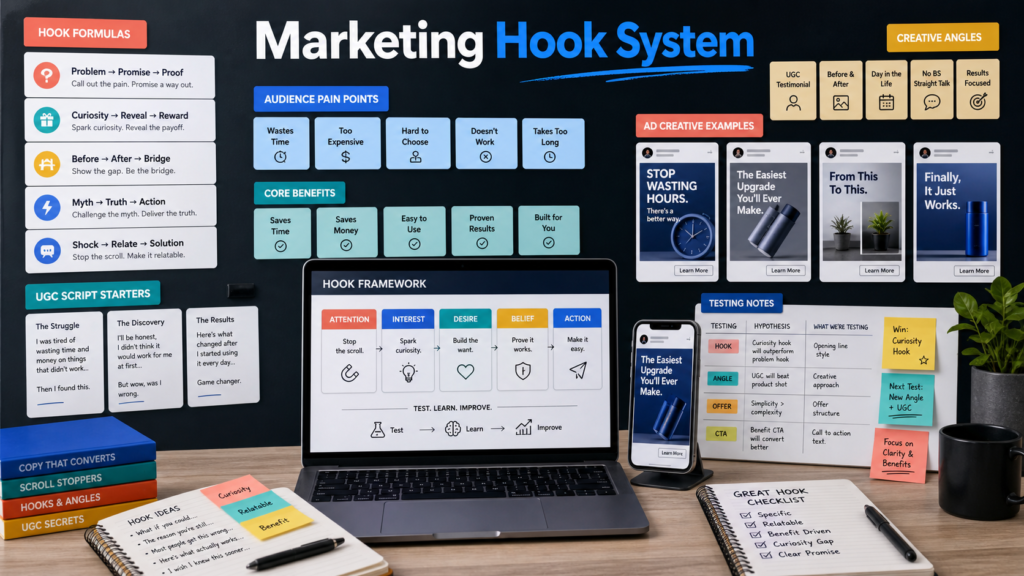
For a deeper dive into hook psychology and copywriting frameworks, check out our complete marketing hooks guide.
1. The Curiosity Gap Hook
Formula: “Most [audience] don’t know [fact/insight]. Here’s why it matters.”
Examples:
- “Most ecommerce stores are wasting 40% of their ad budget. Here’s the fix.”
- “The #1 reason your Facebook ads aren’t converting (it’s not your targeting).”
- “What if I told you one template change could double your CTR?”
Best for: Awareness campaigns, educational content, lead generation.
2. The Bold Statement Hook
Formula: “Stop [common mistake]. Do this instead.”
Examples:
- “Stop hiring expensive agencies for your ad creatives.”
- “Stop wasting $500 per ad design. Use proven templates instead.”
- “Stop guessing what works. Copy what already converts.”
Best for: Direct response, disruption campaigns, competitive markets.
3. The Question Hook
Formula: “What if you could [desired outcome] without [pain point]?”
Examples:
- “What if you could create a winning ad in under 5 minutes?”
- “What if one bundle had everything you need to scale your campaigns?”
- “What if you could test 10 ad variations without hiring a designer?”
Best for: Problem-aware audiences, retargeting, product launches.
4. The Statistic Hook
Formula: “[Specific number]% of [audience] experience [problem]. Here’s how we fixed it.”
Examples:
- “80% of ad creatives fail. Here are the 20% that work.”
- “Meta CPMs are up 467%. Here’s how to get your ROAS back.”
- “90% of marketers struggle with ROAS. Our customers average 8x.”
Best for: Authority building, B2B, data-driven audiences.
5. The Direct Address Hook
Formula: “If you’re [specific audience segment], this is for you.”
Examples:
- “If you spend $5k+/month on Meta ads, read this.”
- “If you’re tired of designing ads from scratch, I have something for you.”
- “If you run a Shopify store and want higher ROAS, keep scrolling — actually, don’t.”
Best for: Highly targeted campaigns, niche products, email list growth.
6. The Story Hook
Formula: “We [struggled/failed/learned] until we discovered [insight].”
Examples:
- “We spent $50k on ads before realizing the creative was the problem.”
- “I almost gave up on Facebook ads. Then I tried one thing that changed everything.”
- “Our first 10 ad campaigns flopped. Here’s what we learned from the 11th.”
Best for: Brand storytelling, personal brands, building trust.
7. The Pain Point Hook
Formula: “Tired of [specific pain]? You’re not alone.”
Examples:
- “Tired of spending hours designing ads that don’t convert?”
- “Frustrated with low ROAS no matter what you try?”
- “Sick of inconsistent campaign results and wasted ad spend?”
Best for: Pain-aware audiences, retargeting, bottom-of-funnel offers.
8. The Social Proof Hook
Formula: “[Number]+ [audience] trust [brand/product]. Here’s why.”
Examples:
- “Join 400+ marketers who transformed their ad performance.”
- “Rated 4.9/5 by customers who actually run ads for a living.”
- “Used by 100+ top brands to create high-converting ads.”
Best for: Trust-building, B2B, high-consideration purchases.
9. The How-To Hook
Formula: “How to [achieve goal] in [short time/number of steps].”
Examples:
- “How to create a high-converting ad in under 5 minutes.”
- “How to slash your design costs by 90% (without sacrificing quality).”
- “How to test 20 ad creatives for the cost of one.”
Best for: Educational content, lead magnets, how-to guides.
10. The Contrarian Hook
Formula: “Everyone says [popular belief]. They’re wrong.”
Examples:
- “Everyone says you need a big budget for great ads. They’re wrong.”
- “Everyone says video ads outperform static ads. Here’s when they don’t.”
- “Everyone says you need to start from scratch. We disagree.”
Best for: Attention-grabbing, challenging industry norms, standing out.
11. The Urgency Hook
Formula: “[Time-sensitive] — [offer] expires [time].”
Examples:
- “This bundle won’t be $27 forever. Price increases soon.”
- “Last chance to get lifetime access at this price.”
- “Only 50 spots left at this rate. Don’t miss out.”
Best for: Flash sales, limited-time offers, launch campaigns.
12. The Comparison Hook
Formula: “[Old way] vs [new way] — the difference is [X].”
Examples:
- “Hiring a designer vs using ad templates. The cost difference will shock you.”
- “Guessing ad creative vs using data-driven templates. One is 8x more profitable.”
- “DIY email design vs 130+ ready-to-use templates. Your time is worth more.”
Best for: Product comparisons, value propositions, direct response.
13. The Relatable Scenario Hook
Formula: “You know that feeling when [relatable situation]? We fixed it.”
Examples:
- “You know that feeling when you spend hours on an ad and it flops?”
- “You know that panic when your CPMs spike and ROAS drops?”
- “You know that frustration of not having enough creative variations to test?”
Best for: Audience connection, emotional resonance, lifestyle brands.
14. The Authority Hook
Formula: “As seen in [trusted source] — [credibility statement].”
Examples:
- “Trusted by 100+ top brands for high-converting ad creatives.”
- “Created by people who run ads for a living — not theory, real results.”
- “The same templates used by agencies charging $10k/month.”
Best for: Premium products, B2B, credibility-focused audiences.
15. The Interactive / Poll Hook
Formula: “Quick question: [binary/simple question]?”
Examples:
- “Quick question: Static ads or video ads — which converts better for you?”
- “Poll: Do you outsource your ad designs or do them in-house?”
- “Which is your biggest struggle: creative, copy, or targeting?”
Best for: Engagement campaigns, audience research, polling.
How to Test Your Hooks
Writing hooks is step one. Testing them is what drives results. Here’s a simple A/B testing process:
- Write 3-5 hook variations for the same offer.
- Run them as separate ad sets with identical targeting and creative.
- Let each run until you have at least 1,000 impressions per variation.
- Compare CTR and CPA — the hook with the best metrics wins.
- Take the winning hook and test it against 3 more variations.
Need help designing the ad visuals for your hooks? Check out our Facebook ad template layouts that pair perfectly with these hook styles.
Frequently Asked Questions
How many hooks should I test per campaign?
Start with 3-5 hook variations per ad set. Test one variable at a time — hook, creative, or offer — never all three simultaneously. This gives you clean data on what’s driving performance.
What makes a hook “scroll-stopping”?
A scroll-stopping hook triggers one of these responses: curiosity (“Wait, what?”), relevance (“That’s me!”), emotion (“That’s frustrating!”), or value (“I need that!”). If it doesn’t trigger at least one, rewrite it.
How long should my hook be?
For Facebook and Instagram ads, keep hooks between 5-15 words. For TikTok, the hook should be delivered in the first 2-3 seconds of video. Short, punchy, and benefit-driven always outperforms long hooks.
Can I reuse hooks across different campaigns?
Yes! The same hook formula can work for different audiences and offers with minor wording changes. The structure is transferable — just update the specifics. Our bundle includes a full hooks library you can adapt across campaigns.
Where can I find ready-to-use ad hooks?
The AdCreativeKit bundle includes a complete library of high-converting ad hooks for every niche, plus 550+ editable ad templates and AI copywriting guides.
Get 15 Proven Ad Hooks + 550+ Templates
Stop writing hooks from scratch. The AdCreativeKit #1 Digital Marketing Bundle gives you:
- ✅ Complete library of scroll-stopping ad hooks
- ✅ 550+ editable Meta ad templates (Canva & Figma)
- ✅ 130+ email templates with proven hooks baked in
- ✅ AI Copywriting Cheat Sheet for generating more hooks
- ✅ Lifetime access — one payment, no subscriptions
You can also compare your hook and creative tests with Meta?s business help resources.
Ad Hooks Testing Checklist
When testing ad hooks, keep the visual layout the same and change only the first message. This helps you see whether the hook is improving attention instead of confusing the result with a new image, new offer, or new CTA.