10 High-Converting Meta Ad Templates to Test in 2026
The phrase “high-converting template” is useful only when it leads to a testable decision. A Meta layout does not inherit another advertiser’s performance; it carries a persuasion structure that your product, evidence, audience, and offer must earn.
This guide turns ten familiar patterns into decision cards. Each card has a buyer stage, campaign job, proof threshold, poor-fit condition, controlled variant, KPI, and interpretation rule. An active ad is evidence that a brand is running the creative, not proof that the ad is profitable.
Quick answer: Choose the template that answers the buyer’s next unresolved question. Build the minimum credible version, isolate one creative lever, and judge the result without treating Ad Library activity as proof of conversion.
What Makes a Meta Ad Template Worth Testing?
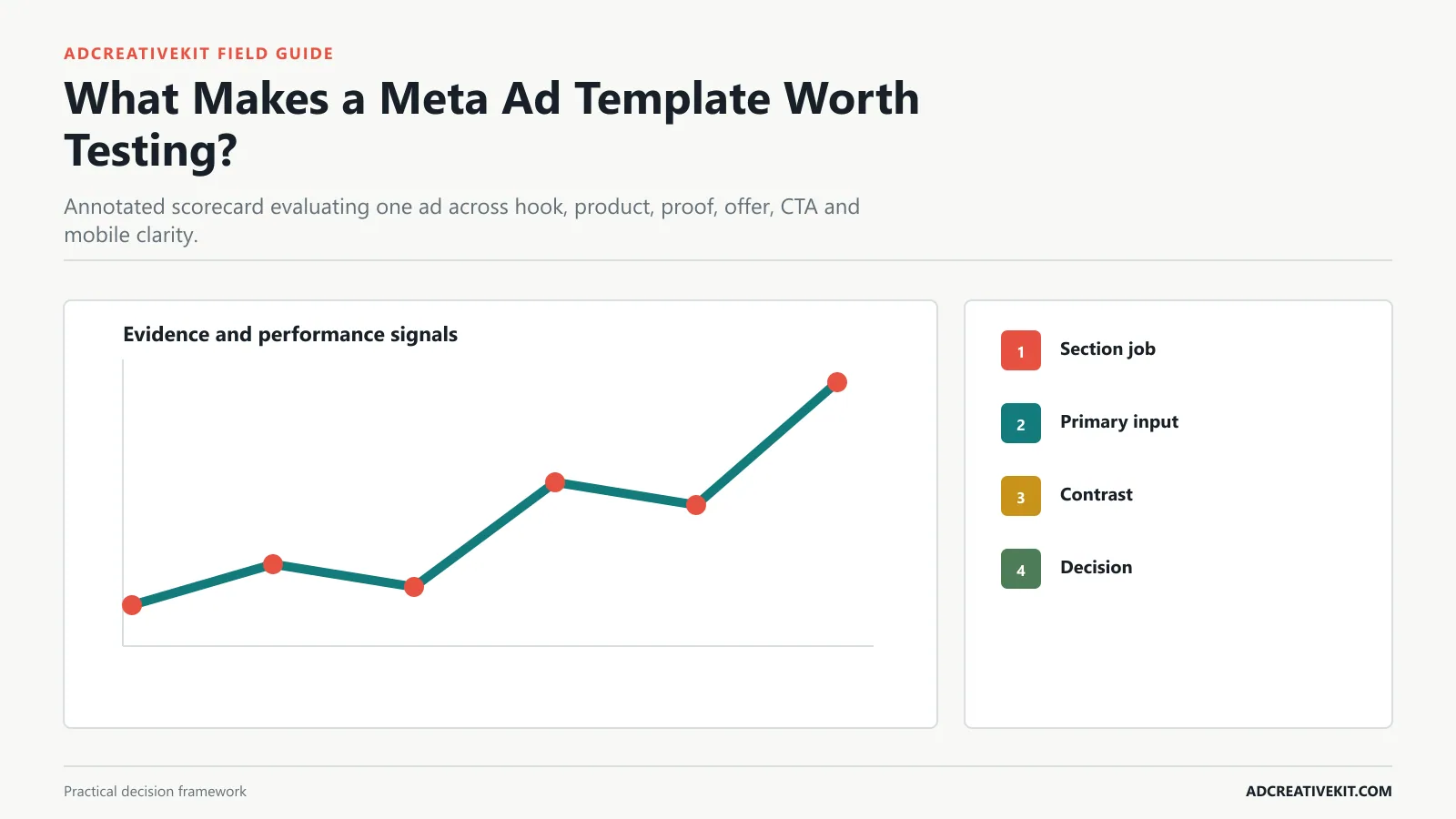
Score the structure before polishing it. A useful candidate makes the product and promise understandable, uses proof the advertiser can substantiate, and leaves one meaningful variable available for the next test. For the problem agitation pattern, record the awareness level, campaign job, proof requirement, unsuitable use case, first variant, and metric that would change the next brief.
Meta ad templates give you a faster way to launch better Facebook and Instagram ads without rebuilding every creative from a blank canvas. The best templates are not random designs. They are repeatable structures for hooks, product proof, offers, objections, and calls to action.
Round 4: CTA test. Keep the winning structure and test the next-step language.
A before-and-after creative makes the transformation easy to understand. Use a split layout, carousel, or short video sequence that shows the old state and the improved result. Avoid exaggerated claims; focus on believable improvements customers can picture.
Separate resemblance from evidence. A brand may run a benefit stack execution for weeks without revealing spend, revenue, margin, or incrementality. Use longevity only as an inspiration clue. Evaluate buyer awareness directly and state what remains unknown.
Treat template selection as a bounded decision: record the suitable audience state, evidence requirement, poor-fit condition, and first variable to test.
| Decision field | Example | Why it matters |
|---|---|---|
| Audience state | Problem-aware cold prospect | Sets the amount of explanation the ad must provide |
| Creative job | Make the mechanism understandable | Prevents a layout from trying to solve every objection |
| Evidence | Recorded product demonstration | Defines which claims the execution can support |
| Controlled variant | Opening hook only | Makes the next result easier to interpret |
Confirm current requirements in Meta Photo Ads. Use the source for platform or compliance facts, while keeping performance conclusions tied to your own account evidence.
Choose a Template by Buyer Awareness and Funnel Stage
For unaware or problem-aware buyers, lead with the situation or cost of inaction. For solution-aware buyers, demonstration and comparison can carry more weight; product-aware and warm audiences are more likely to need proof, objection handling, or offer clarity. For the benefit stack pattern, record the awareness level, campaign job, proof requirement, unsuitable use case, first variant, and metric that would change the next brief.
If your campaigns are getting impressions but weak clicks, low add-to-cart rates, or inconsistent sales, the creative usually needs clearer messaging. Use these high-converting Meta ad templates to test stronger angles, then customize the visuals, copy, and offer for your market.
This turns a template library into a learning system. The goal is not simply to make more ads. The goal is to understand which message structure deserves more budget.
User-generated style ads often feel more native in the feed. Build the template around a customer quote, creator-style selfie video, or simple product-in-hand shot. The copy should sound like a real person explaining why the product helped.
Separate resemblance from evidence. A brand may run a product demonstration execution for weeks without revealing spend, revenue, margin, or incrementality. Use longevity only as an inspiration clue. Evaluate funnel job directly and state what remains unknown.
State when a layout is unsuitable. A proof-led card without credible proof, or a demonstration without visible mechanism, creates a polished version of the wrong argument.
Product checklist
- Label the buyer-awareness stage for benefit stack.
- Name the evidence required before using product demonstration.
- Write one poor-fit condition involving funnel job.
- Change only available proof in the first controlled variant.
Problem, Benefit and Product-Demo Templates
Problem-solution, benefit-stack, and product-demo ads perform different jobs. Choose among them according to whether the buyer must recognize a problem, understand an outcome, or see the mechanism in action. For the product demonstration pattern, record the awareness level, campaign job, proof requirement, unsuitable use case, first variant, and metric that would change the next brief.
Meta ads still need to earn attention and continue into a relevant post-click experience. A template system helps you keep the important pieces consistent: a visible product, a clear benefit, a believable reason to act, and a direct next step. That makes testing easier because you can compare one creative idea against another instead of changing everything at once.
Using a template without a hypothesis. Every creative should test a clear belief, objection, or buying angle.
This template works when the offer needs to feel bigger than the price. Show the main product, bonus items, discount, guarantee, and deadline in one clean composition. The goal is not to make the ad busy. The goal is to make the value obvious in three seconds.
Separate resemblance from evidence. A brand may run a customer review execution for weeks without revealing spend, revenue, margin, or incrementality. Use longevity only as an inspiration clue. Evaluate available proof directly and state what remains unknown.
Attach a primary metric and interpretation rule to each variant so the test changes the next brief rather than merely producing a leaderboard.
Review, Comparison and Objection Templates
Reviews require permission and a faithful representation of the customer’s experience. Comparisons require fair criteria, while objection ads should answer one material hesitation rather than manufacture a concern the buyer did not have. For the customer review pattern, record the awareness level, campaign job, proof requirement, unsuitable use case, first variant, and metric that would change the next brief.
You can also connect your ads to stronger post-click experiences. For example, pair these templates with the ideas in our landing page optimization guide so your creative and landing page tell the same story.
Changing too many elements at once. If the image, offer, hook, CTA, and audience all change, the result is hard to interpret.
Use a comparison layout when your product is faster, easier, cleaner, cheaper, or more complete than the alternative. Compare categories, not direct competitors, unless you have a careful legal review. For example: “manual ad design” versus “ready-to-edit templates.”
Separate resemblance from evidence. A brand may run a comparison execution for weeks without revealing spend, revenue, margin, or incrementality. Use longevity only as an inspiration clue. Evaluate placement directly and state what remains unknown.
Do not infer profitability from an ad’s presence or longevity in Meta Ad Library; spend, revenue, margin, and incrementality are not exposed there.
Offer checklist
- Label the buyer-awareness stage for customer review.
- Name the evidence required before using comparison.
- Write one poor-fit condition involving placement.
- Change only production capacity in the first controlled variant.
Offer, Founder, UGC and Retargeting Templates
Offer, founder, creator-style, and retargeting layouts should not share one proof threshold. A founder explanation may establish mechanism; a retargeting reminder should address the specific reason a previously interested shopper paused. For the comparison pattern, record the awareness level, campaign job, proof requirement, unsuitable use case, first variant, and metric that would change the next brief.
The best Meta ad template is not the most attractive design. It is the structure that matches what the buyer needs to believe before clicking. A cold shopper usually needs relevance and clarity. A warm shopper may need proof. A retargeting shopper may need reassurance or a stronger reason to act now.
Ignoring the landing page. The ad template and page hero should repeat the same promise, product, and offer.
Social proof ads work because they reduce doubt. Use reviews, star ratings, customer counts, creator mentions, or short result statements. The proof should be readable on mobile and tied to a specific benefit.
Separate resemblance from evidence. A brand may run a objection answer execution for weeks without revealing spend, revenue, margin, or incrementality. Use longevity only as an inspiration clue. Evaluate production capacity directly and state what remains unknown.
Preserve ad-to-page continuity by repeating the product, promise, offer terms, and relevant evidence after the click.
Copy Formulas for Every Meta Ad Template
Write the message before selecting the decorative treatment. Primary text can create context, the headline can state the next reason to click, and the creative should make the product, proof, or offer inspectable on a small screen. For the objection answer pattern, record the awareness level, campaign job, proof requirement, unsuitable use case, first variant, and metric that would change the next brief.
Do not launch ten templates and hope one works. Use templates as controlled creative structures. Choose one product, one offer, and one landing page. Then test the template variable in a way that produces a useful learning.
Over-designing the message. A beautiful layout still fails if the buyer cannot understand the value in two seconds.
A product demo template is ideal when the product is visual or easy to show in action. Use a close-up, a quick sequence, or a screen recording. Keep the copy minimal and let the product answer the buyer’s biggest question.
Separate resemblance from evidence. A brand may run a founder story execution for weeks without revealing spend, revenue, margin, or incrementality. Use longevity only as an inspiration clue. Evaluate buyer awareness directly and state what remains unknown.
Turn each copy formula into a fill-in argument, then remove any line that cannot be supported by the product, page, or customer evidence.
Product checklist
- Label the buyer-awareness stage for objection answer.
- Name the evidence required before using founder story.
- Write one poor-fit condition involving buyer awareness.
- Change only funnel job in the first controlled variant.
Connect this step to the landing page optimization guide so the decision survives the handoff from concept to campaign and post-click experience.
Adapt Templates for Feed, Stories and Reels
Adapt hierarchy, not just canvas size. A square or portrait feed execution may support a denser proof block, while a vertical placement needs critical text and product action inside its safe viewing area. For the founder story pattern, record the awareness level, campaign job, proof requirement, unsuitable use case, first variant, and metric that would change the next brief.
Round 1: Angle test. Compare problem-solution, proof-led, comparison, and offer-led templates.
Use templates to create speed, but use a testing system to create learning.
List the doubts that stop buyers from clicking: price, time, difficulty, quality, shipping, trust, or fit. Then build one ad around one objection. A simple headline like “No design experience needed” can outperform a generic benefit if that is the real barrier.
Separate resemblance from evidence. A brand may run a UGC-style explanation execution for weeks without revealing spend, revenue, margin, or incrementality. Use longevity only as an inspiration clue. Evaluate funnel job directly and state what remains unknown.
Document placement changes so a crop or shortened headline is recognized as an adaptation rather than an accidental new variable.
Confirm current requirements in Meta Ad Creative Strategy. Use the source for platform or compliance facts, while keeping performance conclusions tied to your own account evidence.
Turn One Template Into a Controlled Creative Test
A controlled test changes the element named in the hypothesis and keeps the important commercial conditions comparable. Select the primary metric before launch and retain downstream guardrails such as landing-page conversion and acquisition cost. For the UGC-style explanation pattern, record the awareness level, campaign job, proof requirement, unsuitable use case, first variant, and metric that would change the next brief.
Round 2: Hook test. Keep the winning template and test three headline or opening variations.
Start with a painful problem your buyer already recognizes, then show how your product solves it. This works well for skincare, fitness, software, home products, and any offer where the customer has an urgent frustration.
Promotion ads should make the deadline and value clear. Add the discount, bundle, or bonus near the product image and repeat the CTA in the caption. Use urgency carefully; fake urgency can damage trust and reduce future conversion rates.
Separate resemblance from evidence. A brand may run a offer card execution for weeks without revealing spend, revenue, margin, or incrementality. Use longevity only as an inspiration clue. Evaluate available proof directly and state what remains unknown.
Keep the audience, offer, and destination comparable when the question concerns creative; otherwise label the exercise as package screening.
Offer checklist
- Label the buyer-awareness stage for UGC-style explanation.
- Name the evidence required before using offer card.
- Write one poor-fit condition involving available proof.
- Change only placement in the first controlled variant.
Connect this step to the repeatable ad testing system so the decision survives the handoff from concept to campaign and post-click experience.
Build a Repeatable Meta Template Learning Loop
Store the question, control, variant, delivery context, result, caveats, and next action together. That record prevents an isolated win from becoming an unsupported rule for every audience and offer. For the offer card pattern, record the awareness level, campaign job, proof requirement, unsuitable use case, first variant, and metric that would change the next brief.
Round 3: Proof test. Keep the winning hook and test review proof, demo proof, and feature proof.
Structure: problem hook, short explanation, product demonstration, proof point, call to action. Keep the first line specific, such as “Still spending 40 minutes editing one ad?” instead of “Need better marketing?”
If you want a faster starting point, browse the AdCreativeKit template shop and combine these ad structures with stronger marketing hooks .
Separate resemblance from evidence. A brand may run a retargeting reminder execution for weeks without revealing spend, revenue, margin, or incrementality. Use longevity only as an inspiration clue. Evaluate placement directly and state what remains unknown.
Feed the result back into the library with scope notes, because a finding from one audience and offer is not a timeless template ranking.
Frequently asked questions
Can Meta Ad Library prove that a template converts?
No. It can show that an ad is or was active, but it does not expose the advertiser’s profit, attribution quality, margin, or incremental result. An active ad is evidence that a brand is running the creative, not proof that the ad is profitable.
How many Meta templates belong in a first test?
Use enough concepts to answer the highest-priority uncertainty without spreading delivery across unrelated ideas. A hook test, proof test, and offer test are different questions; label them separately.
Should the visible year be updated?
Keep platform references current and review the article when specifications or terminology change. Preserve the existing URL unless a deliberate migration includes a tested redirect.
Save the decision card beside the creative, not in a disconnected report. The next strategist should be able to see which buyer state, evidence, variable, and interpretation produced the recommendation.
Use the Facebook ad creative review checklist before launch, record the hypothesis in the repeatable ad testing system, and inspect post-click continuity with the ecommerce CRO checklist.
Confirm current implementation details in Meta Ad Creative Strategy before production.