Static Ads vs UGC Ads: What Ecommerce Should Test First
Static versus UGC is often presented as a winner-takes-all debate, even though most comparisons change the angle, offer, production quality, speaker, audience, and landing page at the same time. That does not isolate format.
This guide starts with product explainability, trust barrier, demonstration need, AOV, proof, placement, and budget. It then turns the choice into an angle-matched experiment with explicit constants and guardrails. Format comparisons are meaningless when the static and video use different angles, offers, audiences, or landing pages.
Quick answer: Test static first when one frame can carry a simple, visually legible argument. Test UGC-style first when demonstration, education, or human reassurance is central. Run both in parallel only when you can match the underlying claim and conditions.
Static Ads vs UGC Ads: The Short Answer
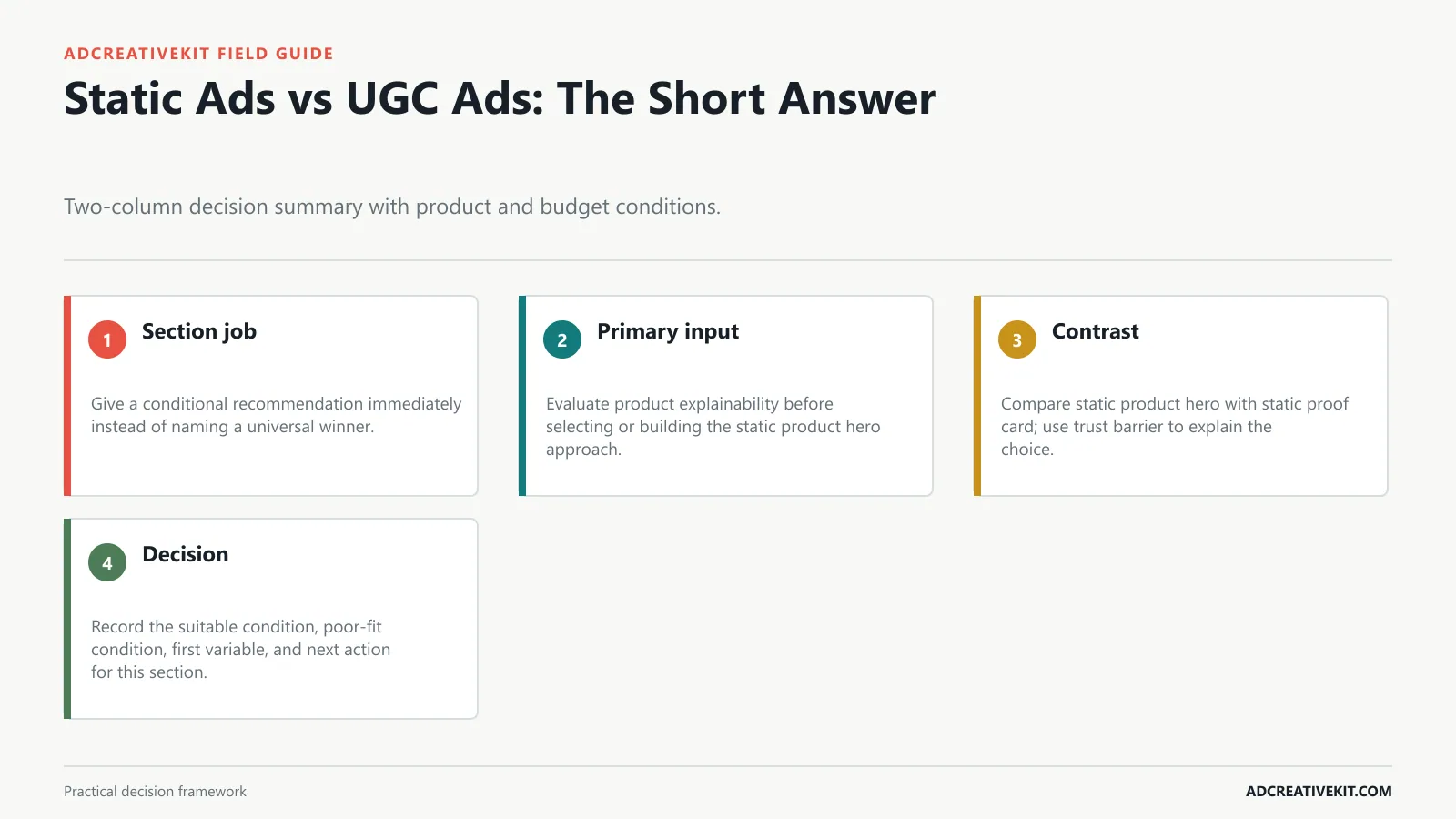
The first format should follow the product’s explanation burden, available proof, production capacity, funnel stage, and budget. When both formats are plausible, run a matched comparison instead of adopting a category-wide rule.
A practical ecommerce case study workflow for deciding whether your first creative test should start with polished static ads, UGC-style video ads, or both.
UGC-style direction: creator-style hooks, product demonstration, casual testimonial framing, and natural objection handling.
If shoppers need more context, trust, or demonstration before buying, a UGC-style ad may create stronger engagement and higher-quality traffic because it answers objections before the click.
The best UGC-style ads are not random testimonials. They are structured sales narratives that still feel natural. A strong UGC-style ad usually follows a simple sequence: hook, problem, product, proof, objection, offer, CTA.
The product has both strong visual appeal and a meaningful explanation gap.
Use product explainability to choose a sensible first format, not to declare a permanent winner. A static product hero execution may expose a trust problem while a static proof card version reveals that the same idea can work with less production.
Isolate presentation format while keeping the commercial argument comparable; otherwise the result is a package comparison, not evidence about static versus UGC-style execution.
| Fair-test field | Hold constant | Reason |
|---|---|---|
| Argument | Angle, promise, evidence, offer, and CTA | Both formats make the same commercial case |
| Delivery | Audience, objective, placements, schedule, and budget logic | Reduces auction and targeting confounds |
| Destination | Landing page, promotion terms, and tracking | Keeps post-click conditions comparable |
| Format | One-frame static versus creator-style video | Leaves presentation as the principal changed variable |
Confirm current requirements in Meta Ad Creative Strategy. Use the source for platform or compliance facts, while keeping performance conclusions tied to your own account evidence.
Define Static, Real UGC and UGC-Style Ads
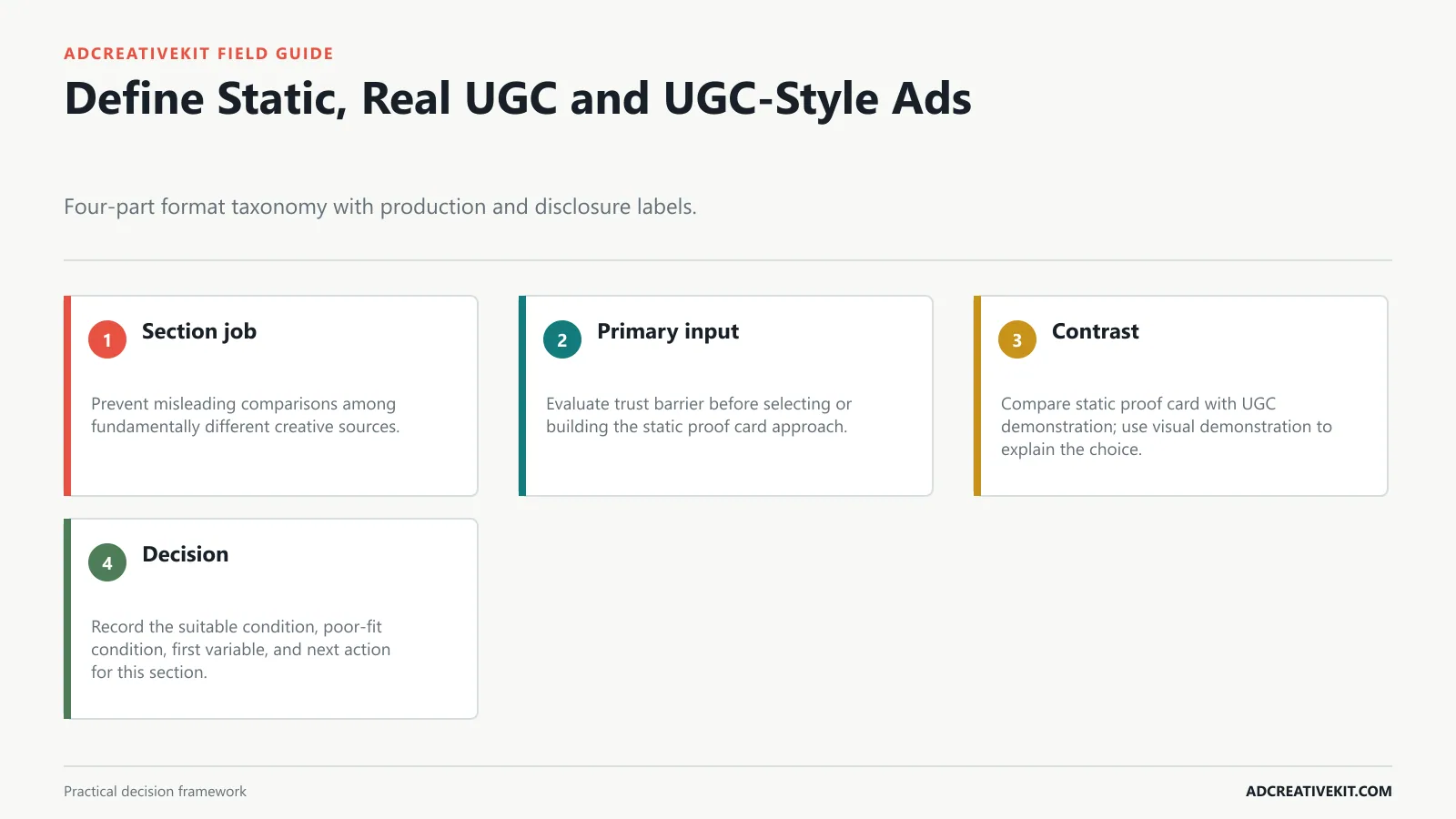
Static ads use a single designed frame; real UGC originates with customers; paid UGC-style ads intentionally use creator conventions. Labeling matters because production control, permissions, endorsements, and disclosure duties differ.
Ecommerce teams often ask the same question before launching a new paid social test: should the first round of creative budget go toward static ads or UGC-style videos?
The brand does not yet know whether shoppers need a fast product-and-offer message or a more human explanation before buying. That is the real question the test should answer.
The winning format will reveal how much explanation the buyer needs. Static winning early suggests the product and offer are easy to understand. UGC-style winning early suggests trust, context, or demonstration may be the missing conversion bridge.
The goal of the first 14 days is not to prove a universal winner. The goal is to identify which format deserves the next branch of creative production.
Use trust barrier to choose a sensible first format, not to declare a permanent winner. A static proof card execution may expose a trust problem while a UGC demonstration version reveals that the same idea can work with less production.
Avoid universal cost or performance benchmarks unless the methodology and context are visible. Production cost and media outcome vary with category, creator, edit complexity, and account conditions.
Control checklist
- Use the same static proof card angle in both formats.
- Match trust barrier, audience, and offer.
- Keep visual demonstration and attribution settings stable.
- Plan the next test for a split or inconclusive result.
Compare Cost, Speed, Control and Testing Value
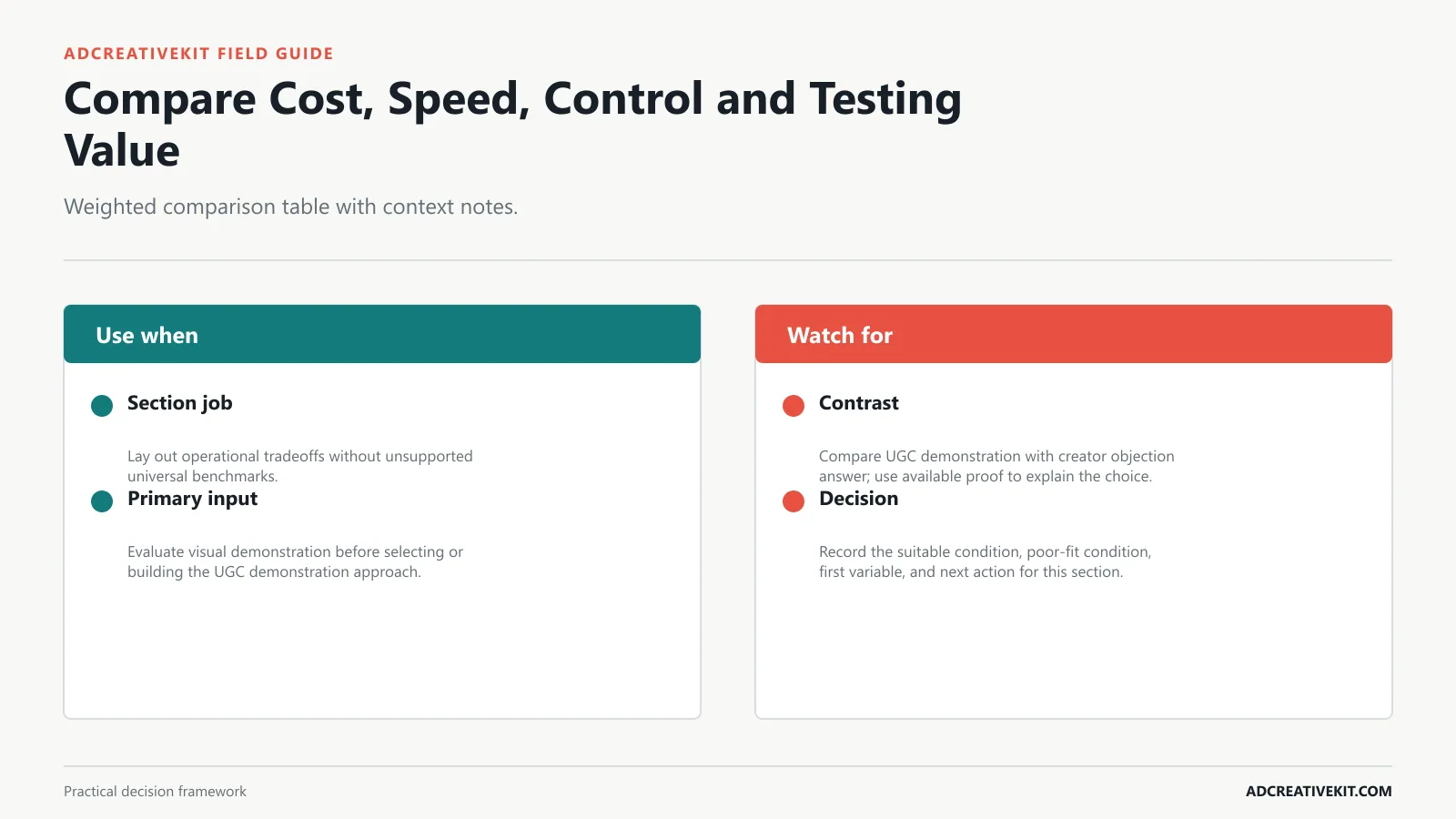
Static usually offers faster iteration and tighter visual control. UGC-style video can show use, texture, fit, sequence, or a human explanation, but it generally requires more production coordination and rights management.
The easy answer is usually too shallow. Static ads are not automatically outdated. UGC-style ads are not automatically more persuasive. The better question is: which format gives this product the cleanest path to learning?
If the team already uses Meta ad templates or ecommerce ad templates , the static side of the test can be produced quickly. The UGC-style side then becomes a script and proof test: can a human-led format communicate trust better than a polished layout?
Static ads should usually be tested first when the team needs fast learning and the product can be understood in one glance.
Choose three angles: one problem-aware angle, one proof-led angle, and one offer-led angle. Build one static ad and one UGC-style concept for each angle.
Use visual demonstration to choose a sensible first format, not to declare a permanent winner. A UGC demonstration execution may expose a trust problem while a creator objection answer version reveals that the same idea can work with less production.
Give product explainability, trust barriers, demonstration need, and available proof explicit weight before choosing the first format.
When Ecommerce Brands Should Test Static First
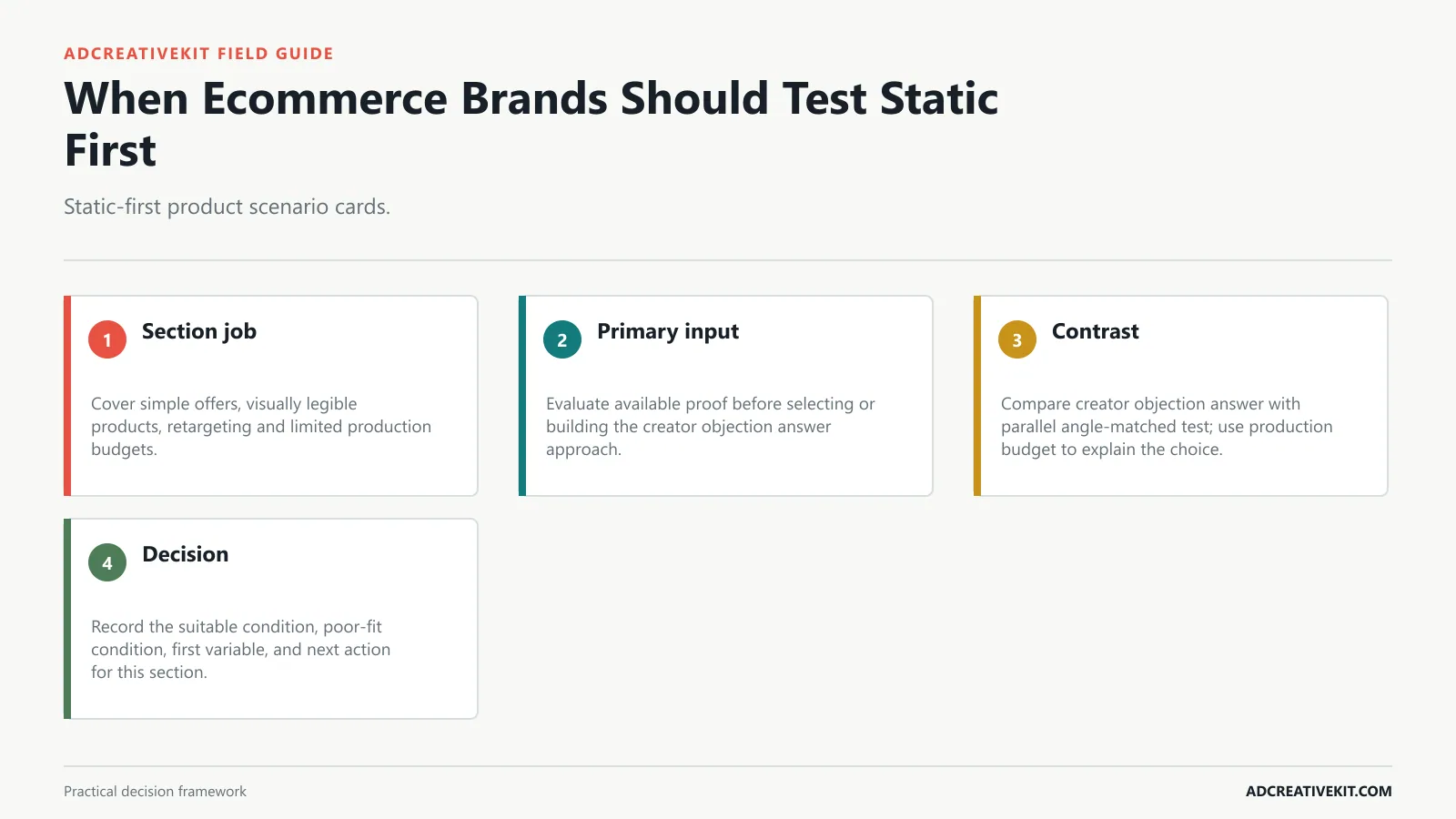
Start static when the product and offer can be understood in one frame, asset volume is limited, or the immediate uncertainty is the message rather than the mechanism.
This case study-style breakdown shows how an ecommerce brand can compare static ads and UGC-style ads without relying on fake ROAS claims, vague best practices, or one-off creative opinions. The goal is to build a controlled test that teaches the team what shoppers need before they buy.
Many teams think they are testing static against UGC, but they are actually testing many variables at once.
A visually distinctive product where the image carries most of the message.
Launch all six creatives with the same offer, same landing page, same audience structure, and same campaign objective. Avoid changing major campaign variables during the first read unless there is a technical issue.
Use available proof to choose a sensible first format, not to declare a permanent winner. A creator objection answer execution may expose a trust problem while a parallel angle-matched test version reveals that the same idea can work with less production.
Include contribution margin and production cost in the decision so a lower platform CPA is not automatically treated as the more profitable system.
Extend checklist
- Use the same creator objection answer angle in both formats.
- Match available proof, audience, and offer.
- Keep production budget and attribution settings stable.
- Plan the next test for a split or inconclusive result.
When Ecommerce Brands Should Test UGC First
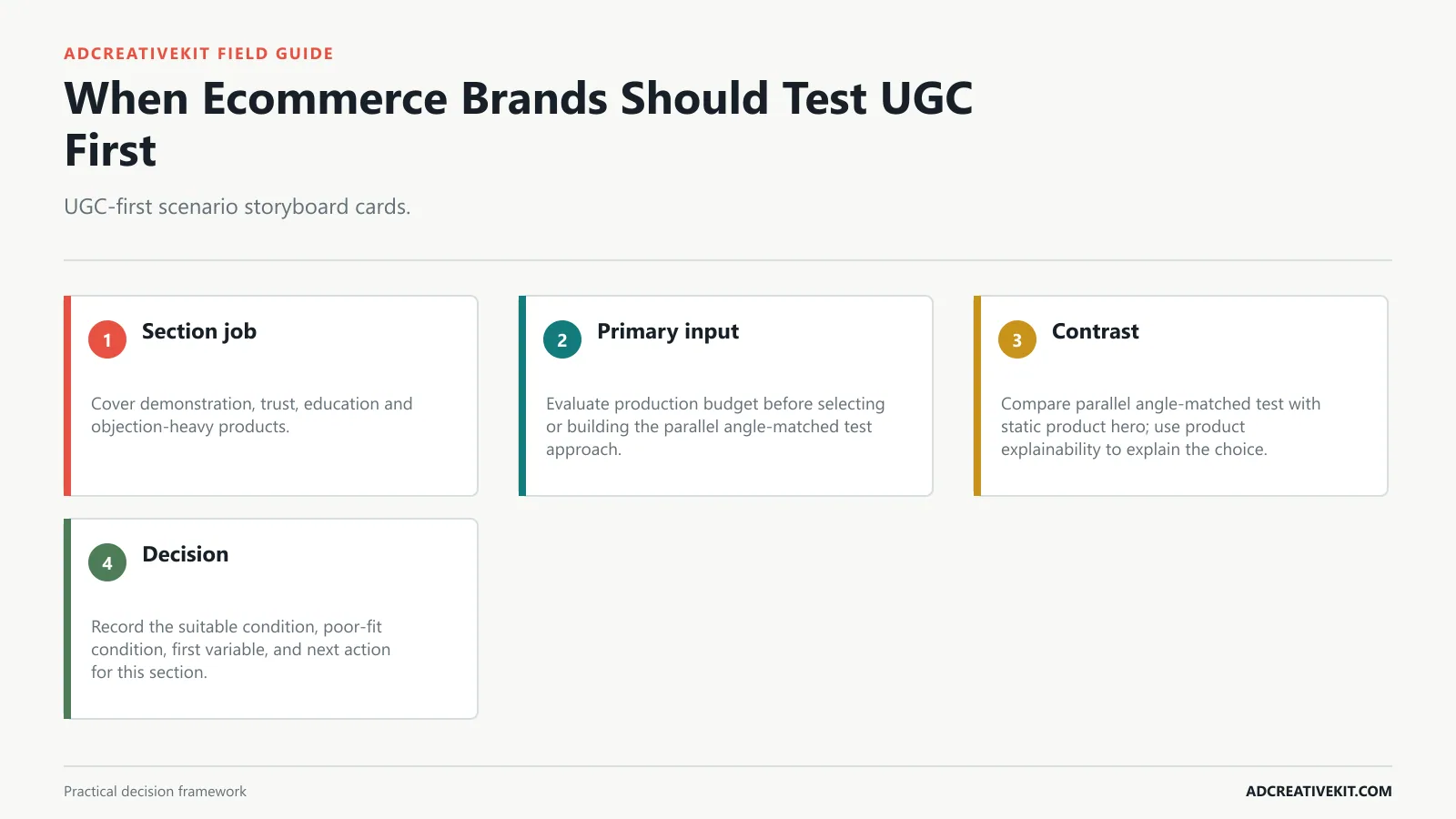
Start UGC-style when seeing the product used materially reduces uncertainty, a credible person must explain the mechanism, or trust and context are harder to establish with a designed card.
Static ads are often the best first test when the product is easy to understand, visually distinctive, offer-led, or price-sensitive. They are fast to produce, easy to iterate, and strong for testing hooks, layouts, product angles, guarantees, bundles, and calls to action.
For example, the static ad may use a discount, a clean product image, and a direct CTA. The UGC-style ad may use a different hook, a different offer, a longer explanation, a creator face, a different landing page, and a testimonial angle. If one wins, the team cannot know whether the winning variable was the format, the offer, the hook, the proof, or the post-click experience.
A brand that needs to test many angles before investing in creator production.
Look at attention and click behavior first. Static ads may produce clearer CTR and CPC signals. UGC-style ads need video attention metrics, because a weak first three seconds can hide an otherwise useful concept.
Use production budget to choose a sensible first format, not to declare a permanent winner. A parallel angle-matched test execution may expose a trust problem while a static product hero version reveals that the same idea can work with less production.
Define the landing page, attribution settings, guardrails, and inconclusive rule before launch to prevent post-result reinterpretation.
Choose by Funnel Stage and Placement
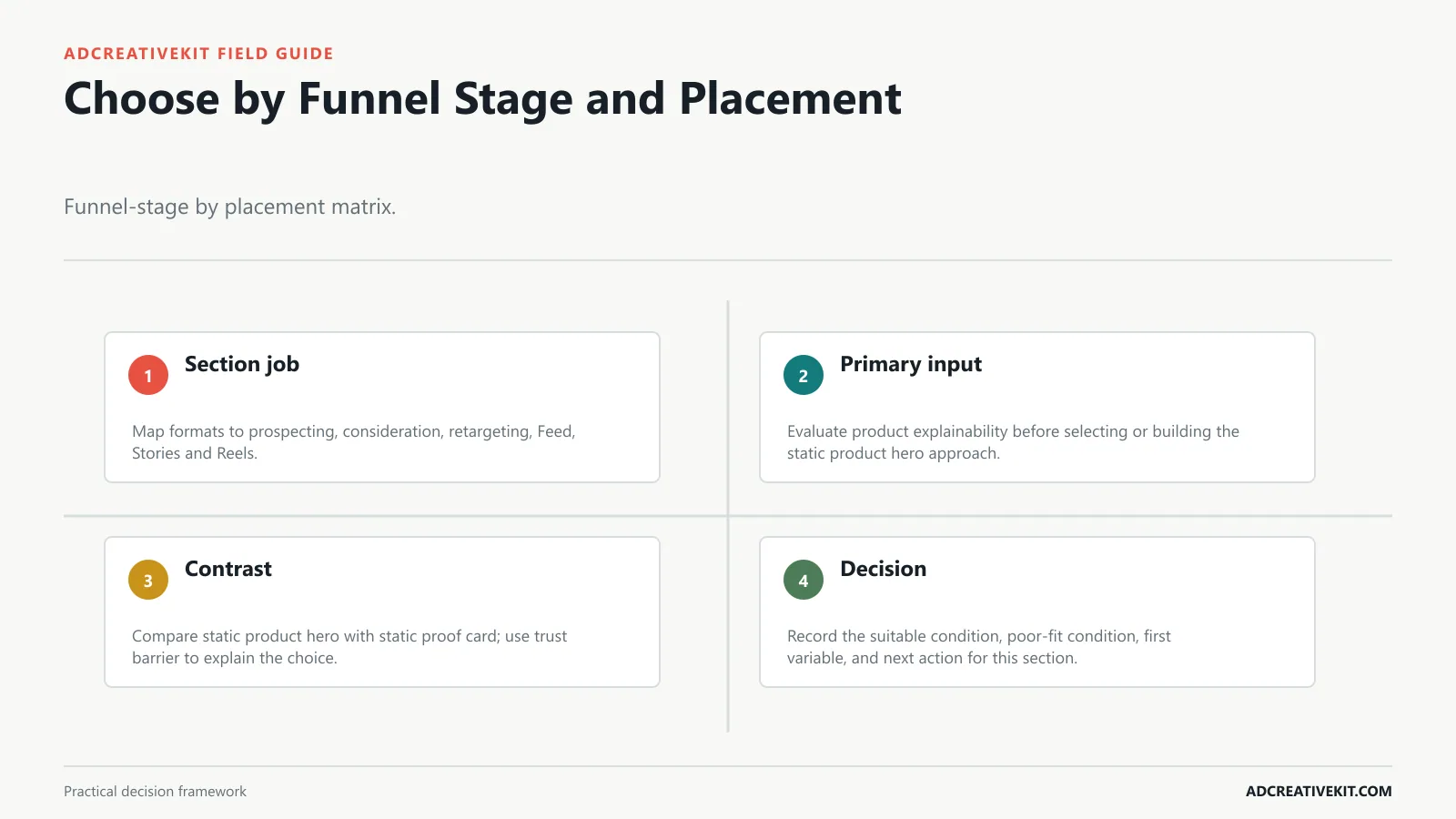
Use funnel stage as context, not a universal rule. Static and UGC-style executions can both prospect or retarget when the argument, placement, and destination fit the audience’s next question.
UGC-style ads are often stronger when the product needs explanation, trust, demonstration, objection handling, or emotional context. They are especially useful when shoppers need to see texture, fit, routine, setup, taste, comfort, transformation, or real-world use before they believe the claim.
The cleanest version of this experiment starts with six creatives: three static ads and three UGC-style ads.
A product where price, style, convenience, or benefit clarity drives the purchase decision.
Pause ads with weak attention, poor click-through, or low purchase intent. Keep the strongest static ad and strongest UGC-style ad active long enough to compare traffic quality.
Use product explainability to choose a sensible first format, not to declare a permanent winner. A static product hero execution may expose a trust problem while a static proof card version reveals that the same idea can work with less production.
Name the three content categories accurately so commissioned creator work is not presented as spontaneous customer endorsement.
Control checklist
- Use the same static product hero angle in both formats.
- Match product explainability, audience, and offer.
- Keep trust barrier and attribution settings stable.
- Plan the next test for a split or inconclusive result.
Connect this step to the Facebook ad creative review checklist so the decision survives the handoff from concept to campaign and post-click experience.
Use Product and Buyer Constraints to Decide
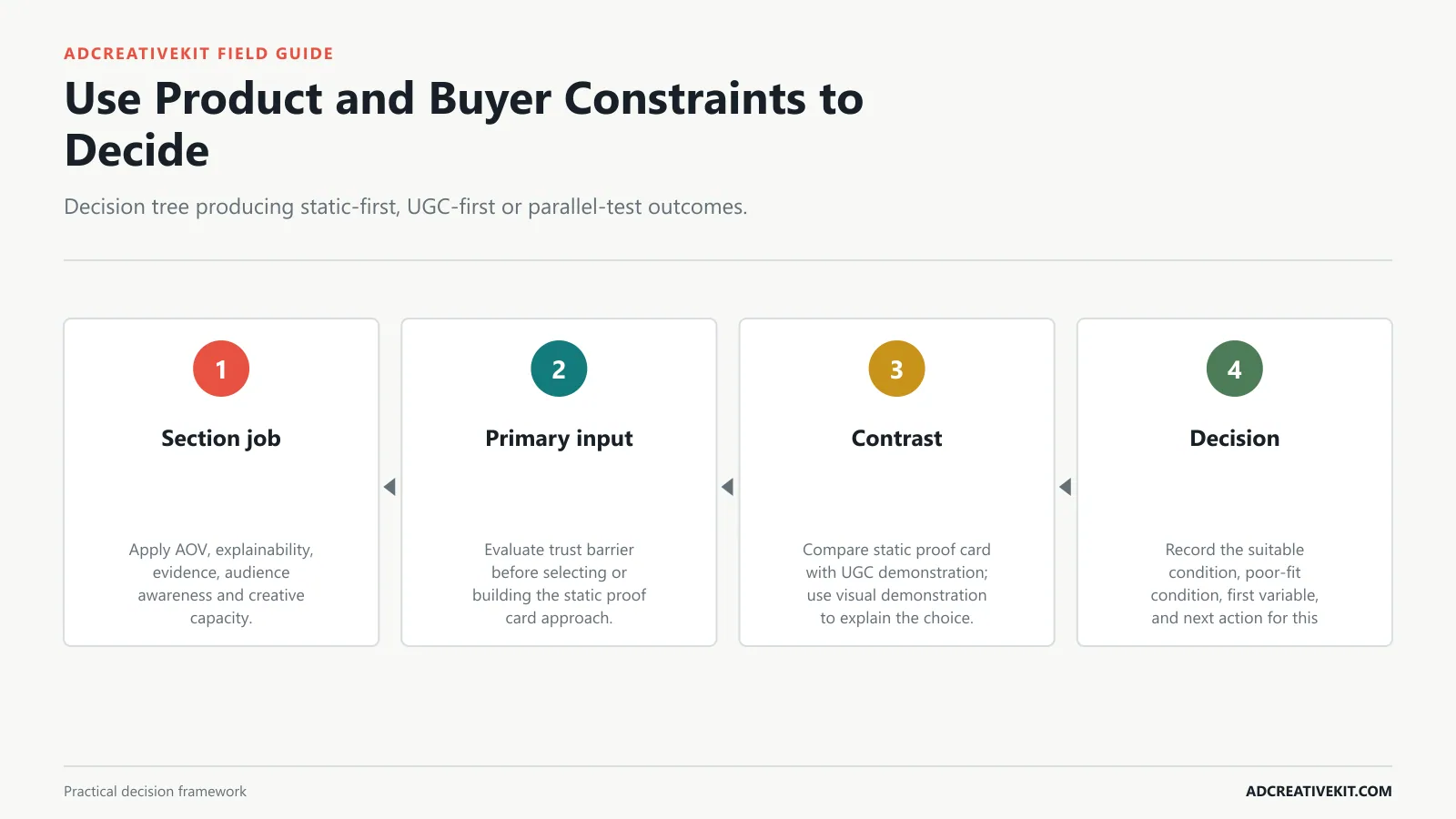
Weight product explainability, trust barrier, visual demonstration, available proof, AOV, production cost, iteration speed, and destination readiness. State which inputs drove the recommendation.
For most ecommerce teams, the strongest first test is not one static ad against one UGC video. A better test compares several variations of each format using the same product, offer, audience, and landing page. That way, the team can learn whether the format drove the result or whether the message itself was the real winner.
Instead of making random ads, the team chooses three angles that can work in both formats.
Static ads are also useful for diagnosing positioning. If a clear static ad cannot generate interest, the issue may not be the format. It may be the angle, offer, audience fit, product-market clarity, or page experience.
Create two new versions of the leading format and one challenger from the other format. This keeps the team from overcommitting too early while still using the first test to guide production.
Use trust barrier to choose a sensible first format, not to declare a permanent winner. A static proof card execution may expose a trust problem while a UGC demonstration version reveals that the same idea can work with less production.
Compare production speed, control, demonstration power, and rights burden as tradeoffs rather than assigning one permanent format winner.
Confirm current requirements in Meta Photo Ads. Use the source for platform or compliance facts, while keeping performance conclusions tied to your own account evidence.
Run a Fair Static-vs-UGC Test
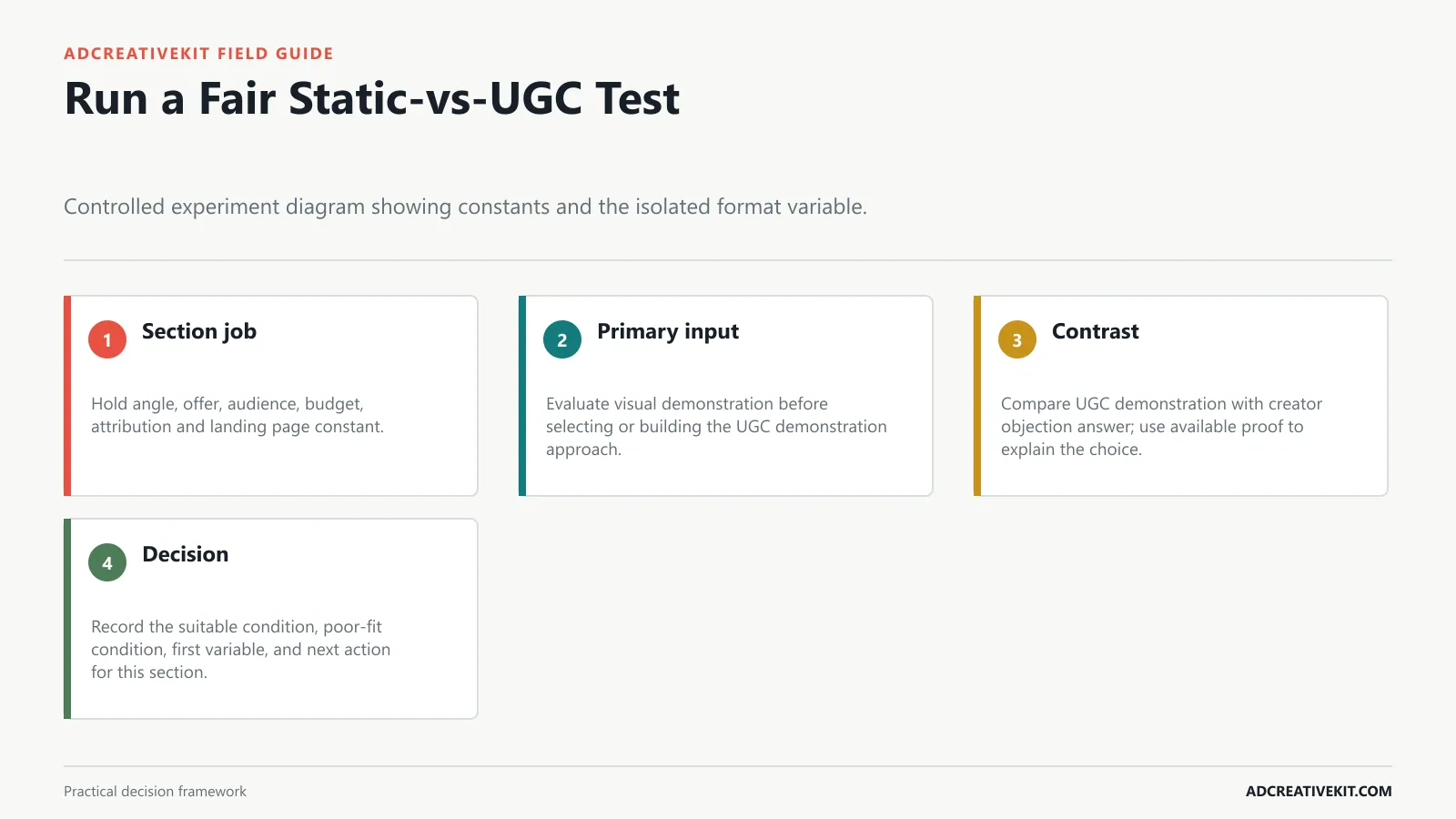
Keep angle, offer, evidence, audience, optimization, attribution, budget logic, and landing page comparable. The intended difference is presentation format; production quality should be competent in both arms.
Imagine a Shopify or WooCommerce brand preparing to launch Meta ads for a product with proven organic interest but limited paid creative history.
This structure makes the test more useful. If the problem-aware angle wins in both static and UGC-style formats, the team has learned that the message matters. If the same angle only wins in UGC-style video, the team has learned that the product may need a human explanation.
Teams can speed this stage up with Canva ad templates , because the goal is to test different messages quickly without rebuilding every layout from scratch.
A format test should never be judged from one metric alone. Each metric answers a different question.
Use visual demonstration to choose a sensible first format, not to declare a permanent winner. A UGC demonstration execution may expose a trust problem while a creator objection answer version reveals that the same idea can work with less production.
Use funnel and placement to refine the execution while keeping the buyer question at the center of the recommendation.
Extend checklist
- Use the same UGC demonstration angle in both formats.
- Match visual demonstration, audience, and offer.
- Keep available proof and attribution settings stable.
- Plan the next test for a split or inconclusive result.
Connect this step to the landing page optimization guide so the decision survives the handoff from concept to campaign and post-click experience.
Interpret Results and Build the Next Test
Interpret attention, clicks, qualified conversion, acquisition cost, order quality, and profit together. A split result should produce a narrower follow-up hypothesis, not a convenient declaration that one format always wins.
Static ad direction: polished product visuals, benefit-led headlines, offer clarity, review snippets, and comparison layouts.
If shoppers already understand the product category, a polished static ad with a clear benefit, strong product image, and direct offer may create efficient clicks and purchases because it reduces cognitive load.
UGC-style ads should usually be tested first when the product needs belief before action.
A high CTR with weak add-to-cart behavior may mean the ad is interesting but misaligned with the product page. A lower CTR with stronger conversion behavior may mean the ad attracts fewer but better-qualified shoppers. This is why the post-click path matters. If your ad promise and page message do not match, use landing page templates or page sections to make the continuation clearer.
Use available proof to choose a sensible first format, not to declare a permanent winner. A creator objection answer execution may expose a trust problem while a parallel angle-matched test version reveals that the same idea can work with less production.
Translate a split result into the next isolated question, such as opening frame, proof type, or demonstration depth.
Frequently asked questions
Are UGC-style ads always better for prospecting?
No. They can explain, demonstrate, and build trust, but a clear static ad may communicate a simple product or offer faster. Product and buyer constraints should choose the first test.
How can a format test stay fair?
Match the angle, offer, audience, budget logic, attribution, evidence, and landing page. Change the expression from static to UGC-style while preserving the commercial argument.
What if static wins clicks but UGC wins purchases?
Treat that as a funnel signal, not a contradiction. Review click quality, page continuity, conversion volume, cost, and uncertainty. The next test may use static for discovery and UGC-style proof later in the journey.
Use the first format test to narrow uncertainty, then build a mixed portfolio around the jobs each format performs well. The purpose is better allocation, not crowning a permanent winner.
Use the Facebook ad creative review checklist before launch, record the hypothesis in the repeatable ad testing system, and inspect post-click continuity with the ecommerce CRO checklist.
Confirm current implementation details in Meta Photo Ads and Meta Video Ads before production.