Marketing Hooks: 25 Formulas, Examples, and Testing Frameworks
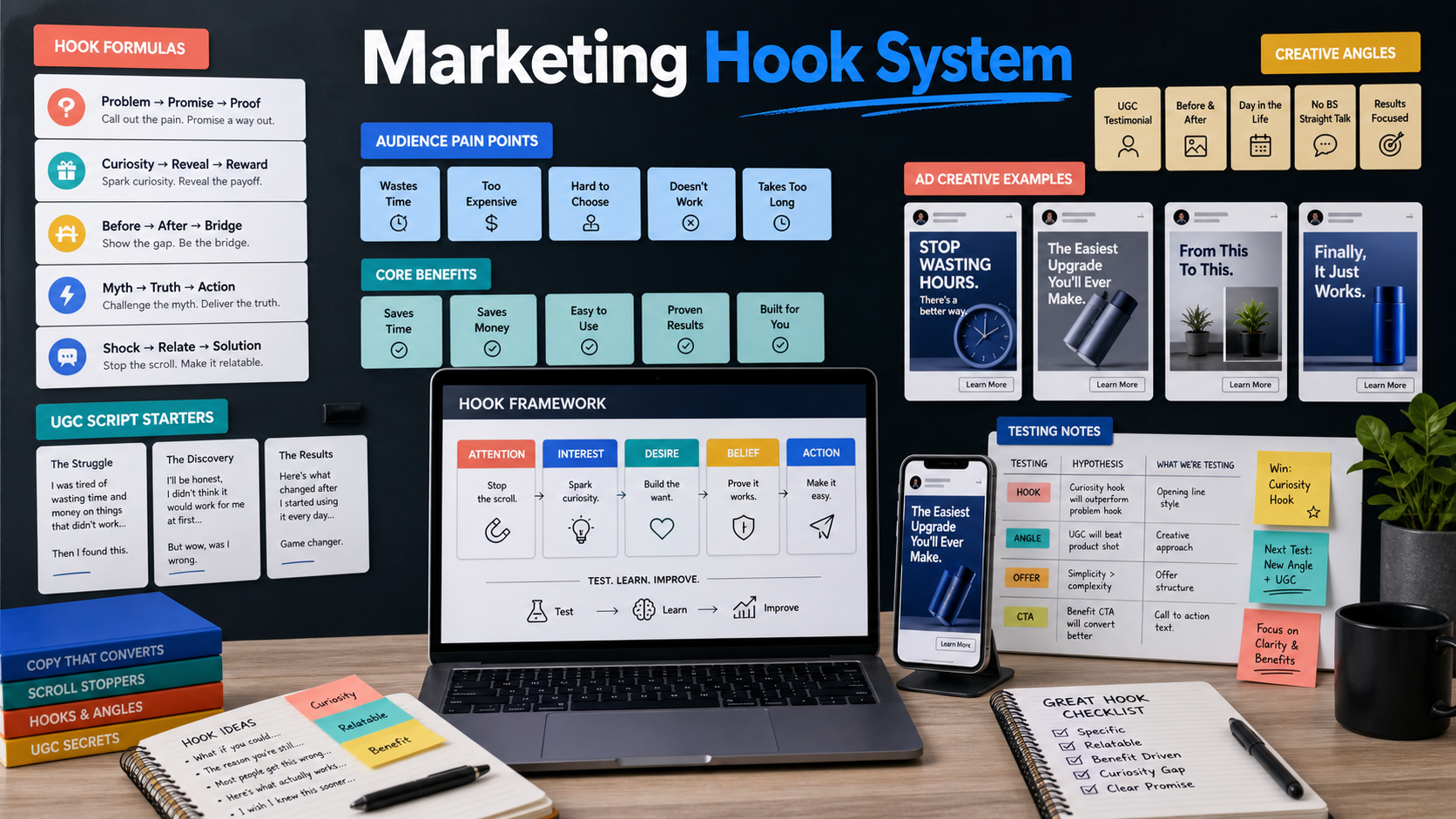
Marketing hooks are not just clever opening lines. A hook is the first relevance trigger in your campaign: the line, visual, question, contrast, or idea that tells someone, ‘this is for me, and it is worth another second of attention.’
That matters because most people do not approach ads calmly. They scan. They compare. They skip. Your product may be good, your offer may be fair, and your landing page may be polished, but if the hook does not create a reason to stop, the rest of the campaign never gets a real chance.
This guide goes deeper than a simple list of hook examples. You will learn what hooks do, how to choose the right hook by audience awareness, how to write hooks from customer research, how to adapt them for ads, landing pages, emails, and UGC scripts, and how to test them without confusing the results. If you want to generate ideas while reading, use the Free Facebook Ad Creative Generator; then turn the best ideas into visuals with the free editable Meta ad templates.
Quick answer: The best marketing hooks are specific, relevant, believable, and connected to the next message. They call out a real problem, desired outcome, curiosity gap, proof point, objection, or offer without overpromising.
Table of Contents
What Is a Marketing Hook?
A marketing hook is the first message or creative signal that earns attention and frames the rest of the offer. It can be a headline, video opening line, image concept, carousel cover, email subject line, landing page headline, first sentence, creator script opener, or even a product demonstration moment.
The hook does not need to explain everything. Its job is to make the next second feel worth it. A weak hook tries to sell before the audience cares. A strong hook creates relevance first, then gives the copy, creative, or page room to explain the offer.
| Hook type | What it leads with | Example |
|---|---|---|
| Problem | A pain the customer recognizes | Still rebuilding every ad from scratch? |
| Outcome | The desired result | Launch a cleaner product ad before your next sale. |
| Curiosity | A useful information gap | The first line we test before changing the design. |
| Proof | Evidence or credibility | The template structure marketers use for faster campaign launches. |
| Objection | A doubt the buyer has | No design experience needed. |
| Offer | The incentive | Free editable Meta ad templates for your next campaign. |
Why Marketing Hooks Matter for Ads, Landing Pages, Emails, and UGC
Hooks matter because attention is a sequence. First, the audience has to notice the message. Then they have to understand why it matters. Then they decide whether the offer is worth considering. If the opening signal is vague, the sequence breaks early.
For Facebook and Instagram ads, the hook can be the first line of text, the first frame of a video, the biggest words inside a static creative, or the concept of the image itself. For a landing page, the hook is usually the hero headline plus the first visual. For email, it is the subject line and preview text. For UGC, it is the first spoken line and the first scene.
A hook is also useful because it gives your creative testing structure. If you change the hook, visual style, offer, CTA, and landing page all at once, you will not know what caused the result. If you test hooks inside a controlled creative system, you can learn faster.
Choose the Hook by Audience Awareness Level
The best hook depends on how much the audience already understands. Cold audiences need a reason to care. Warm audiences need a reason to believe. Hot audiences need a reason to act.
| Audience stage | What they are thinking | Best hook types | Example |
|---|---|---|---|
| Cold | Why should I care? | Problem, curiosity, myth, audience callout | Still designing every campaign from a blank page? |
| Problem-aware | I have this issue, but I am comparing options. | Before-and-after, comparison, mistake | Your ad design may not be the problem. Your first promise might be. |
| Solution-aware | I know the type of solution I need. | Outcome, proof, demonstration | Create a polished Meta ad set without hiring a designer. |
| Product-aware | Why this product? | Social proof, objection, product benefit | Editable layouts built for ecommerce, lead magnets, apps, and retargeting. |
| Most aware | Should I act now? | Offer, urgency, FAQ, guarantee | Download the free Canva-ready ad template pack today. |
Marketing Hook Matrix: Match the Hook to Funnel Stage
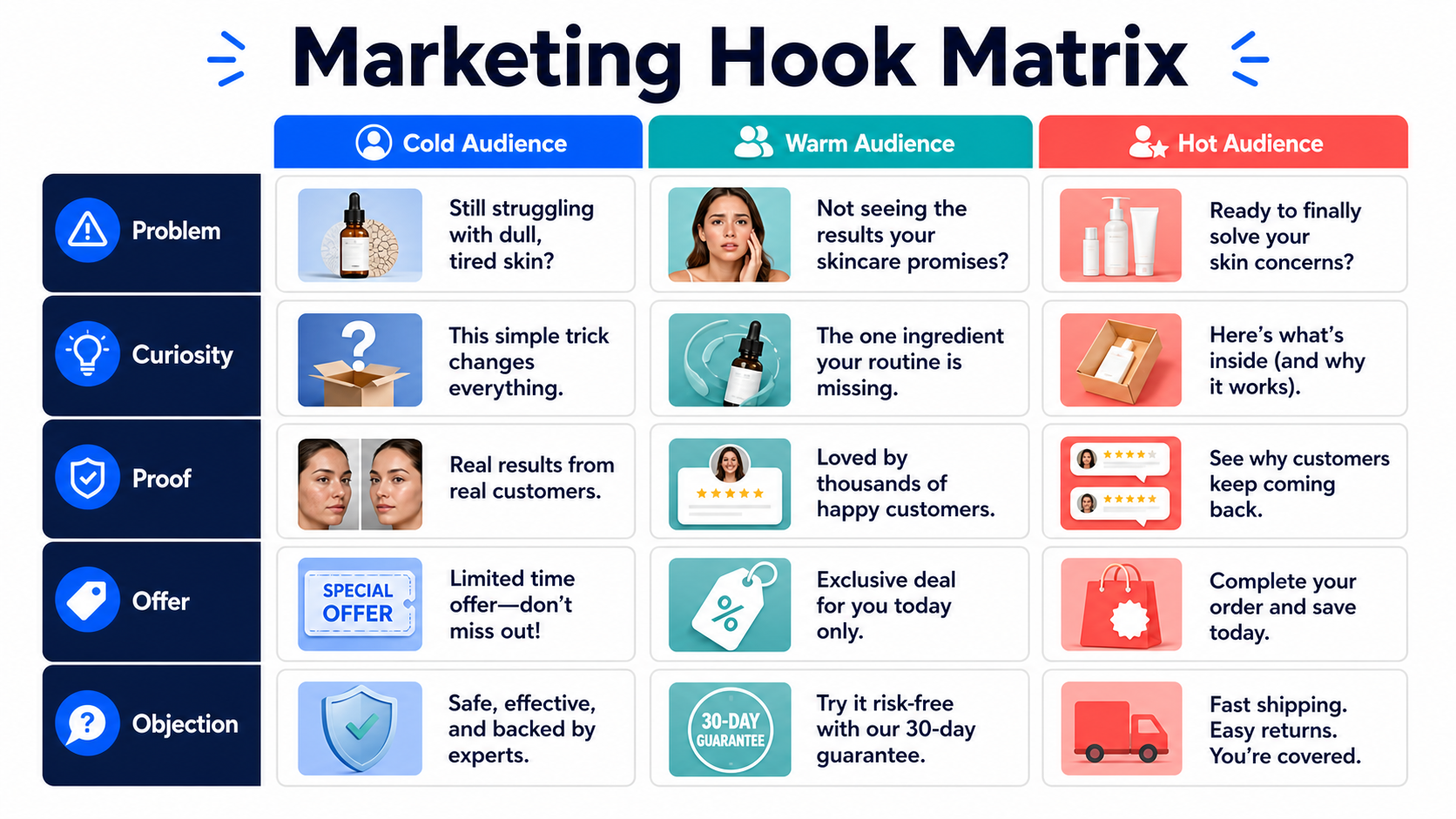
A hook matrix prevents one of the most common creative mistakes: using the same hook for every buyer stage. Cold audiences often need context. Warm audiences need differentiation. Hot audiences need confidence and a next step.
Before writing the first line, decide what the audience already knows. If they do not know they have the problem, a hard offer hook may feel too early. If they already visited your product page, another basic education hook may feel too slow. The hook should meet the buyer where they are.
How to Find Better Marketing Hook Ideas
The best hook language usually comes from customers, not brainstorming sessions. Customer language is specific, emotional, and grounded in real buying friction. Your job is to collect it, organize it, and turn it into usable angles.
- Reviews: look for repeated phrases about pain, surprise, ease, speed, quality, and results.
- Support questions: turn repeated doubts into objection hooks.
- Sales calls: capture the exact words people use before buying or hesitating.
- Comments: read ad comments, social comments, Reddit threads, and competitor comments for language patterns.
- Search queries: use long-tail questions as FAQ hooks and educational angles.
- Competitor ads: study the angle, not to copy wording, but to identify which promises are common and which gaps remain.
Once you collect language, group it into pain points, desired outcomes, objections, proof points, comparisons, and use cases. Those groups become your hook bank.
25 Marketing Hook Formulas With Examples
Use these formulas as starting points, then rewrite them with your product, audience, offer, and proof. The formula is the structure. The customer language is what makes it feel alive.
1. Problem-to-Promise Hook
Formula: Problem + desired outcome + easier path.
Why it works: It connects a current frustration to a believable next step.
Example: Still rebuilding every ad from scratch? Start with a proven layout and launch your next Meta creative faster.
Use it when: Your audience already knows the problem and wants a practical solution.
Avoid: Making the promise too broad, such as ‘grow your business overnight.’
2. Specific Pain Callout
Formula: Specific audience + specific pain.
Why it works: Specificity creates recognition. The reader feels like the message was written for them.
Example: For ecommerce founders tired of designing product ads one blank Canva page at a time.
Use it when: You know a repeated complaint from reviews, comments, calls, or support tickets.
Avoid: Calling out personal traits in a way that feels invasive or policy-sensitive.
3. Before-and-After Bridge
Formula: Before state + after state + bridge.
Why it works: It turns the product into a transition, not just an object.
Example: From scattered product photos to a polished campaign-ready ad set in one afternoon.
Use it when: The product changes a workflow, look, routine, or result.
Avoid: Using unrealistic transformations or fake proof.
4. Curiosity Gap Hook
Formula: Interesting claim + missing explanation.
Why it works: Curiosity works when the payoff is useful and not clickbait.
Example: The ad layout we test before touching campaign budgets.
Use it when: You have a practical insight that readers would want to know.
Avoid: Overpromising mystery without delivering a clear answer.
5. Contrarian Belief Hook
Formula: Common belief + opposite insight.
Why it works: It interrupts familiar thinking and invites the reader to reconsider.
Example: Your ad color is probably not the problem. Your first line is.
Use it when: Your audience follows a common best practice that is incomplete.
Avoid: Being contrarian just to sound clever.
6. Myth vs Truth Hook
Formula: Myth: X. Truth: Y.
Why it works: It quickly reframes a problem and creates an educational angle.
Example: Myth: Better ads need more design skill. Truth: Most need a clearer hook and offer hierarchy.
Use it when: You want to teach while selling softly.
Avoid: Attacking the audience for believing the myth.
7. Audience Callout Hook
Formula: For [audience] who want [outcome].
Why it works: It filters attention fast and attracts the right reader.
Example: For small brands that need cleaner Facebook ads without hiring a designer.
Use it when: The offer serves a clear segment.
Avoid: Making the audience so broad that the hook loses power.
8. Outcome-First Hook
Formula: Desired result first, product second.
Why it works: People buy outcomes before features.
Example: Launch a sharper product ad before your next sale goes live.
Use it when: The outcome is easy to understand and tied to the product.
Avoid: Promising an outcome you cannot directly support.
9. Time-Saved Hook
Formula: Task + shorter path.
Why it works: Time is a strong value driver for founders, marketers, and small teams.
Example: Build five ad concepts before lunch instead of starting from a blank page.
Use it when: Your product genuinely speeds up a repetitive task.
Avoid: Using speed claims when the setup is actually complex.
10. Money-Saved Hook
Formula: Costly alternative + more efficient option.
Why it works: It frames the offer against a real cost the buyer wants to reduce.
Example: Before you hire another designer for every promo, try editable ad templates built for Meta campaigns.
Use it when: The buyer compares your product with labor, agency, or tool costs.
Avoid: Turning the hook into a race to the lowest price.
11. Mistake Callout Hook
Formula: Common mistake + better approach.
Why it works: It creates an immediate reason to keep reading.
Example: Most brands test ten designs before testing one stronger offer angle.
Use it when: You can teach a useful correction.
Avoid: Making the reader feel foolish instead of helped.
12. Objection Reversal Hook
Formula: Objection + reassurance.
Why it works: It answers doubt before doubt becomes a bounce.
Example: No design experience needed. Start with the layout, then edit the copy and product image.
Use it when: People like the offer but worry about effort, skill, cost, or fit.
Avoid: Answering objections you cannot honestly solve.
13. Social Proof Hook
Formula: Real proof + relevant context.
Why it works: Proof reduces perceived risk.
Example: The template format our customers use for product launches, lead magnets, and retargeting ads.
Use it when: You have reviews, customer examples, ratings, or case evidence.
Avoid: Inventing numbers or vague proof like ‘everyone loves it.’
14. Demonstration Hook
Formula: Show the process or result in motion.
Why it works: It lets the viewer understand the value without heavy explanation.
Example: Watch one product photo become three Facebook ad concepts.
Use it when: The value is visual or process-based.
Avoid: Explaining what should simply be shown.
15. ‘I Tried X So You Do Not Have To’ Hook
Formula: Experiment + saved lesson.
Why it works: It feels human and creates a story frame.
Example: I tried rebuilding the same ad from scratch every week. Here is the shortcut I wish I used earlier.
Use it when: The brand or creator can share a real lesson.
Avoid: Making up personal experience.
16. Checklist Hook
Formula: List of essentials + gap.
Why it works: Checklists feel practical and easy to scan.
Example: Before your next ad goes live, check the hook, offer, proof, CTA, and landing page match.
Use it when: The audience wants a simple decision aid.
Avoid: Creating a checklist that is too long for the format.
17. ‘What Nobody Tells You’ Hook
Formula: Hidden lesson + clear topic.
Why it works: It promises useful nuance beyond basic advice.
Example: What nobody tells you about Facebook ad hooks: the first line and the first visual must make the same promise.
Use it when: You have a real, non-obvious insight.
Avoid: Using the phrase for basic information everyone already knows.
18. Story Open Hook
Formula: Moment + conflict + next step.
Why it works: Stories pull the reader into a situation before selling.
Example: Our best ad idea started as a support question: ‘Can I make this work without a designer?’
Use it when: You have customer stories, founder stories, or behind-the-scenes lessons.
Avoid: Dragging the story before the point is clear.
19. Comparison Hook
Formula: Old way vs new way.
Why it works: It makes the benefit obvious through contrast.
Example: Old way: build every creative from zero. New way: start with a tested ad layout and customize the message.
Use it when: Your product replaces a familiar workflow.
Avoid: Comparing unfairly or exaggerating the weakness of alternatives.
20. Offer-Led Hook
Formula: Offer + reason to act.
Why it works: It works when the audience already understands the product category.
Example: Free editable Meta ad templates for Facebook and Instagram campaigns.
Use it when: The offer is strong enough to lead the ad.
Avoid: Using offer hooks for cold audiences who still need education.
21. Real Urgency Hook
Formula: Deadline or scarcity + reason.
Why it works: Urgency helps when it is true and connected to buyer motivation.
Example: Sale templates are free this week so you can prep your next campaign before launch day.
Use it when: There is a real deadline, event, inventory limit, or seasonal reason.
Avoid: Fake countdowns or pressure that damages trust.
22. New Way vs Old Way Hook
Formula: Old habit + better method.
Why it works: It makes change feel practical rather than abstract.
Example: Stop guessing your ad angle. Generate hooks first, then design around the strongest promise.
Use it when: You want to introduce a workflow shift.
Avoid: Making the new way sound effortless when it still needs thinking.
23. Simple Test Hook
Formula: Hypothesis + test.
Why it works: It attracts marketers because it promises learning, not magic.
Example: Test this: keep the design the same and change only the first line.
Use it when: The audience cares about optimization and experimentation.
Avoid: Pretending one test can prove everything.
24. UGC Confession Hook
Formula: Honest admission + discovery.
Why it works: It feels natural for creator-style videos.
Example: I used to think better ads meant better graphics. Then I realized the hook was doing most of the work.
Use it when: You are creating UGC scripts, Reels, or TikTok-style ads.
Avoid: Making the confession sound scripted or fake.
25. FAQ Question Hook
Formula: Buyer question + direct answer.
Why it works: It turns a common objection into a useful opening.
Example: Can you create Facebook ads without design experience? Yes, if you start with the right structure.
Use it when: Customers keep asking the same question before buying.
Avoid: Answering a question nobody actually asks.
Marketing Hook Examples by Channel
Facebook and Instagram Ads
For Meta ads, the hook should work visually and verbally. If your biggest text says one thing and your primary text says another, the ad feels scattered. A simple structure is: big visual hook, short supporting line, product image, proof or benefit, CTA.
- Still guessing which ad angle will stop the scroll?
- Your product photo is not enough. Give it a stronger first promise.
- Create five Meta ad variations before your next campaign review.
- Pair a hook with a layout from these static ad templates so the message is easy to read on mobile.
TikTok, Reels, and UGC Scripts
For creator-style ads, the hook should sound like a natural opening line. It can be a confession, discovery, objection, quick demo, or problem callout. The first scene should prove the line quickly.
- I used to think better ads meant better graphics. I was wrong.
- Here is the first thing I check before I redesign an ad.
- If your product ads look fine but still do not convert, watch this.
- Use these UGC ad templates when you want the hook to become a short video script.
Landing Pages
Landing page hooks need clarity more than drama. The visitor already clicked. Now the page must confirm they are in the right place and repeat the ad promise quickly.
- Editable Meta ad templates for faster Facebook and Instagram campaign launches.
- Create cleaner product ads without starting from a blank design file.
- Launch your next promotion with ready-to-edit ad layouts and practical copy prompts.
Email Subject Lines
Email hooks need to earn the open without tricking the reader. Curiosity works, but the email must pay it off quickly.
- A better first line for your next product ad
- The ad hook checklist before launch
- Stop testing colors before testing this
Ecommerce Campaigns
Ecommerce hooks should connect the product, offer, visual proof, and buyer stage. If you sell physical products, look at your reviews and product photos first, then build hooks around use cases, transformations, comparisons, and objections. For structure, review these ecommerce Facebook ad templates.
How to Test Marketing Hooks Without Confusing the Results
Testing hooks does not mean launching random creative and hoping the platform chooses a winner. Keep the test clean enough that you can interpret it.
| Test | Keep constant | Change | What you learn |
|---|---|---|---|
| Hook test | Product, offer, design, audience | Opening line or first-frame text | Which message earns attention |
| Angle test | Product, offer, audience | Problem vs proof vs comparison vs offer | Which persuasion path is strongest |
| Visual hook test | Copy and offer | Image concept or first video frame | Which visual idea stops the scroll |
| Landing page hook test | Traffic source and offer | Hero headline and subheadline | Which promise creates more continuity |
| Retargeting hook test | Warm audience | Objection answered | What keeps people from buying |
When reading results, do not stop at click-through rate. A hook can attract attention but attract the wrong intent. Look at the full path: thumbstop or hook rate if available, CTR, CPC, add-to-cart, lead quality, conversion rate, and landing page behavior. A hook that creates curiosity but hurts conversion may need a clearer promise.
How to Use AI to Generate Better Marketing Hooks
AI is useful for creating structured hook batches, especially when you give it the right context. The Free Facebook Ad Creative Generator can help you generate hooks, primary text, headlines, CTAs, creative angles, static layout recommendations, and UGC scripts. For a deeper AI workflow, read the AI ad creative generator guide.
The key is to avoid asking for generic hooks. Give the AI your product, audience, offer, funnel stage, top pain points, proof, objections, and tone. Then ask it to generate hooks by category: problem, curiosity, proof, objection, comparison, outcome, offer, and UGC confession.
Generate Hook Ideas Faster
Use the free generator to create Facebook ad hooks, creative angles, primary text, headlines, CTAs, static layout ideas, and UGC scripts. Then customize the strongest ideas inside editable templates.
After generating ideas, choose the strongest hooks and build the finished ads using the free editable Meta ad templates. This keeps your workflow practical: strategy first, editable design second, testing third.
Common Marketing Hook Mistakes
- Being too vague: ‘Grow faster’ is less useful than naming the specific problem and outcome.
- Trying to be clever before being clear: the audience should understand the point quickly.
- Overpromising: a strong hook still needs to be believable and supported by the product.
- Using the same hook for every funnel stage: cold and warm audiences need different openings.
- Ignoring the visual: the image or video first frame is part of the hook.
- Changing too much in a test: if every variable changes, the result teaches very little.
- Breaking message match: the landing page should continue the same promise the ad started.
- Copying competitors: study patterns, but use your customer language and real proof.
Frequently Asked Questions About Marketing Hooks
What is a marketing hook?
A marketing hook is the first line, visual, idea, or creative signal that captures attention and makes the audience want to continue. It can appear in an ad, landing page, email, social post, or video script.
What makes a good marketing hook?
A good hook is specific, relevant, easy to understand, believable, and connected to the rest of the message. It usually leads with a problem, outcome, curiosity gap, proof point, objection, comparison, or offer.
How long should a marketing hook be?
For ads and short-form video, shorter is usually better. The hook should be understood in one quick glance or one spoken sentence. Landing pages and emails can use slightly longer hooks if the message remains clear.
How many marketing hooks should I test?
Start with three to five hooks around the same product, offer, and audience. Keep other variables stable at first so you can understand which opening message performs better.
Are curiosity hooks good for ads?
Yes, but only when the payoff is useful. Curiosity should create interest, not trick the click. If the landing page or ad body does not answer the curiosity, performance and trust can suffer.
Can AI write marketing hooks?
AI can help generate hook options quickly, but the best results come from strong inputs, customer research, human editing, claim review, and controlled testing.
What is the difference between a hook and a headline?
A headline can be a hook, but a hook is broader. The hook may be the headline, image concept, first video frame, first spoken line, subject line, or opening idea.
Should every ad start with a problem hook?
No. Problem hooks are useful for cold and problem-aware audiences, but warm or hot audiences may respond better to proof, offer, objection, demonstration, or outcome hooks.