Creative Testing Framework: A Repeatable Learning System
Creative volume is not a testing system. A team can launch new ads every week and still relearn the same lessons because ideas have weak evidence, variants change too many things, delivery cannot support the batch, or results never return to the briefing process. This framework keeps the strongest parts of the existing case-style guide and turns them into an operating model that can be sized for a founder, small team, agency, or scaled in-house program.
Quick answer: A repeatable testing system uses five connected loops: evidence, portfolio, production, experiment, and memory. Diagnose the weakest loop first, separate concept discovery from controlled validation, read results from attention through customer quality, and make every test produce the next brief.
Evidence boundary: This is an operating-model case study, not a report of a named client’s revenue or ROAS. The examples demonstrate how decisions and handoffs change; teams must set their own baselines, guardrails, read windows, and test volume from actual account data.
The operating model draws on current primary documentation, including Google Ads experiment best practices and Google Ads Experiments overview. The five loops convert platform constraints into a cadence that strategists, producers, buyers, and analysts can run together.
Diagnose Your Creative Testing Maturity
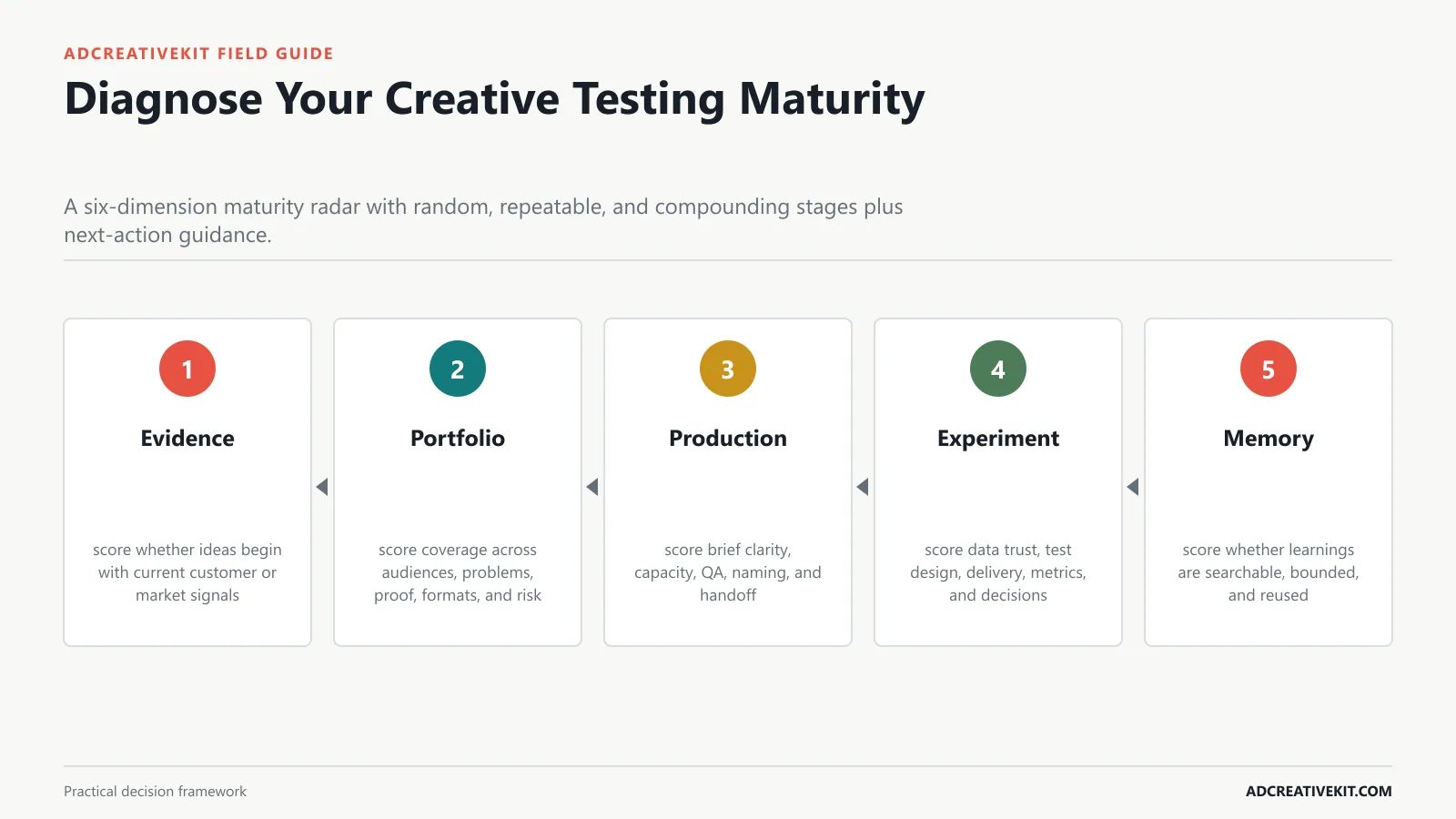
Score evidence, portfolio design, production, experimentation, measurement, and memory to identify the real bottleneck. This loop must leave an observable artifact for the next loop. Name the input, the accountable role, and the output before judging whether the operating system is functioning.
Maturity diagnosis
Begin with evidence: score whether ideas begin with current customer or market signals. Then inspect portfolio: score coverage across audiences, problems, proof, formats, and risk. Together they reveal whether the loop is supplying usable material to the next stage or merely creating activity.
- Evidence: score whether ideas begin with current customer or market signals.
- Portfolio: score coverage across audiences, problems, proof, formats, and risk.
- Production: score brief clarity, capacity, QA, naming, and handoff.
- Experiment: score data trust, test design, delivery, metrics, and decisions.
- Memory: score whether learnings are searchable, bounded, and reused.
Loop 1: Turn Customer Evidence Into Testable Ideas
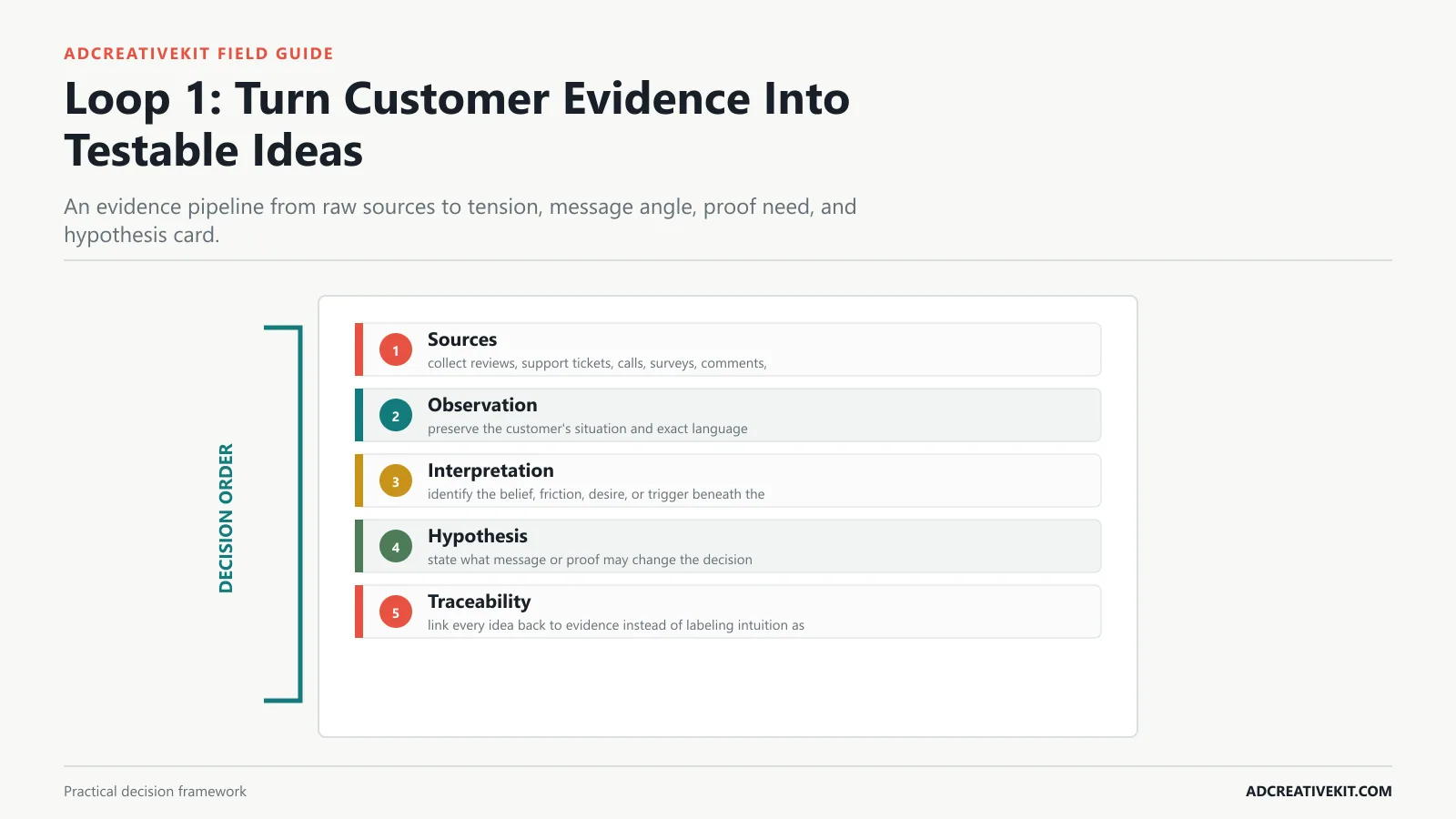
Collect reviews, support tickets, calls, surveys, comments, sales objections, and competitor patterns, then convert them into hypotheses. This loop must leave an observable artifact for the next loop. Name the input, the accountable role, and the output before judging whether the operating system is functioning.
Evidence loop
Begin with sources: collect reviews, support tickets, calls, surveys, comments, search language, and sales objections. Then inspect observation: preserve the customer’s situation and exact language. Together they reveal whether the loop is supplying usable material to the next stage or merely creating activity.
- Sources: collect reviews, support tickets, calls, surveys, comments, search language, and sales objections.
- Observation: preserve the customer’s situation and exact language.
- Interpretation: identify the belief, friction, desire, or trigger beneath the words.
- Hypothesis: state what message or proof may change the decision.
- Traceability: link every idea back to evidence instead of labeling intuition as research.
| Evidence loop element | Practical requirement | Review question |
|---|---|---|
| Sources | collect reviews, support tickets, calls, surveys, comments, search language, and sales objections | Locate the record, accountable role, and downstream handoff. |
| Observation | preserve the customer’s situation and exact language | Locate the record, accountable role, and downstream handoff. |
| Interpretation | identify the belief, friction, desire, or trigger beneath the words | Locate the record, accountable role, and downstream handoff. |
| Hypothesis | state what message or proof may change the decision | Locate the record, accountable role, and downstream handoff. |
| Traceability | link every idea back to evidence instead of labeling intuition as research | Locate the record, accountable role, and downstream handoff. |
Loop exit: move forward only when the required output exists, its limitations are recorded, and the receiving role can use it without reconstructing the strategy. Route anything else back to the owner of the weak loop.
Loop 2: Build a Balanced Creative Portfolio
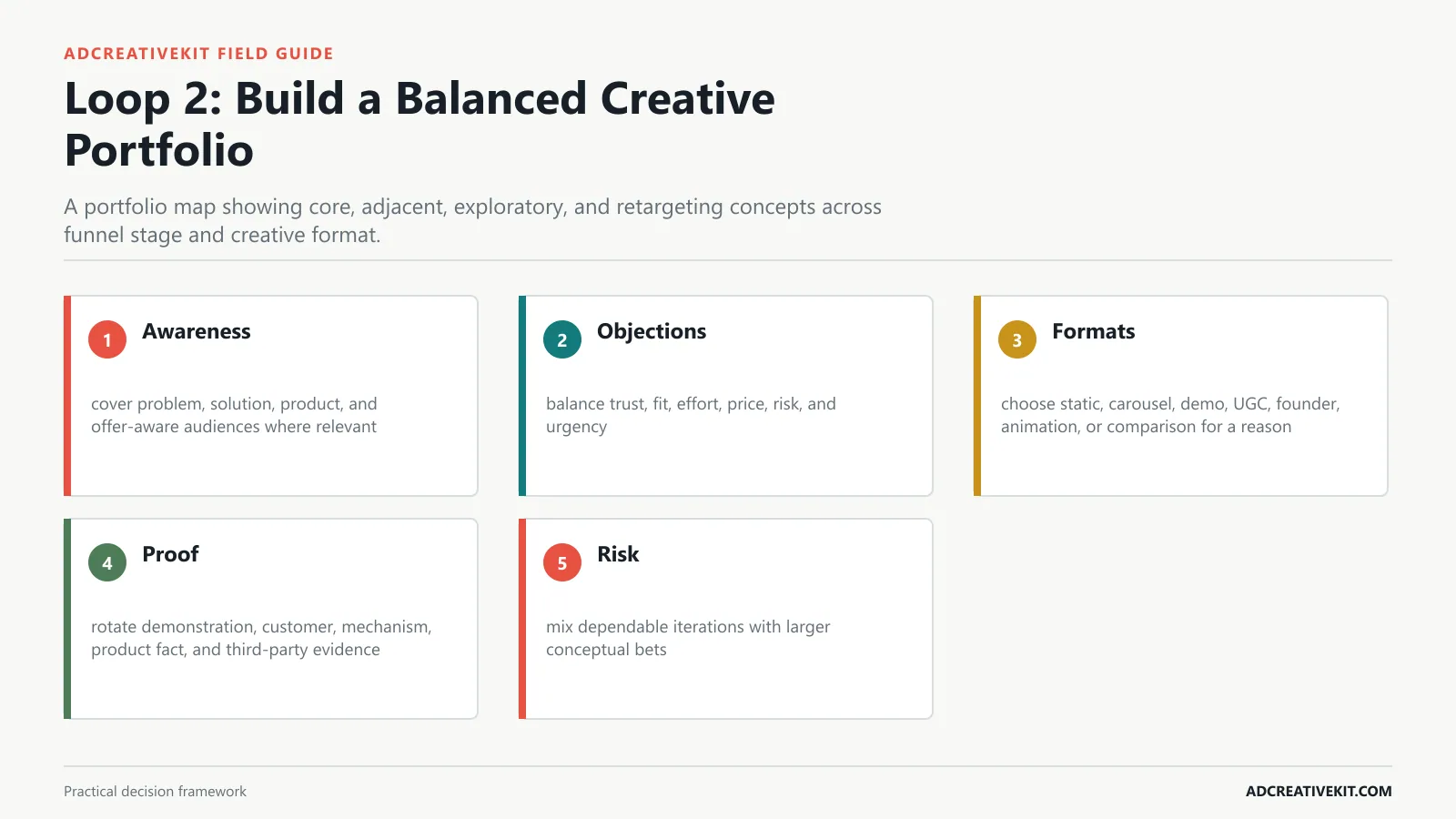
Prioritize concepts across awareness, objections, formats, proof types, risk, expected impact, and learning value. This loop must leave an observable artifact for the next loop. Name the input, the accountable role, and the output before judging whether the operating system is functioning.
Portfolio loop
Begin with awareness: cover problem, solution, product, and offer-aware audiences where relevant. Then inspect objections: balance trust, fit, effort, price, risk, and urgency. Together they reveal whether the loop is supplying usable material to the next stage or merely creating activity.
- Awareness: cover problem, solution, product, and offer-aware audiences where relevant.
- Objections: balance trust, fit, effort, price, risk, and urgency.
- Formats: choose static, carousel, demo, UGC, founder, animation, or comparison for a reason.
- Proof: rotate demonstration, customer, mechanism, product fact, and third-party evidence.
- Risk: mix dependable iterations with larger conceptual bets.
For the adjacent workflow, use the Facebook creative review checklist. When this section reveals a broader conversion or production issue, continue with the static versus UGC testing guide.
Loop 3: Brief and Produce Controlled Variants
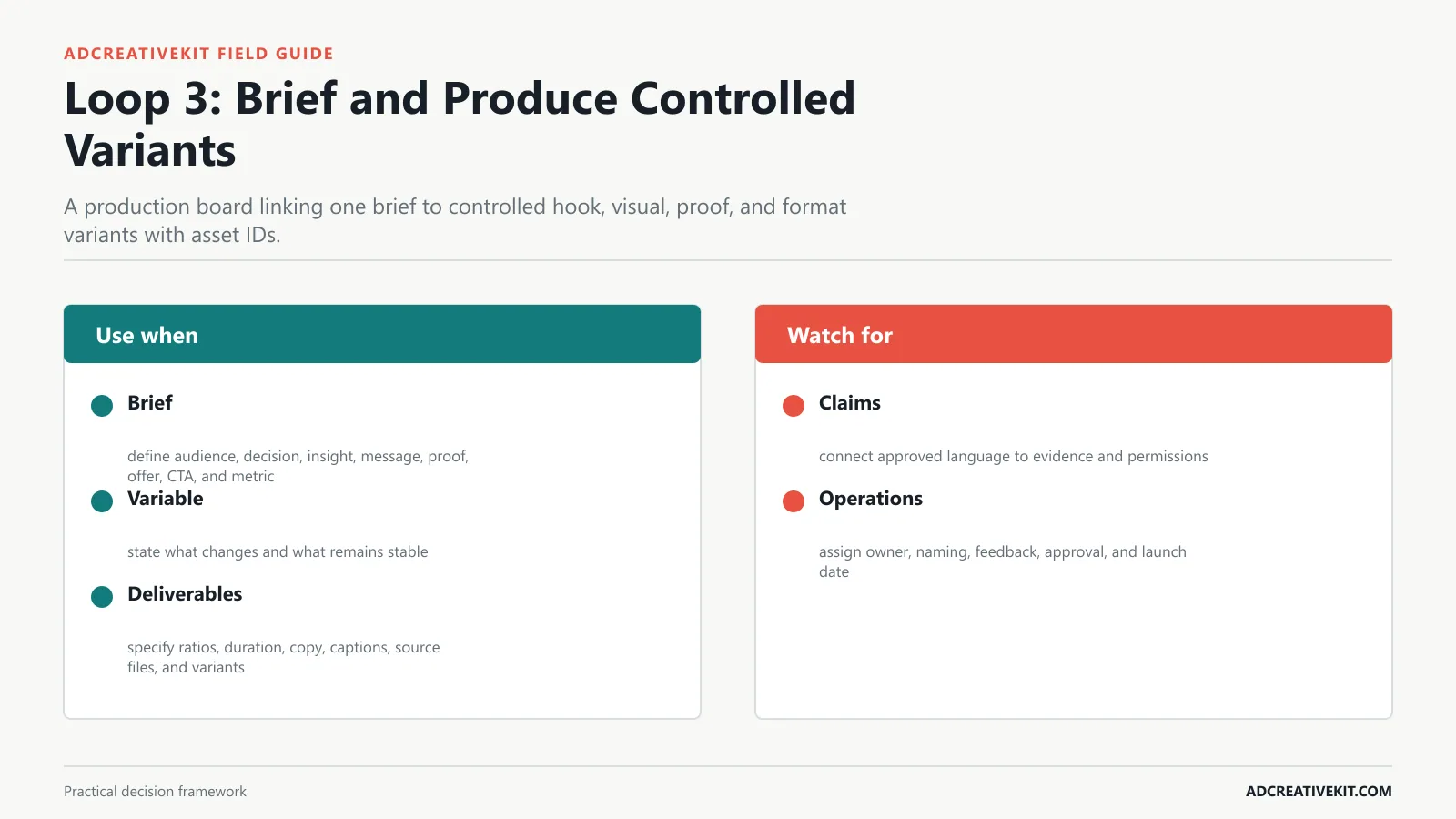
Define the concept, primary variable, constants, deliverables, claims, ownership, naming, and approval process. This loop must leave an observable artifact for the next loop. Name the input, the accountable role, and the output before judging whether the operating system is functioning.
Production loop
Begin with brief: define audience, decision, insight, message, proof, offer, CTA, and metric. Then inspect variable: state what changes and what remains stable. Together they reveal whether the loop is supplying usable material to the next stage or merely creating activity.
- Brief: define audience, decision, insight, message, proof, offer, CTA, and metric.
- Variable: state what changes and what remains stable.
- Deliverables: specify ratios, duration, copy, captions, source files, and variants.
- Claims: connect approved language to evidence and permissions.
- Operations: assign owner, naming, feedback, approval, and launch date.
Loop exit: move forward only when the required output exists, its limitations are recorded, and the receiving role can use it without reconstructing the strategy. Route anything else back to the owner of the weak loop.
Loop 4: Launch Discovery and Validation Tests
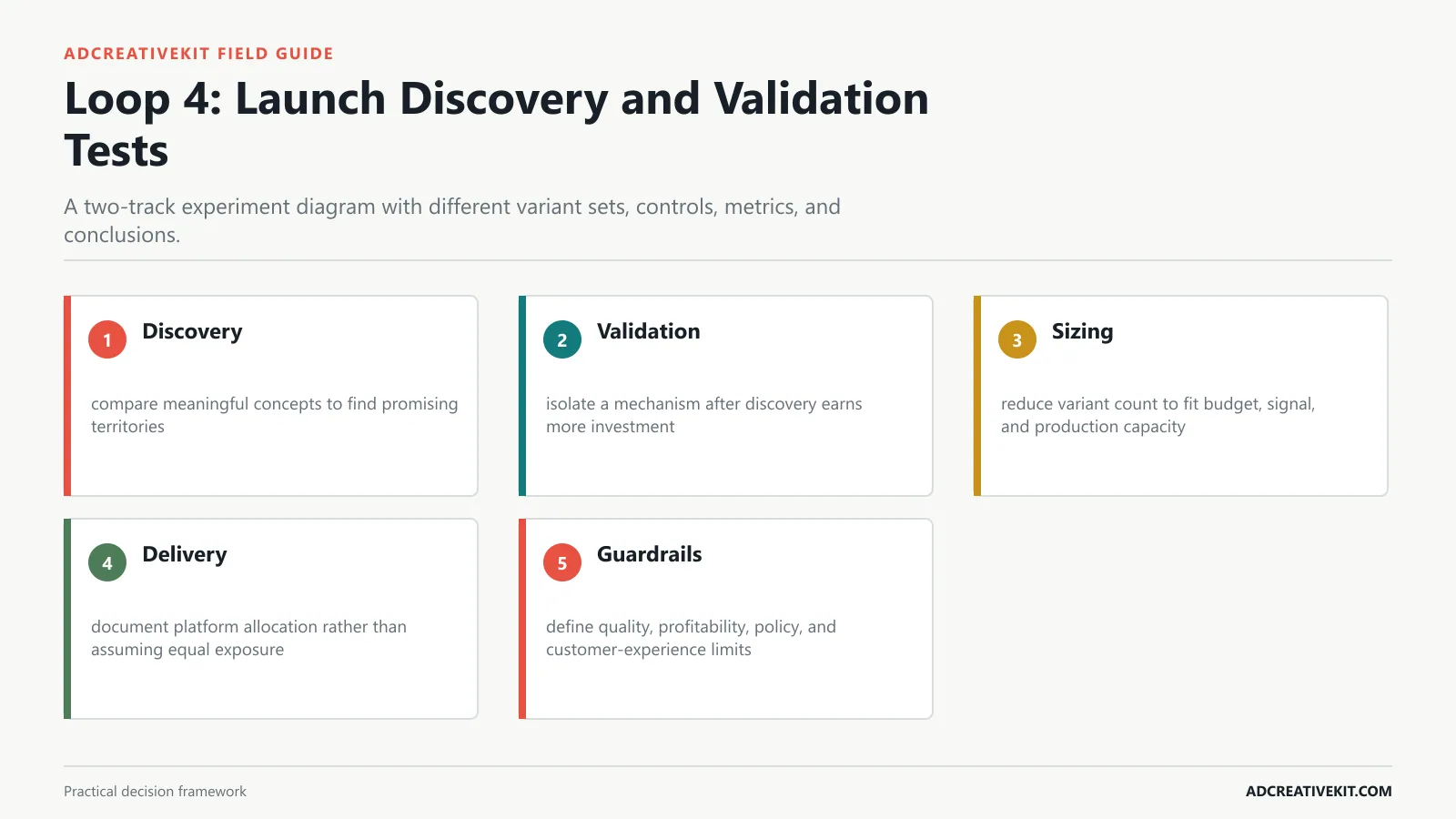
Separate broad concept discovery from controlled validation and size each batch to spend and signal. This loop must leave an observable artifact for the next loop. Name the input, the accountable role, and the output before judging whether the operating system is functioning.
Experiment loop
Begin with discovery: compare meaningful concepts to find promising territories. Then inspect validation: isolate a mechanism after discovery earns more investment. Together they reveal whether the loop is supplying usable material to the next stage or merely creating activity.
- Discovery: compare meaningful concepts to find promising territories.
- Validation: isolate a mechanism after discovery earns more investment.
- Sizing: reduce variant count to fit budget, signal, and production capacity.
- Delivery: document platform allocation rather than assuming equal exposure.
- Guardrails: define quality, profitability, policy, and customer-experience limits.
Read Creative Performance in Layers
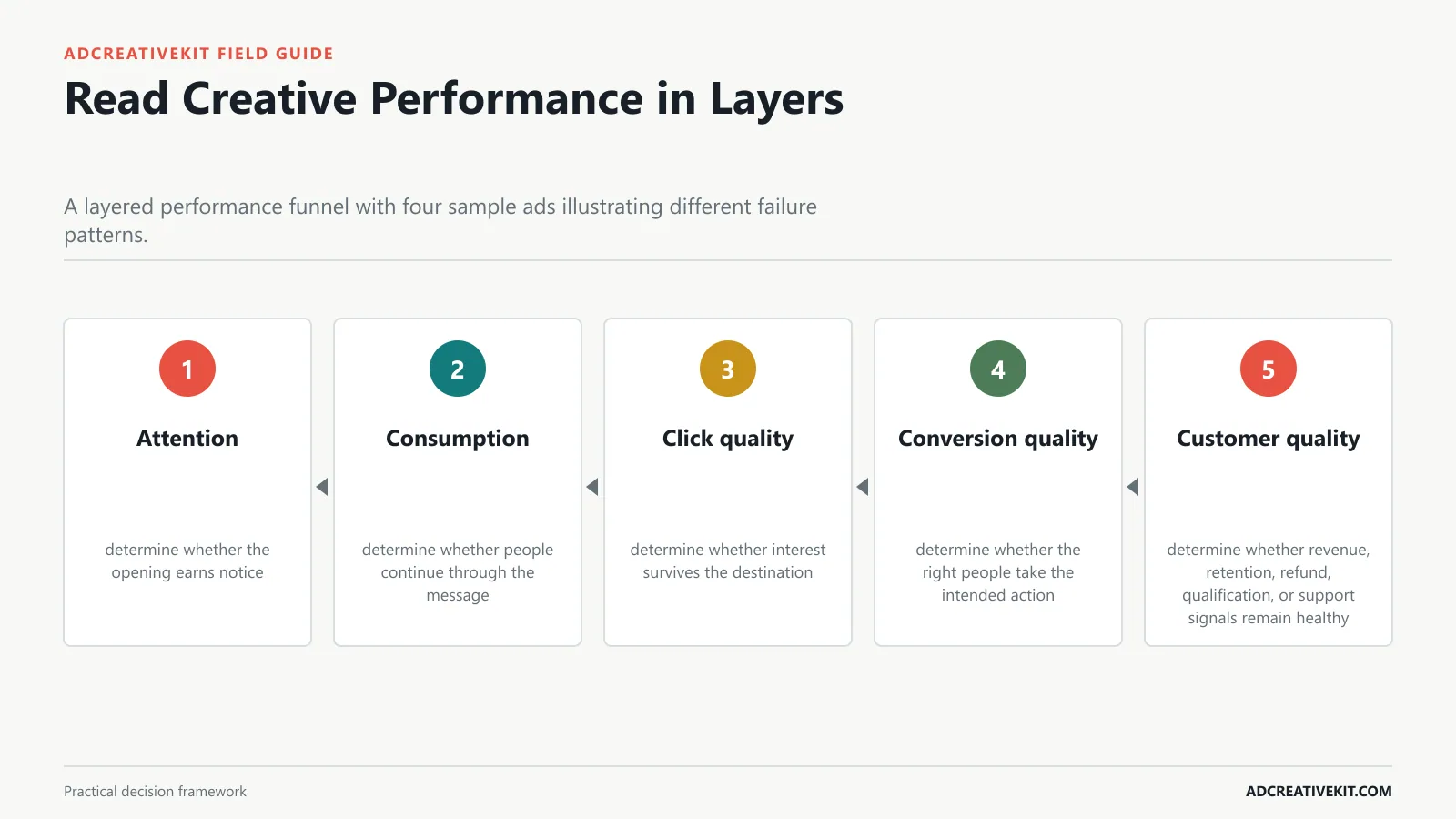
Interpret attention, consumption, click quality, conversion quality, profitability, and customer quality without rewarding vanity wins. This loop must leave an observable artifact for the next loop. Name the input, the accountable role, and the output before judging whether the operating system is functioning.
Performance ladder
Begin with attention: determine whether the opening earns notice. Then inspect consumption: determine whether people continue through the message. Together they reveal whether the loop is supplying usable material to the next stage or merely creating activity.
- Attention: determine whether the opening earns notice.
- Consumption: determine whether people continue through the message.
- Click quality: determine whether interest survives the destination.
- Conversion quality: determine whether the right people take the intended action.
- Customer quality: determine whether revenue, retention, refund, qualification, or support signals remain healthy.
Loop exit: move forward only when the required output exists, its limitations are recorded, and the receiving role can use it without reconstructing the strategy. Route anything else back to the owner of the weak loop.
For the adjacent workflow, use the creative brief template. When this section reveals a broader conversion or production issue, continue with the Facebook creative review checklist.
Make Scale, Iterate, Retest, and Stop Decisions
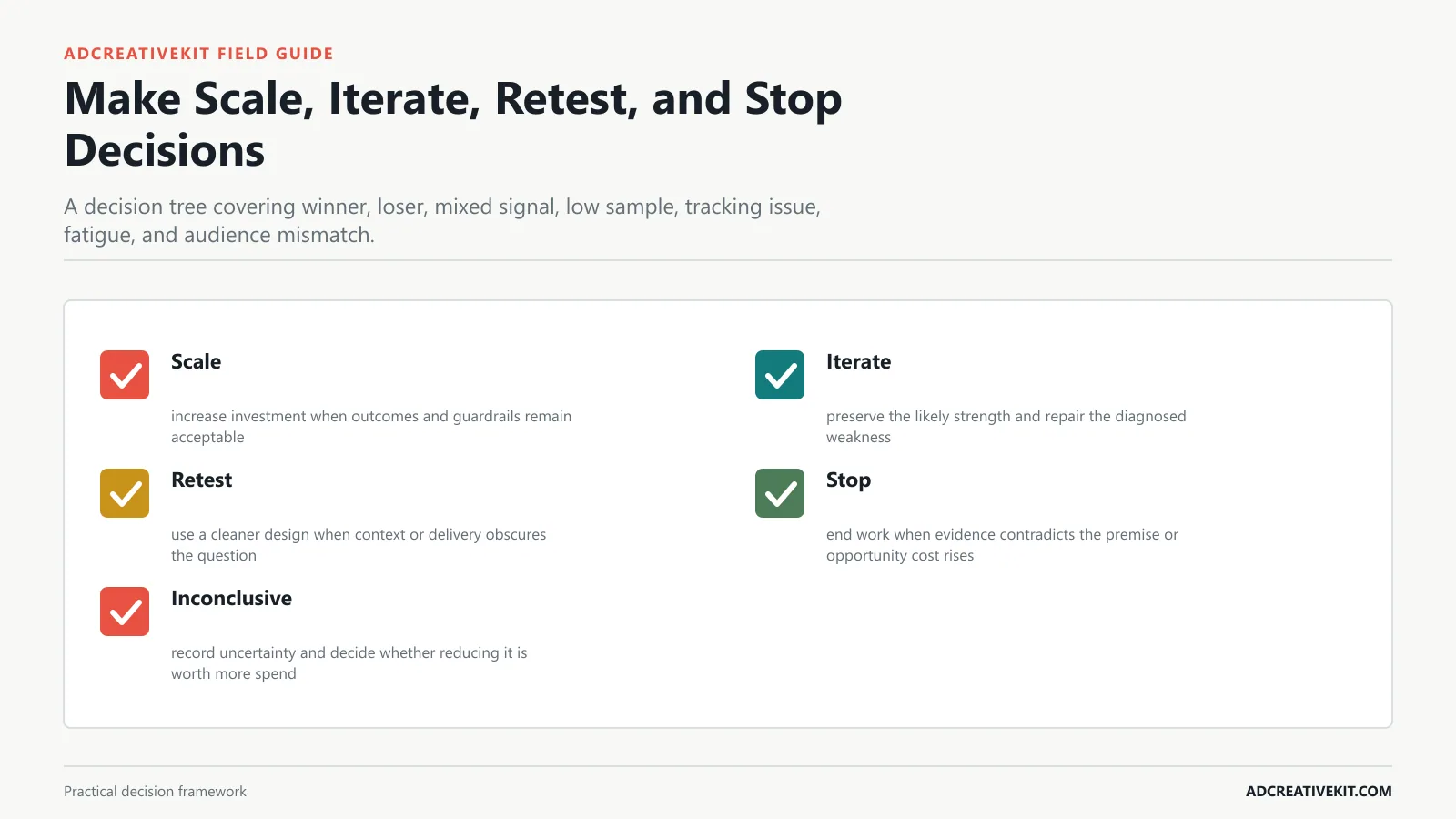
Use predefined business thresholds, confidence, guardrails, and context for clear, mixed, and inconclusive outcomes. This loop must leave an observable artifact for the next loop. Name the input, the accountable role, and the output before judging whether the operating system is functioning.
Decision loop
Begin with scale: increase investment when outcomes and guardrails remain acceptable. Then inspect iterate: preserve the likely strength and repair the diagnosed weakness. Together they reveal whether the loop is supplying usable material to the next stage or merely creating activity.
- Scale: increase investment when outcomes and guardrails remain acceptable.
- Iterate: preserve the likely strength and repair the diagnosed weakness.
- Retest: use a cleaner design when context or delivery obscures the question.
- Stop: end work when evidence contradicts the premise or opportunity cost rises.
- Inconclusive: record uncertainty and decide whether reducing it is worth more spend.
Loop 5: Build a Creative Learning Library
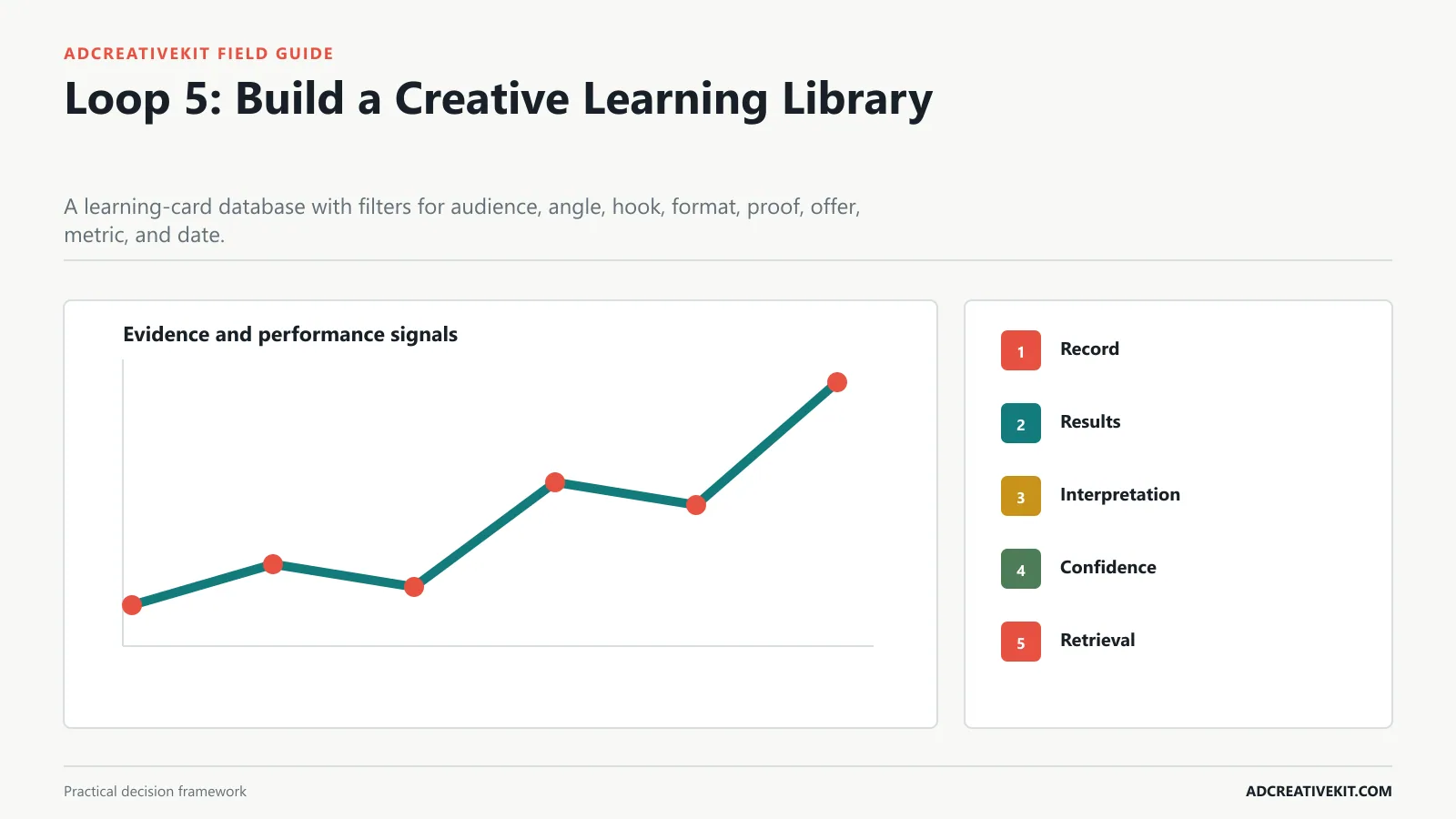
Store hypotheses, assets, results, interpretation, confidence, exceptions, and next actions in a searchable taxonomy. This loop must leave an observable artifact for the next loop. Name the input, the accountable role, and the output before judging whether the operating system is functioning.
Memory loop
Begin with record: store hypothesis, evidence, brief, assets, audience, offer, page, and dates. Then inspect results: preserve raw delivery and layered outcome metrics. Together they reveal whether the loop is supplying usable material to the next stage or merely creating activity.
- Record: store hypothesis, evidence, brief, assets, audience, offer, page, and dates.
- Results: preserve raw delivery and layered outcome metrics.
- Interpretation: distinguish observation from proposed mechanism.
- Confidence: record limitations, alternative explanations, and boundaries.
- Retrieval: tag by audience, problem, concept, hook, proof, format, and decision.
Loop exit: move forward only when the required output exists, its limitations are recorded, and the receiving role can use it without reconstructing the strategy. Route anything else back to the owner of the weak loop.
For implementation details, consult Meta A/B test documentation. Requirements and platform behavior change, so review the current primary documentation before launch rather than relying on a static checklist alone.
Run the Weekly Creative Operating Rhythm
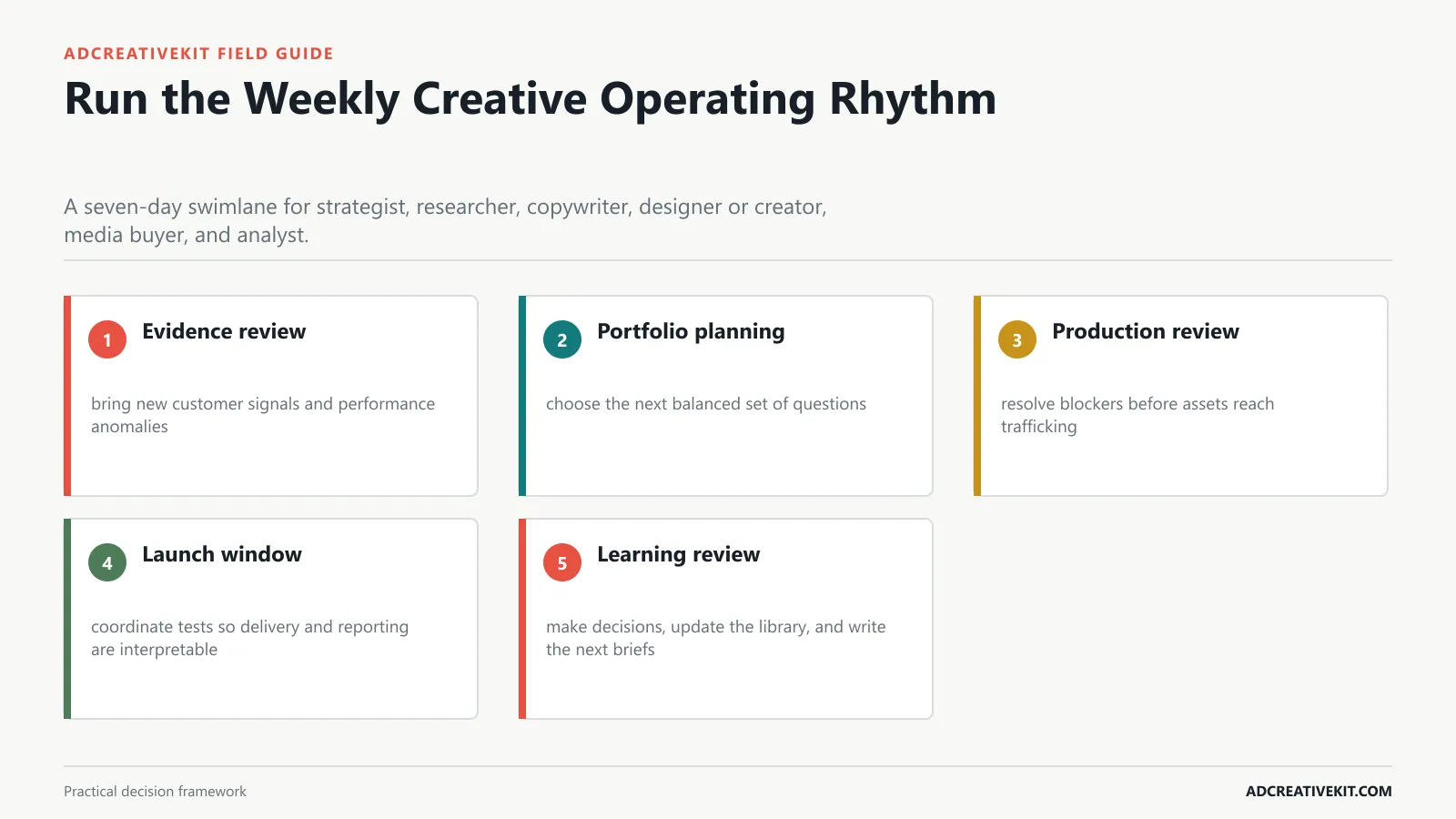
Define meetings, owners, handoffs, deadlines, production capacity, launch windows, review timing, and backlog updates. This loop must leave an observable artifact for the next loop. Name the input, the accountable role, and the output before judging whether the operating system is functioning.
Operating cadence
Begin with evidence review: bring new customer signals and performance anomalies. Then inspect portfolio planning: choose the next balanced set of questions. Together they reveal whether the loop is supplying usable material to the next stage or merely creating activity.
- Evidence review: bring new customer signals and performance anomalies.
- Portfolio planning: choose the next balanced set of questions.
- Production review: resolve blockers before assets reach trafficking.
- Launch window: coordinate tests so delivery and reporting are interpretable.
- Learning review: make decisions, update the library, and write the next briefs.
| Operating cadence element | Practical requirement | Review question |
|---|---|---|
| Evidence review | bring new customer signals and performance anomalies | Locate the record, accountable role, and downstream handoff. |
| Portfolio planning | choose the next balanced set of questions | Locate the record, accountable role, and downstream handoff. |
| Production review | resolve blockers before assets reach trafficking | Locate the record, accountable role, and downstream handoff. |
| Launch window | coordinate tests so delivery and reporting are interpretable | Locate the record, accountable role, and downstream handoff. |
| Learning review | make decisions, update the library, and write the next briefs | Locate the record, accountable role, and downstream handoff. |
For the adjacent workflow, use the ad testing matrix template. When this section reveals a broader conversion or production issue, continue with the creative brief template.
Adapt the System to Budget, Team, and Volume
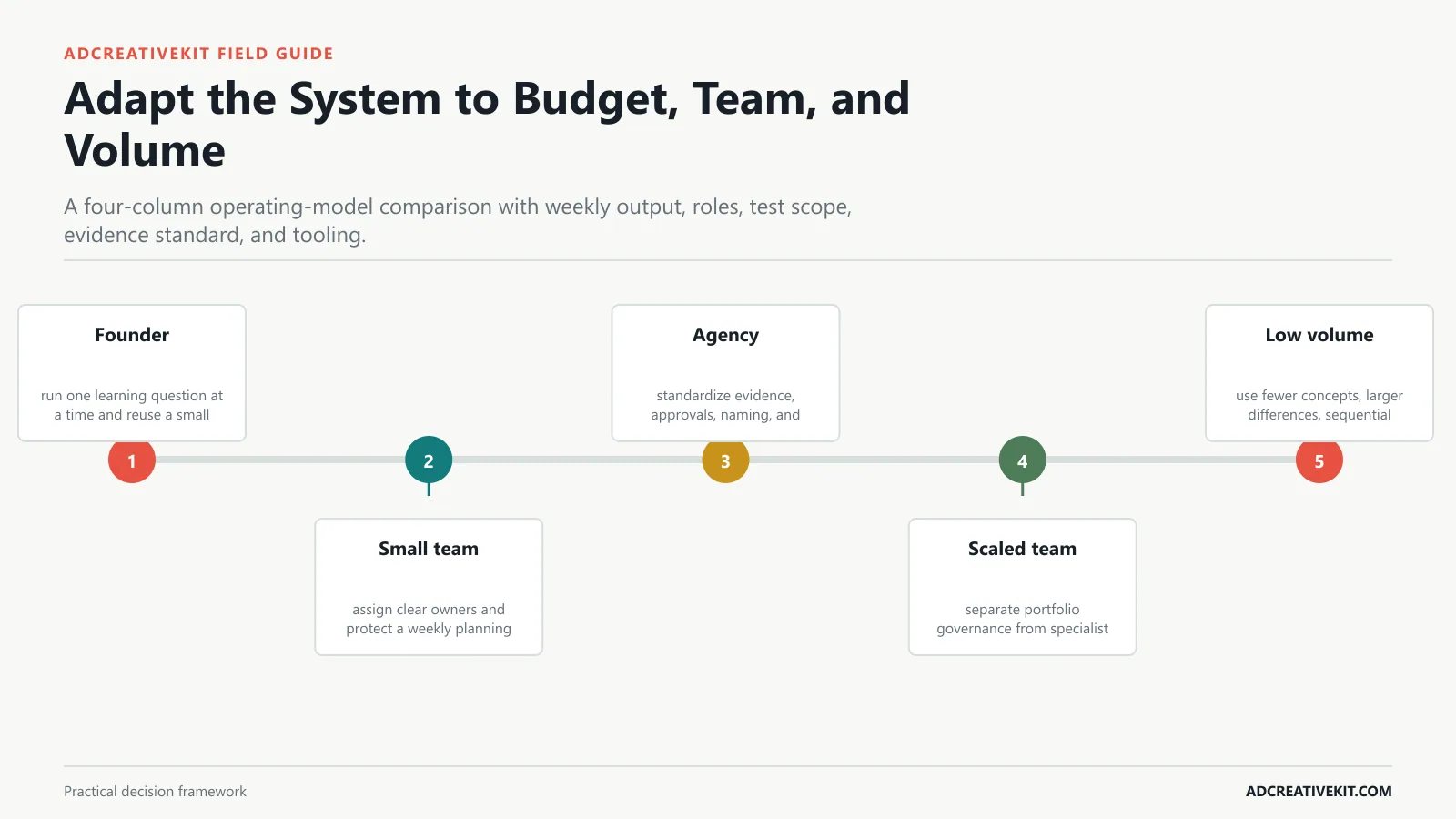
Offer operating models for a founder, small team, agency, and scaled in-house program, including low-conversion adaptations. This loop must leave an observable artifact for the next loop. Name the input, the accountable role, and the output before judging whether the operating system is functioning.
Capacity model
Begin with founder: run one learning question at a time and reuse a small component system. Then inspect small team: assign clear owners and protect a weekly planning and review cadence. Together they reveal whether the loop is supplying usable material to the next stage or merely creating activity.
- Founder: run one learning question at a time and reuse a small component system.
- Small team: assign clear owners and protect a weekly planning and review cadence.
- Agency: standardize evidence, approvals, naming, and client decision rights.
- Scaled team: separate portfolio governance from specialist production lanes.
- Low volume: use fewer concepts, larger differences, sequential learning, and qualitative evidence.
Loop exit: move forward only when the required output exists, its limitations are recorded, and the receiving role can use it without reconstructing the strategy. Route anything else back to the owner of the weak loop.
Frequently asked questions
How many creatives should a brand test each week?
There is no universal quota. Match cadence to production capacity, budget, conversion signal, and the number of decisions the team can actually interpret.
What is the difference between discovery and validation?
Discovery compares broader concepts to find promising territory. Validation controls more context to test a specific mechanism.
What makes creative testing repeatable?
Clear evidence, a balanced backlog, controlled briefs, trusted measurement, explicit decisions, and a learning library connected to the next production cycle.
Turn this guide into an operating asset
Run the maturity score quarterly and review the learning library weekly. The purpose is organizational memory: each cycle should improve idea quality, production focus, decision speed, and the questions entering the next cycle.