
Ad Testing Matrix Template: Plan, Read, and Compound Tests
An ad testing matrix is not a colorful grid of every hook multiplied by every format. That approach often creates more cells than the budget can inform. A useful matrix protects interpretability: it states the learning question, distinguishes discovery from validation, records what changed and what stayed stable, and connects attention signals to business quality. It also gives low-volume accounts a practical path that does not pretend small samples can support precise conclusions.
Quick answer: Use discovery mode to compare meaningfully different concepts and validation mode to isolate why a promising concept works. Before either, verify tracking and business definitions. Size the matrix to budget and signal, read results in layers, and allow an explicit inconclusive outcome.
Important implementation claims in this guide are grounded in primary guidance, including Google Ads experiment best practices and Google Ads Experiments overview. The frameworks below translate those requirements into decisions a working creative or growth team can review.
Build the Ad Testing Matrix
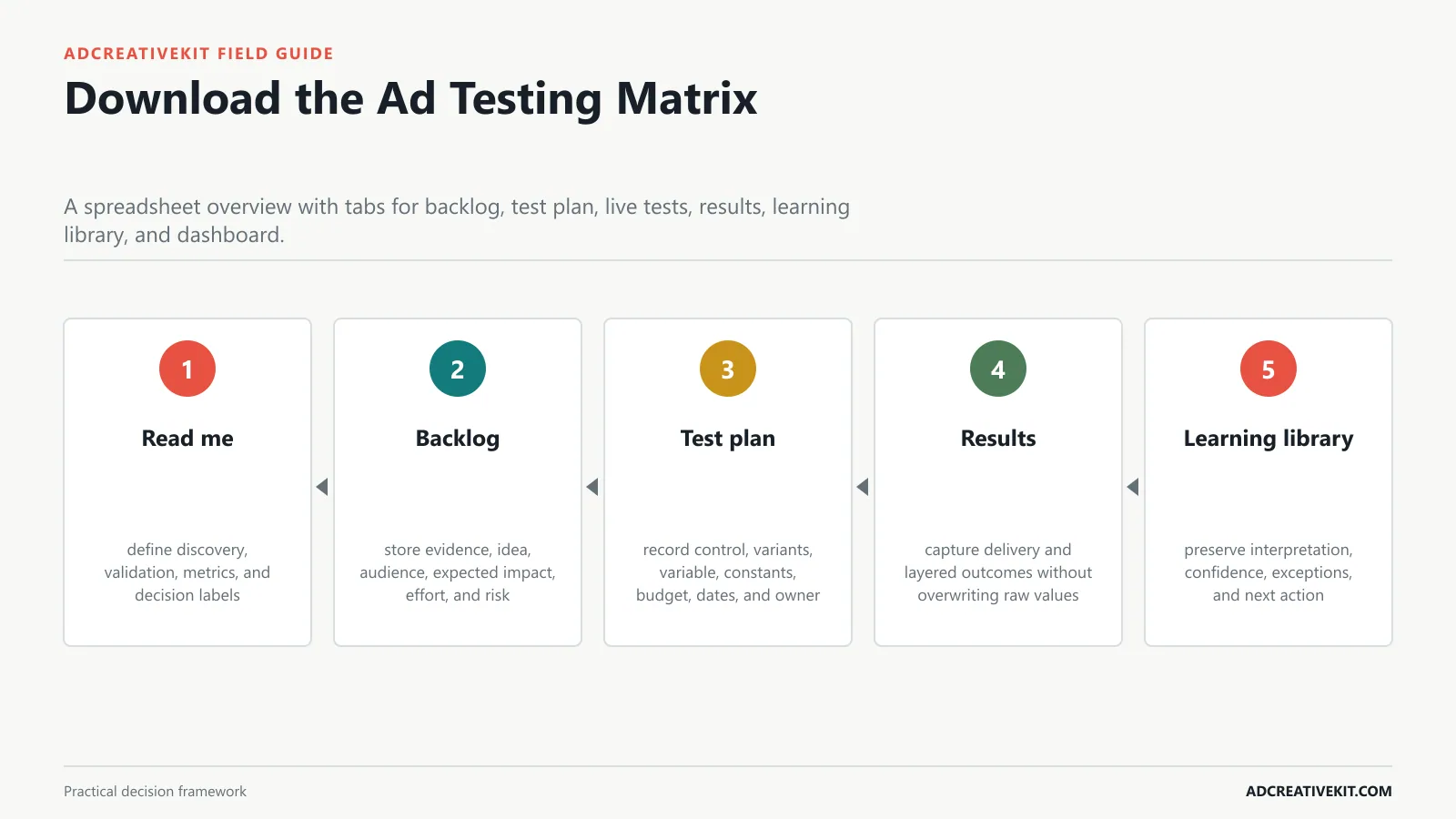
Present the editable workbook, explain its tabs, and show a completed example before the methodology.
Workbook logic
Begin with read me: define discovery, validation, metrics, and decision labels. Then inspect backlog: store evidence, idea, audience, expected impact, effort, and risk.
- Read me: define discovery, validation, metrics, and decision labels.
- Backlog: store evidence, idea, audience, expected impact, effort, and risk.
- Test plan: record control, variants, variable, constants, budget, dates, and owner.
- Results: capture delivery and layered outcomes without overwriting raw values.
- Learning library: preserve interpretation, confidence, exceptions, and next action.
Pass the Data-Trust Gate Before Testing
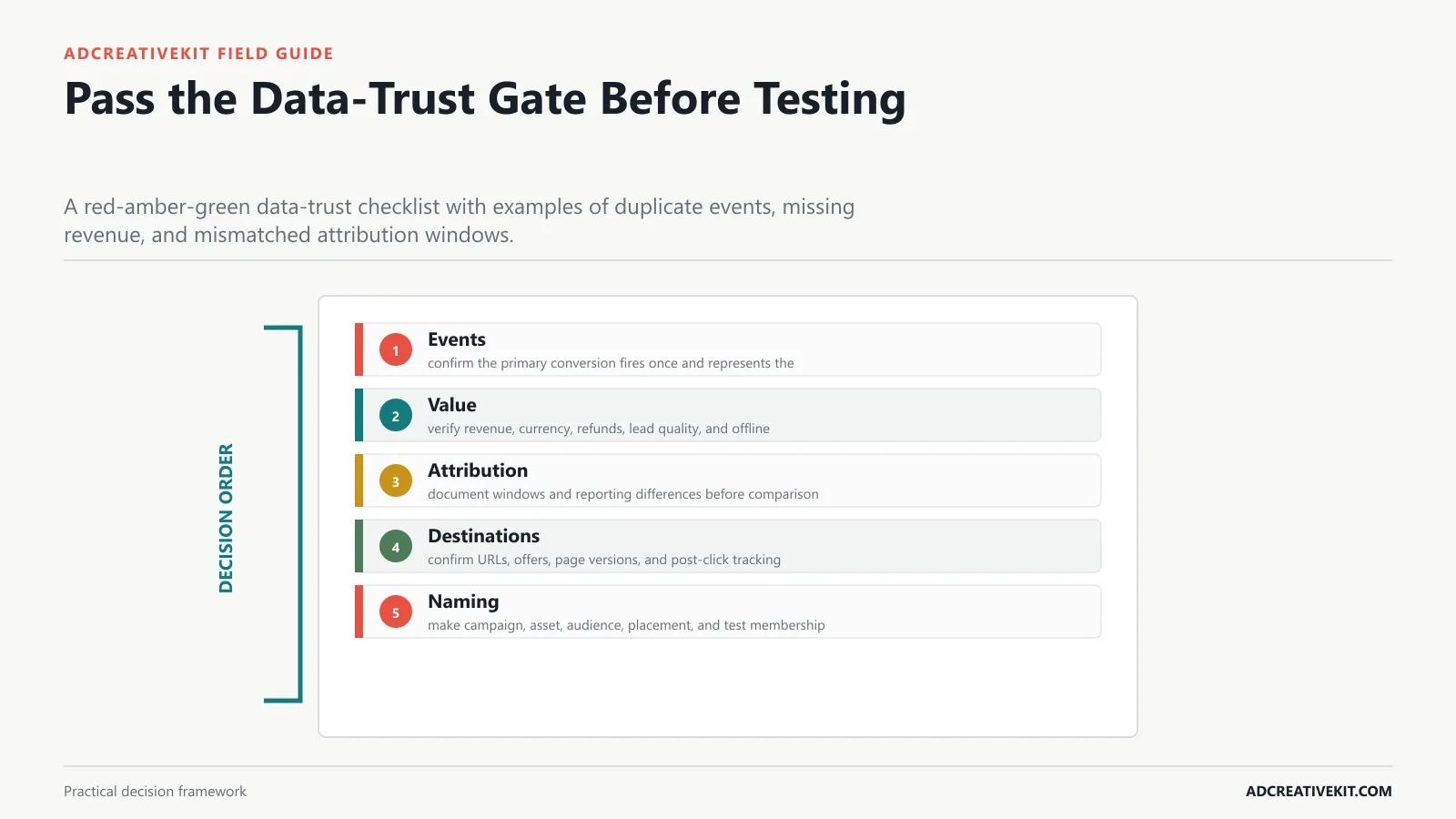
Verify conversion events, attribution assumptions, naming, landing destinations, and business outcome definitions.
Trust gate
Begin with events: confirm the primary conversion fires once and represents the intended action. Then inspect value: verify revenue, currency, refunds, lead quality, and offline outcomes where relevant.
- Events: confirm the primary conversion fires once and represents the intended action.
- Value: verify revenue, currency, refunds, lead quality, and offline outcomes where relevant.
- Attribution: document windows and reporting differences before comparison.
- Destinations: confirm URLs, offers, page versions, and post-click tracking.
- Naming: make campaign, asset, audience, placement, and test membership traceable.
| Trust gate element | Practical requirement | Review question |
|---|---|---|
| Events | confirm the primary conversion fires once and represents the intended action | Record the observable evidence, any failure, and the owner of the next action. |
| Value | verify revenue, currency, refunds, lead quality, and offline outcomes where relevant | Record the observable evidence, any failure, and the owner of the next action. |
| Attribution | document windows and reporting differences before comparison | Record the observable evidence, any failure, and the owner of the next action. |
| Destinations | confirm URLs, offers, page versions, and post-click tracking | Record the observable evidence, any failure, and the owner of the next action. |
| Naming | make campaign, asset, audience, placement, and test membership traceable | Record the observable evidence, any failure, and the owner of the next action. |
Choose Discovery or Validation Mode
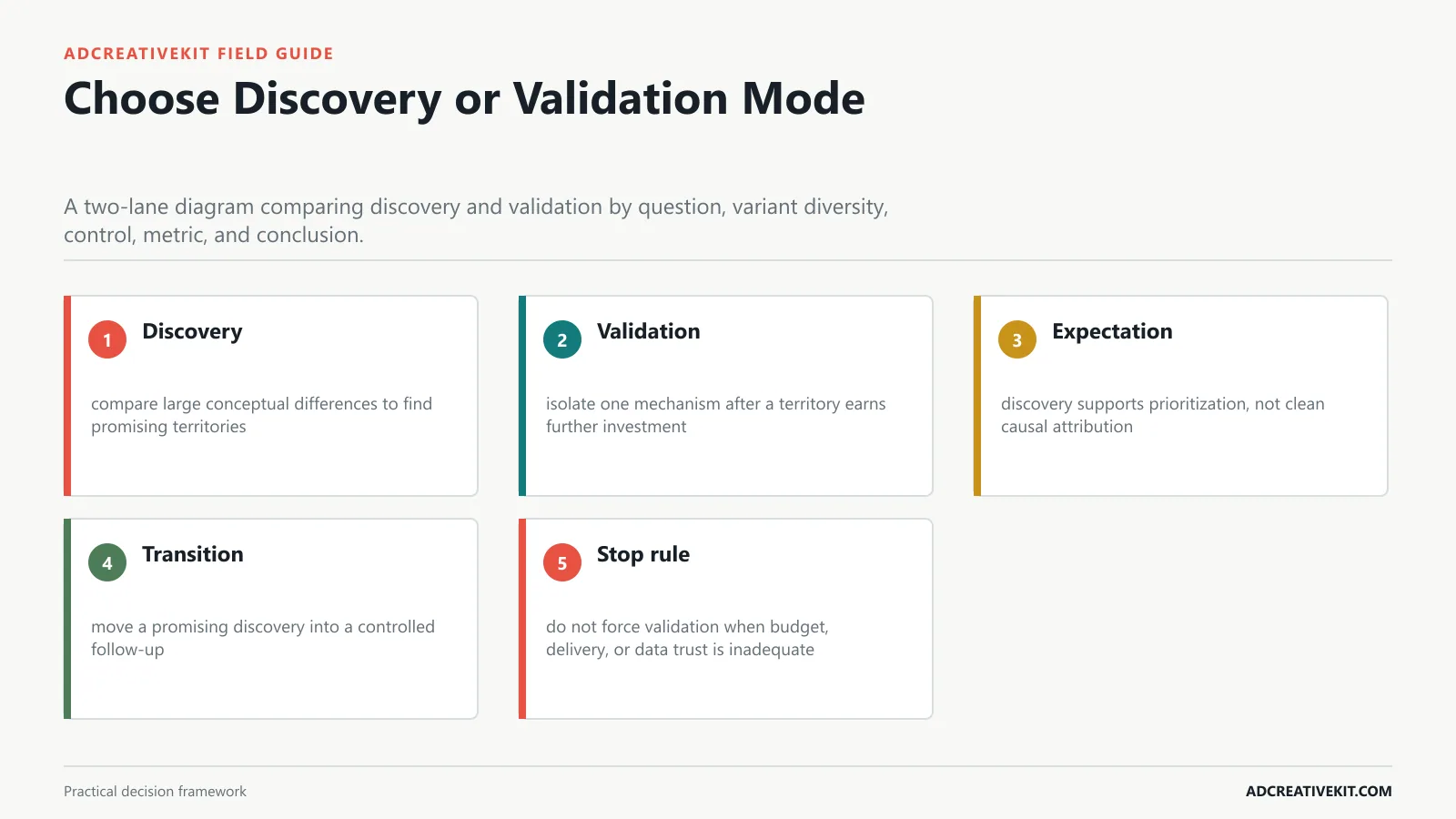
Distinguish broad concept exploration from controlled follow-up tests and prevent teams from demanding causal certainty from discovery batches.
Mode choice
Begin with discovery: compare large conceptual differences to find promising territories. Then inspect validation: isolate one mechanism after a territory earns further investment.
- Discovery: compare large conceptual differences to find promising territories.
- Validation: isolate one mechanism after a territory earns further investment.
- Expectation: discovery supports prioritization, not clean causal attribution.
- Transition: move a promising discovery into a controlled follow-up.
- Stop rule: do not force validation when budget, delivery, or data trust is inadequate.
For the adjacent workflow, use the static ads versus UGC-style ads. When this section reveals a broader conversion or production issue, continue with the Facebook creative review checklist.
Define the Variable and Hypothesis
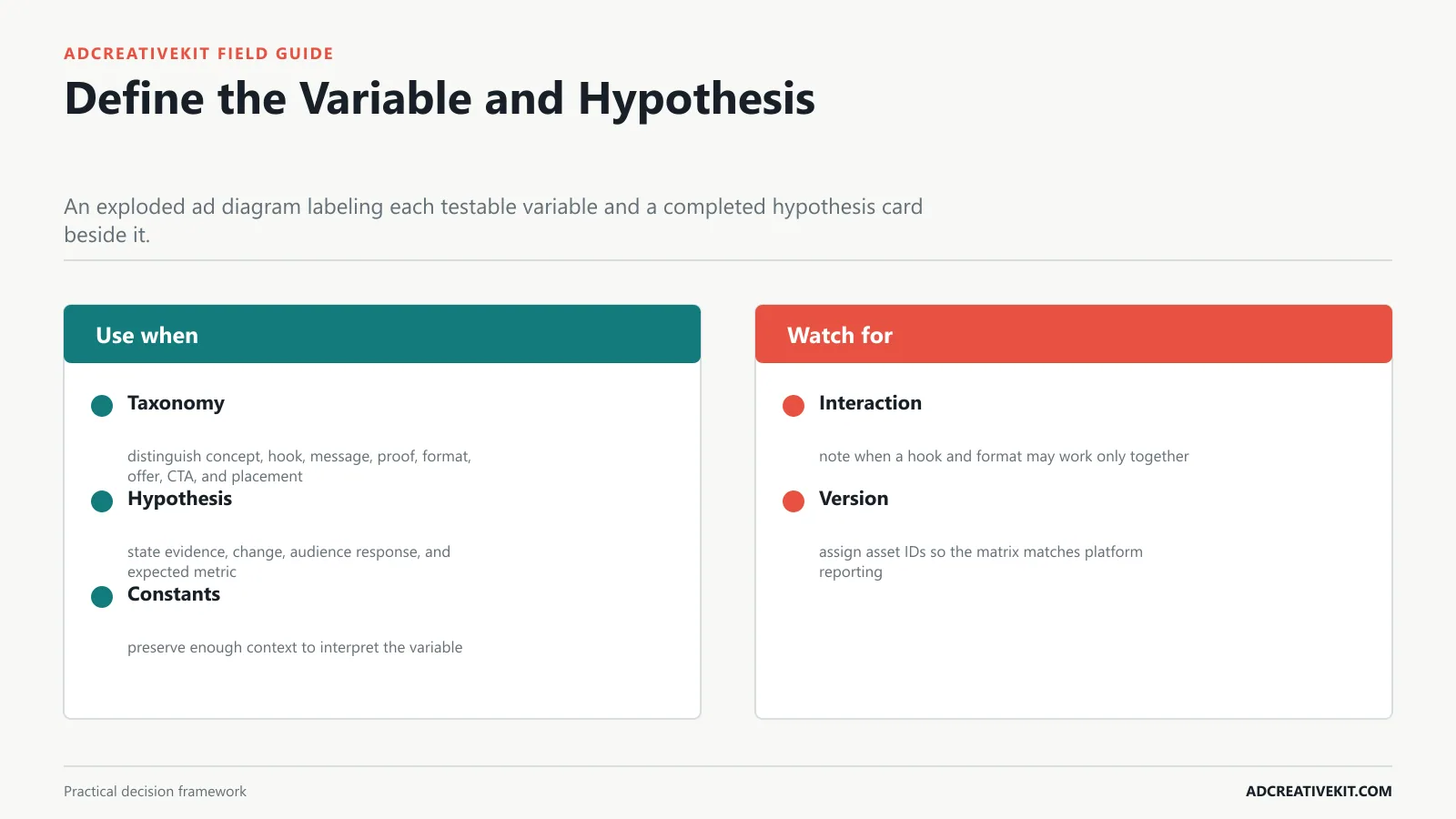
Use a taxonomy for concept, hook, format, message, proof, offer, CTA, and placement while holding relevant context stable.
Variable discipline
Begin with taxonomy: distinguish concept, hook, message, proof, format, offer, CTA, and placement. Then inspect hypothesis: state evidence, change, audience response, and expected metric.
- Taxonomy: distinguish concept, hook, message, proof, format, offer, CTA, and placement.
- Hypothesis: state evidence, change, audience response, and expected metric.
- Constants: preserve enough context to interpret the variable.
- Interaction: note when a hook and format may work only together.
- Version: assign asset IDs so the matrix matches platform reporting.
Size the Matrix to Budget and Signal
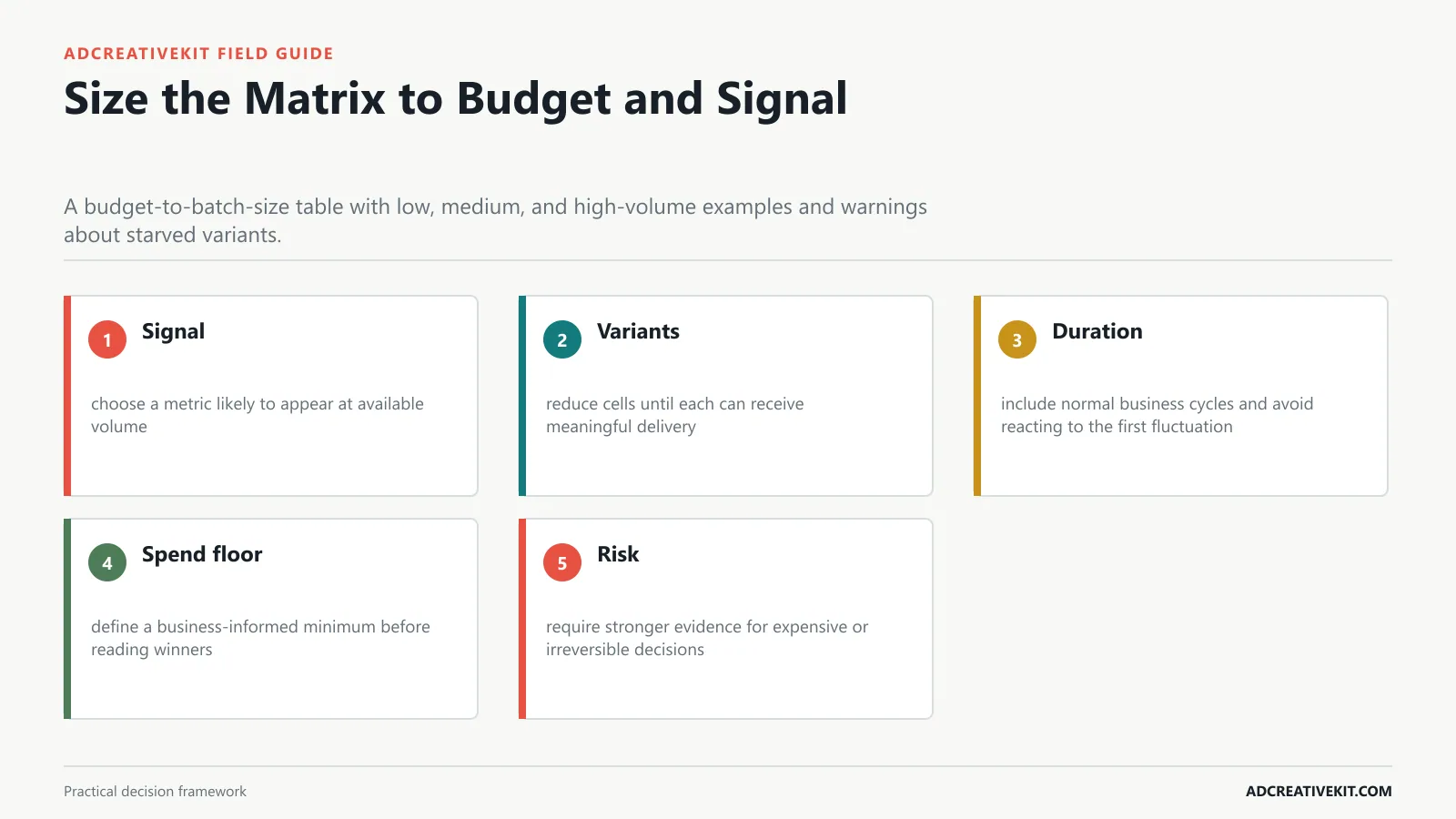
Select variant count, duration, spend floor, and metric according to conversion volume and business risk.
Signal budget
Begin with signal: choose a metric likely to appear at available volume. Then inspect variants: reduce cells until each can receive meaningful delivery.
- Signal: choose a metric likely to appear at available volume.
- Variants: reduce cells until each can receive meaningful delivery.
- Duration: include normal business cycles and avoid reacting to the first fluctuation.
- Spend floor: define a business-informed minimum before reading winners.
- Risk: require stronger evidence for expensive or irreversible decisions.
Build the Test Plan and Naming System
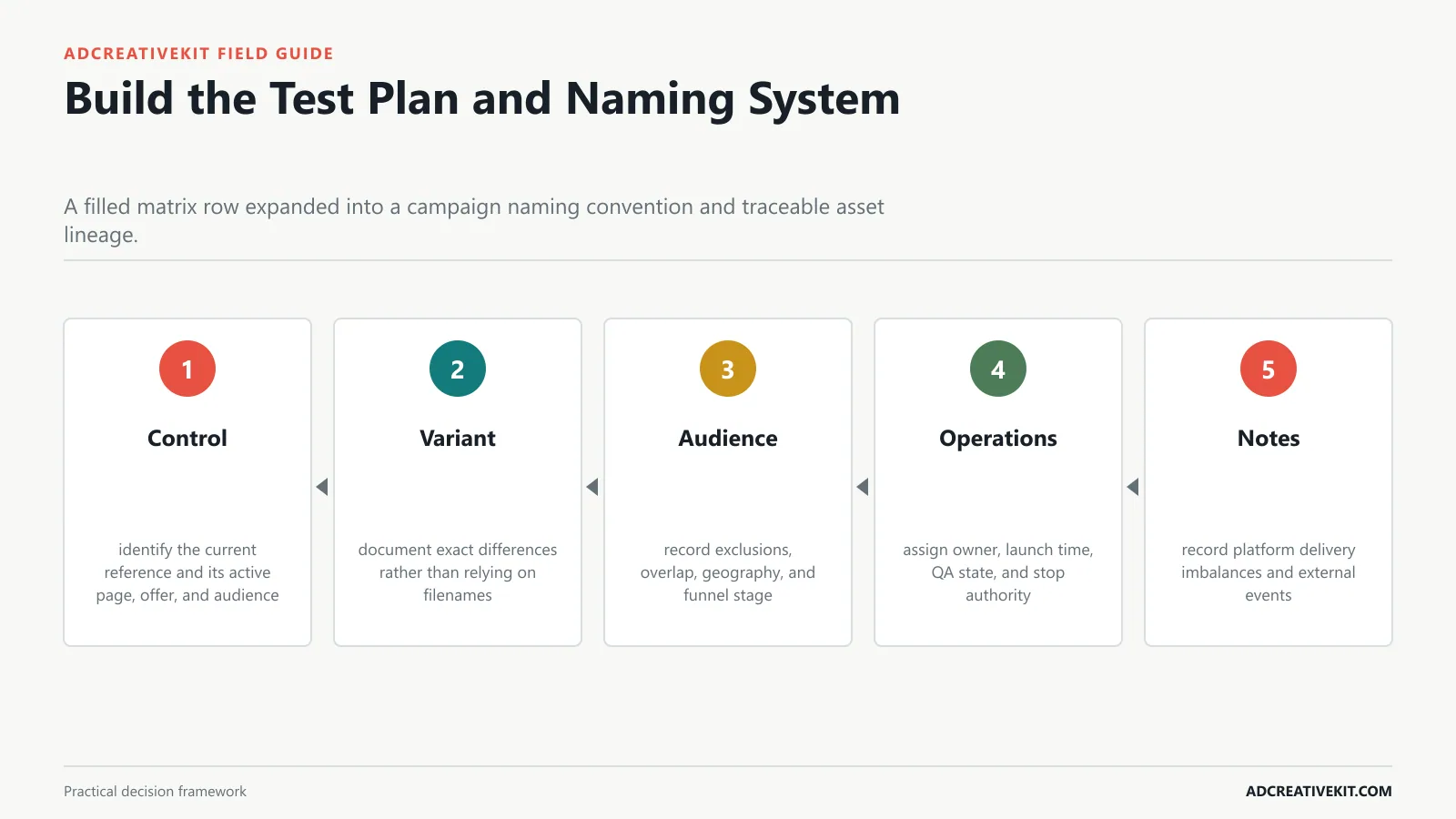
Specify control, variants, audience, placement, landing page, start date, owner, asset ID, and exclusion rules.
Test record
Begin with control: identify the current reference and its active page, offer, and audience. Then inspect variant: document exact differences rather than relying on filenames.
- Control: identify the current reference and its active page, offer, and audience.
- Variant: document exact differences rather than relying on filenames.
- Audience: record exclusions, overlap, geography, and funnel stage.
- Operations: assign owner, launch time, QA state, and stop authority.
- Notes: record platform delivery imbalances and external events.
For the adjacent workflow, use the creative brief template. When this section reveals a broader conversion or production issue, continue with the static ads versus UGC-style ads.
Read Results in Signal Layers
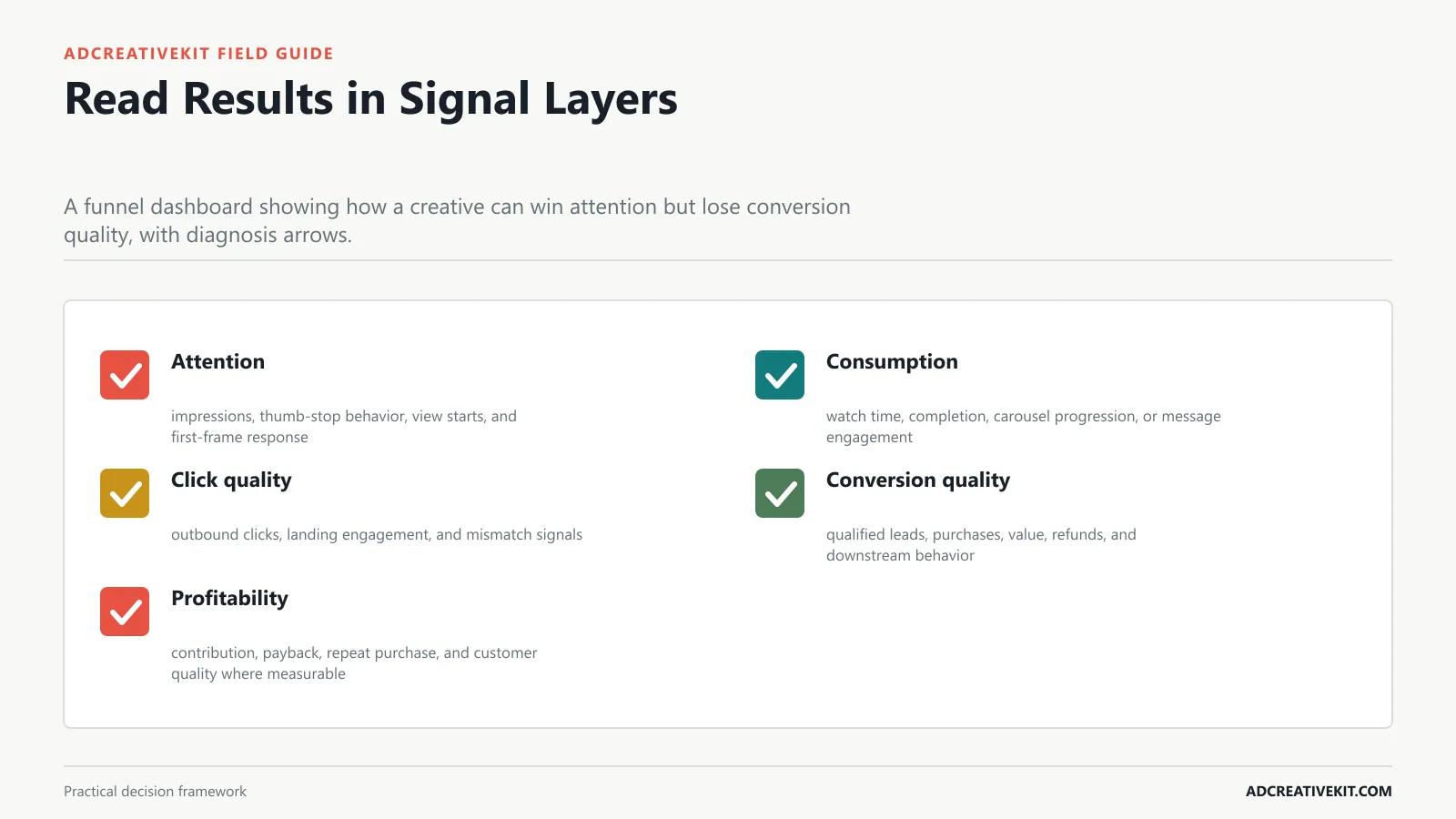
Separate attention, consumption, click quality, conversion quality, profitability, and customer quality.
Metric ladder
Begin with attention: impressions, thumb-stop behavior, view starts, and first-frame response. Then inspect consumption: watch time, completion, carousel progression, or message engagement.
- Attention: impressions, thumb-stop behavior, view starts, and first-frame response.
- Consumption: watch time, completion, carousel progression, or message engagement.
- Click quality: outbound clicks, landing engagement, and mismatch signals.
- Conversion quality: qualified leads, purchases, value, refunds, and downstream behavior.
- Profitability: contribution, payback, repeat purchase, and customer quality where measurable.
Use Decision Rules Without Pretending Certainty
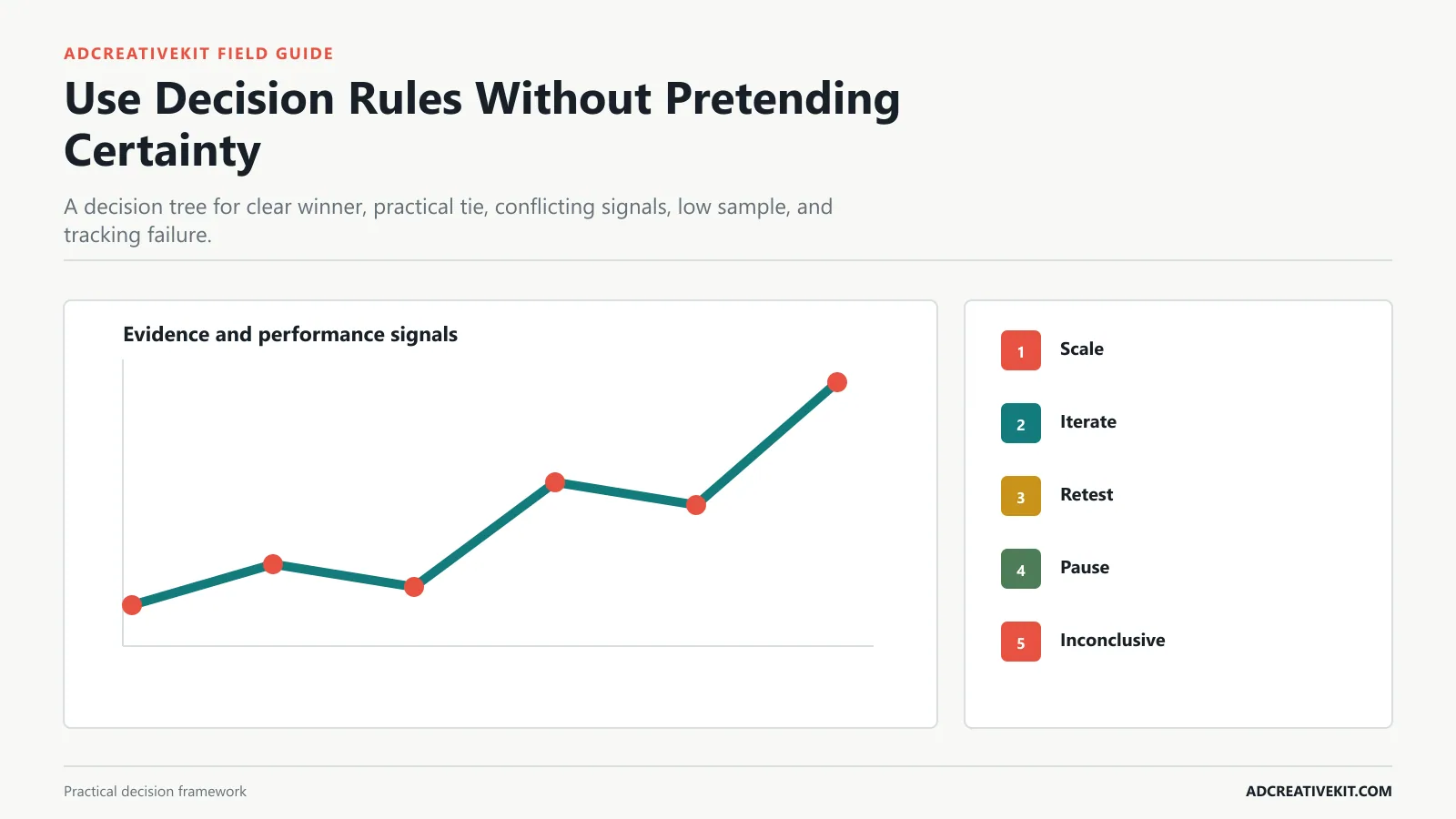
Define scale, iterate, pause, retest, and inconclusive outcomes using business thresholds and confidence.
Decision discipline
Begin with scale: increase investment when business outcome and guardrails remain acceptable. Then inspect iterate: preserve the promising mechanism and change the diagnosed weakness.
- Scale: increase investment when business outcome and guardrails remain acceptable.
- Iterate: preserve the promising mechanism and change the diagnosed weakness.
- Retest: use when context, delivery, or measurement prevented a fair read.
- Pause: stop when downside is clear or the test no longer answers a useful question.
- Inconclusive: record uncertainty honestly and decide whether more evidence is worth its cost.
For implementation details, consult Meta A/B test documentation. Requirements and platform behavior change, so review the current primary documentation before launch rather than relying on a static checklist alone.
Adapt the Matrix for Low-Volume Accounts
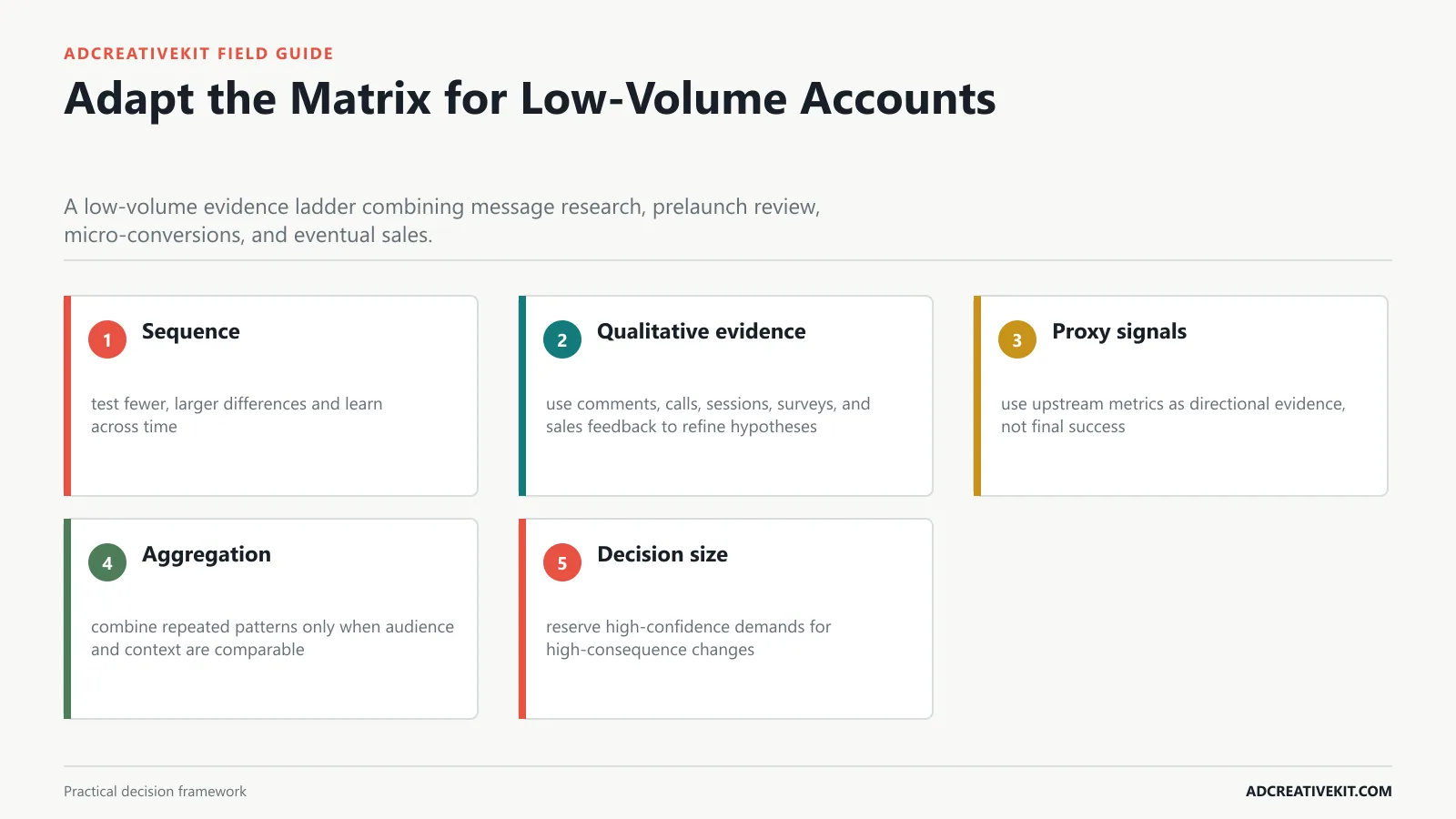
Use sequential learning, qualitative evidence, upper-funnel signals, and larger conceptual differences when conversions are scarce.
Low-volume path
Begin with sequence: test fewer, larger differences and learn across time. Then inspect qualitative evidence: use comments, calls, sessions, surveys, and sales feedback to refine hypotheses.
- Sequence: test fewer, larger differences and learn across time.
- Qualitative evidence: use comments, calls, sessions, surveys, and sales feedback to refine hypotheses.
- Proxy signals: use upstream metrics as directional evidence, not final success.
- Aggregation: combine repeated patterns only when audience and context are comparable.
- Decision size: reserve high-confidence demands for high-consequence changes.
| Low-volume path element | Practical requirement | Review question |
|---|---|---|
| Sequence | test fewer, larger differences and learn across time | Record the observable evidence, any failure, and the owner of the next action. |
| Qualitative evidence | use comments, calls, sessions, surveys, and sales feedback to refine hypotheses | Record the observable evidence, any failure, and the owner of the next action. |
| Proxy signals | use upstream metrics as directional evidence, not final success | Record the observable evidence, any failure, and the owner of the next action. |
| Aggregation | combine repeated patterns only when audience and context are comparable | Record the observable evidence, any failure, and the owner of the next action. |
| Decision size | reserve high-confidence demands for high-consequence changes | Record the observable evidence, any failure, and the owner of the next action. |
For the adjacent workflow, use the repeatable creative testing system. When this section reveals a broader conversion or production issue, continue with the creative brief template.
Turn Every Test Into the Next Brief
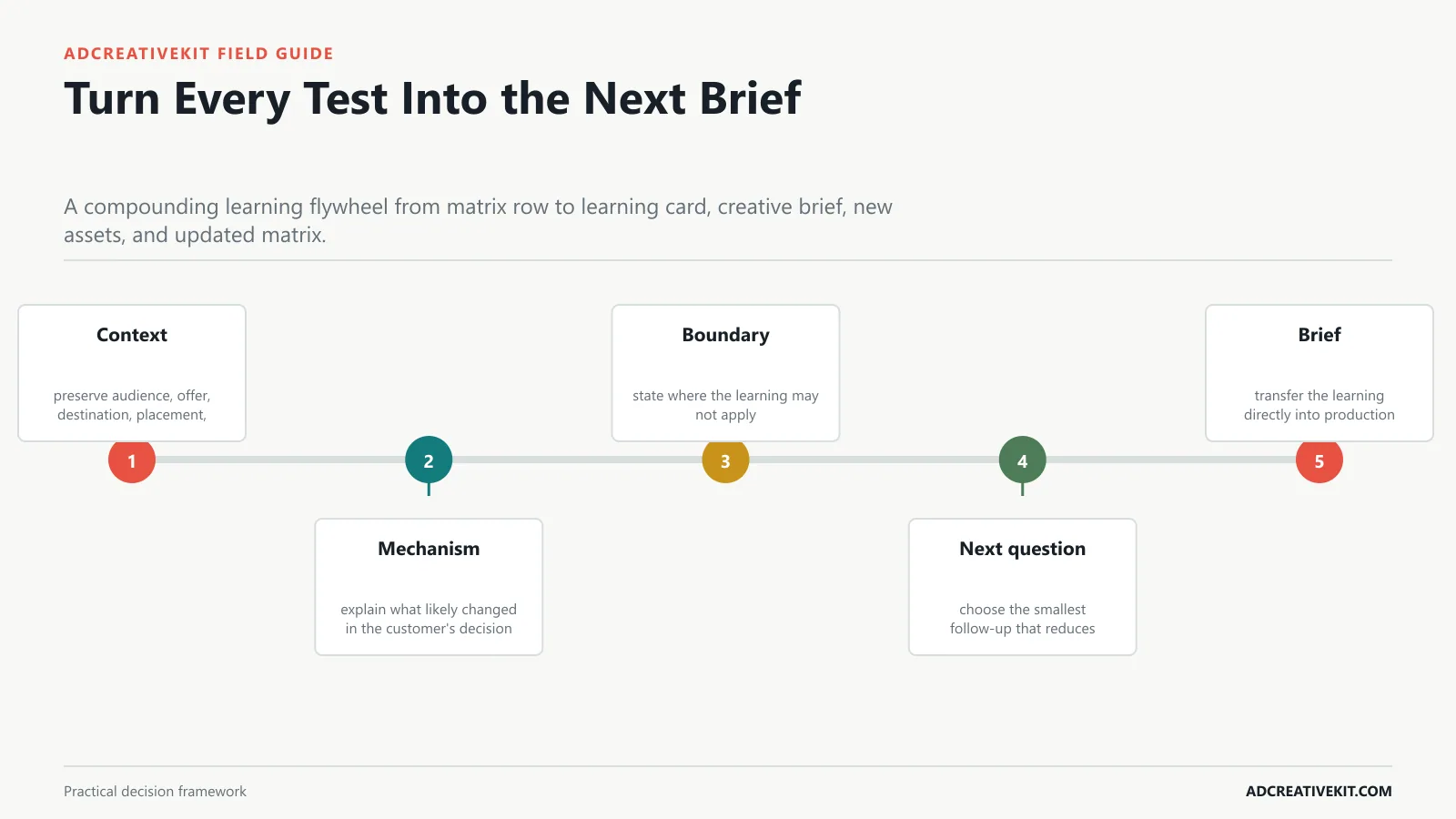
Capture the result, interpretation, reusable principle, confidence, exceptions, and next experiment.
Learning transfer
Begin with context: preserve audience, offer, destination, placement, season, and delivery. Then inspect mechanism: explain what likely changed in the customer’s decision process.
- Context: preserve audience, offer, destination, placement, season, and delivery.
- Mechanism: explain what likely changed in the customer’s decision process.
- Boundary: state where the learning may not apply.
- Next question: choose the smallest follow-up that reduces important uncertainty.
- Brief: transfer the learning directly into production instructions.
Worked Matrix Row: Price-Objection Creative
Write the row before production begins. Evidence might be repeated comments that the product appears expensive compared with a familiar alternative. The hypothesis is not “testimonial ads will win”; it is “specific durability proof may make the price feel proportional for comparison-stage shoppers.” Keep the audience, offer, destination, and core product presentation stable while changing the proof treatment.
Record the requested assets, launch date, delivery by variant, primary business outcome, and guardrails. A strong click-through rate with weak purchase quality is not a clean win. The decision field should allow scale, iterate, retest, stop, and inconclusive, with a short reason. That row becomes useful history even when no variant wins.
Frequently asked questions
What the matrix cannot prove: A tidy spreadsheet does not create random assignment, equal platform delivery, adequate sample size, or clean attribution. Record delivery imbalance, tracking failures, audience overlap, seasonality, offer changes, and landing-page changes beside the result. When those conditions prevent a defensible conclusion, label the test inconclusive instead of manufacturing a winner.
How many ads should be in a testing matrix?
Use only as many variants as the budget and expected signal can inform. Fewer meaningful differences are usually more useful than a large underfunded grid.
Can CTR select a winning ad?
CTR can reveal response to the creative, but a click winner may attract poor-fit traffic. Read conversion and customer-quality guardrails whenever available.
What if platform delivery is uneven?
Record the imbalance, avoid naive comparisons, and use a controlled follow-up or longer sequential learning when the business value justifies it.
Turn this guide into an operating asset
Save the framework with the evidence, owner, date, and decision attached. That turns a one-time article into a repeatable review system and prevents future teams from treating an old output as a universal rule.

Pingback: David