Customer Testimonial Ad Templates: Build Credible Proof
A testimonial ad succeeds when the proof fits the doubt in the buyer’s mind. A generic five-star quote may look reassuring yet answer nothing about fit, durability, ease, risk, or expected outcome. This guide organizes templates by objection, then adds the credibility work galleries usually omit: sourcing, verification, permission, typical-results context, format adaptation, testing, and retirement.
Quick answer: Select a testimonial format according to the objection it must resolve. Preserve the customer’s meaning and context, document permission and incentives, make material disclosures visible, and test the proof variable rather than merely changing decoration.
Important implementation claims in this guide are grounded in primary guidance, including FTC Endorsements, Influencers, and Reviews and FTC advertisement endorsements guidance. The frameworks below translate those requirements into decisions a working creative or growth team can review.
Choose a Testimonial Template by Buyer Objection
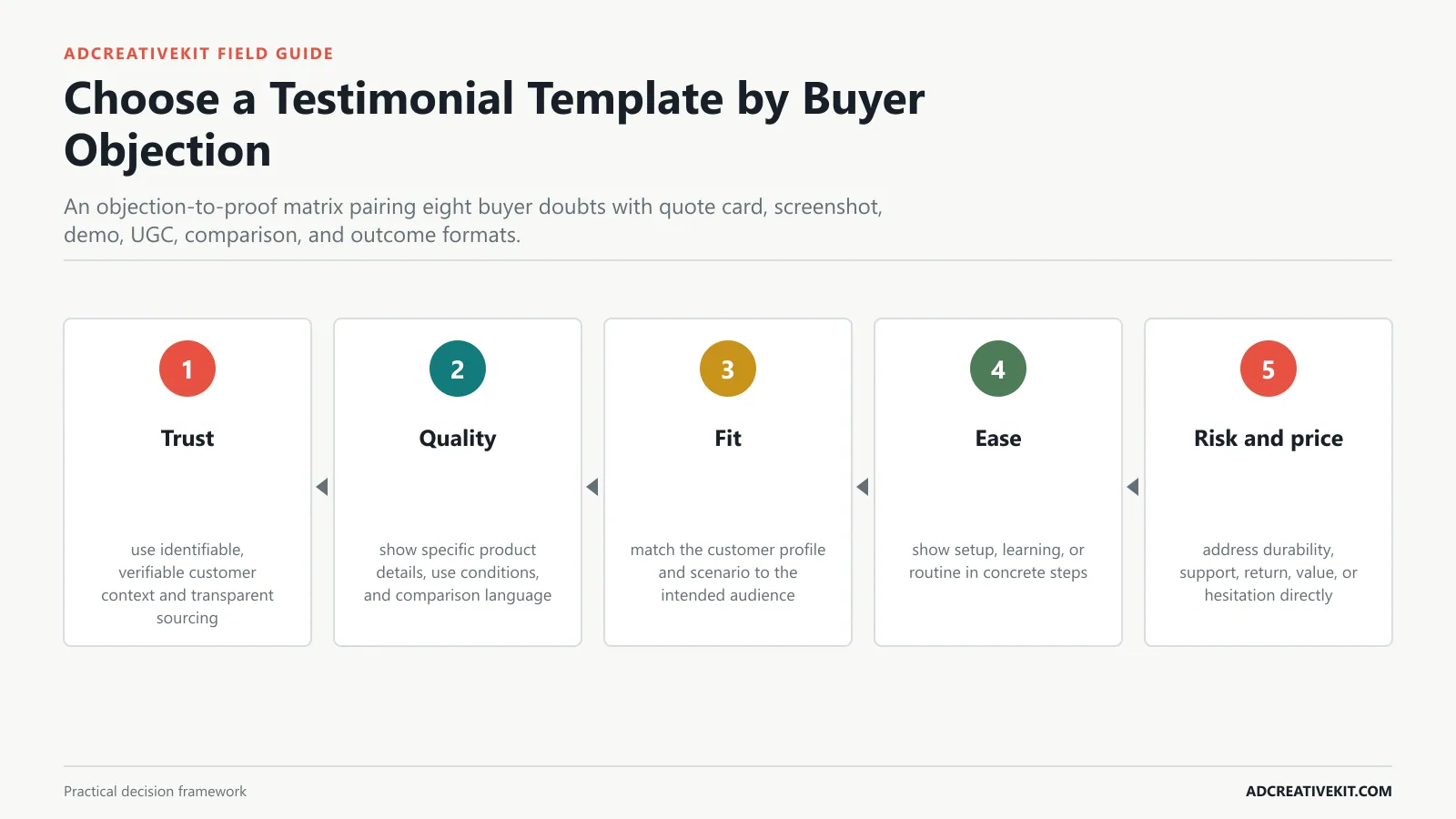
Map trust, quality, fit, speed, ease, risk, price, and outcome objections to the proof format most capable of resolving them.
Objection match
Begin with trust: use identifiable, verifiable customer context and transparent sourcing. Then inspect quality: show specific product details, use conditions, and comparison language.
- Trust: use identifiable, verifiable customer context and transparent sourcing.
- Quality: show specific product details, use conditions, and comparison language.
- Fit: match the customer profile and scenario to the intended audience.
- Ease: show setup, learning, or routine in concrete steps.
- Risk and price: address durability, support, return, value, or hesitation directly.
The Proof Hierarchy Behind a Credible Testimonial Ad
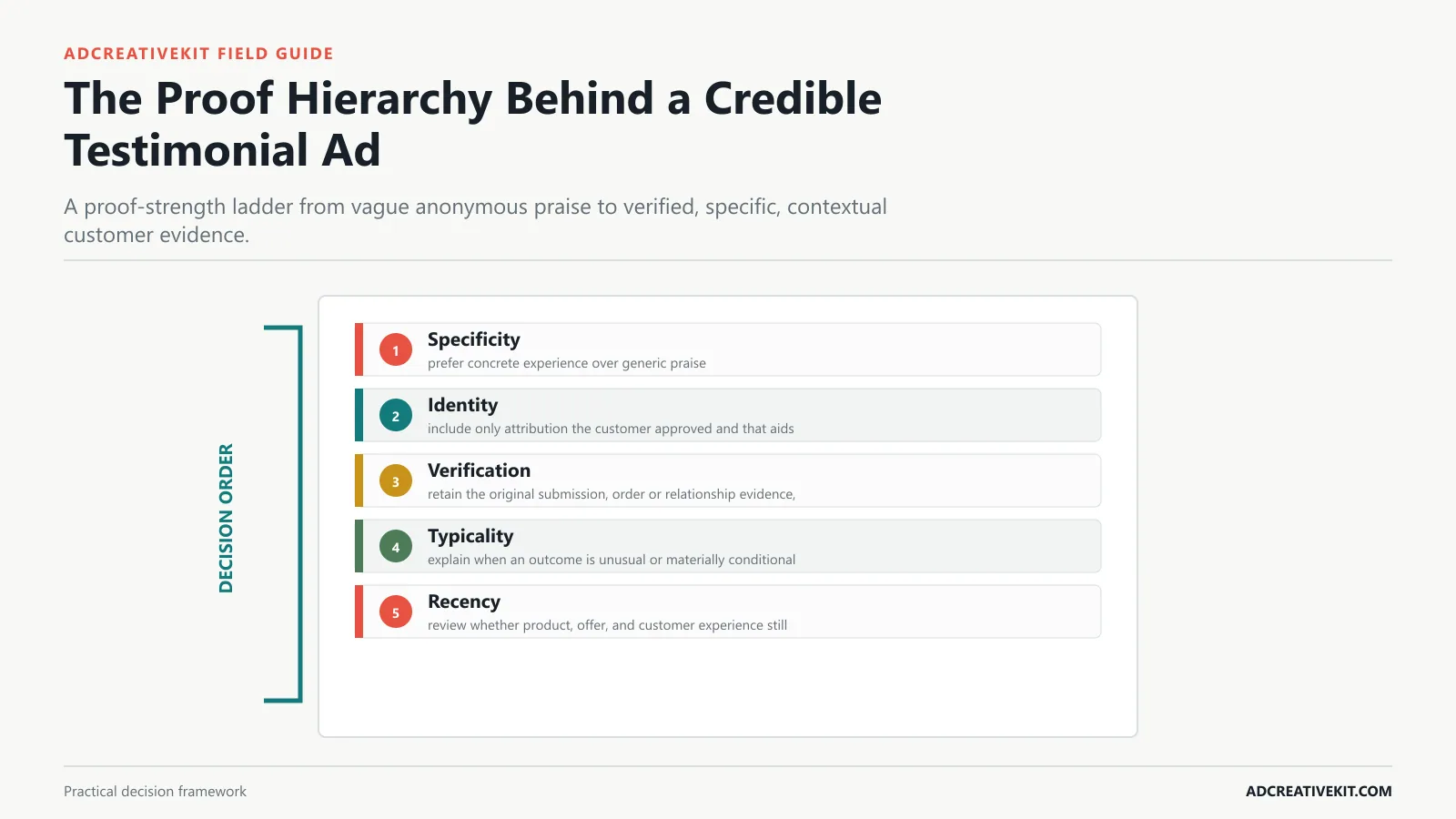
Score specificity, identity, verification, context, typicality, recency, and supporting evidence.
Proof-strength test
Begin with specificity: prefer concrete experience over generic praise. Then inspect identity: include only attribution the customer approved and that aids context.
- Specificity: prefer concrete experience over generic praise.
- Identity: include only attribution the customer approved and that aids context.
- Verification: retain the original submission, order or relationship evidence, and edits.
- Typicality: explain when an outcome is unusual or materially conditional.
- Recency: review whether product, offer, and customer experience still match the claim.
| Proof-strength test element | Practical requirement | Review question |
|---|---|---|
| Specificity | prefer concrete experience over generic praise | Record the observable evidence, any failure, and the owner of the next action. |
| Identity | include only attribution the customer approved and that aids context | Record the observable evidence, any failure, and the owner of the next action. |
| Verification | retain the original submission, order or relationship evidence, and edits | Record the observable evidence, any failure, and the owner of the next action. |
| Typicality | explain when an outcome is unusual or materially conditional | Record the observable evidence, any failure, and the owner of the next action. |
| Recency | review whether product, offer, and customer experience still match the claim | Record the observable evidence, any failure, and the owner of the next action. |
Quote Card and Customer Photo Templates
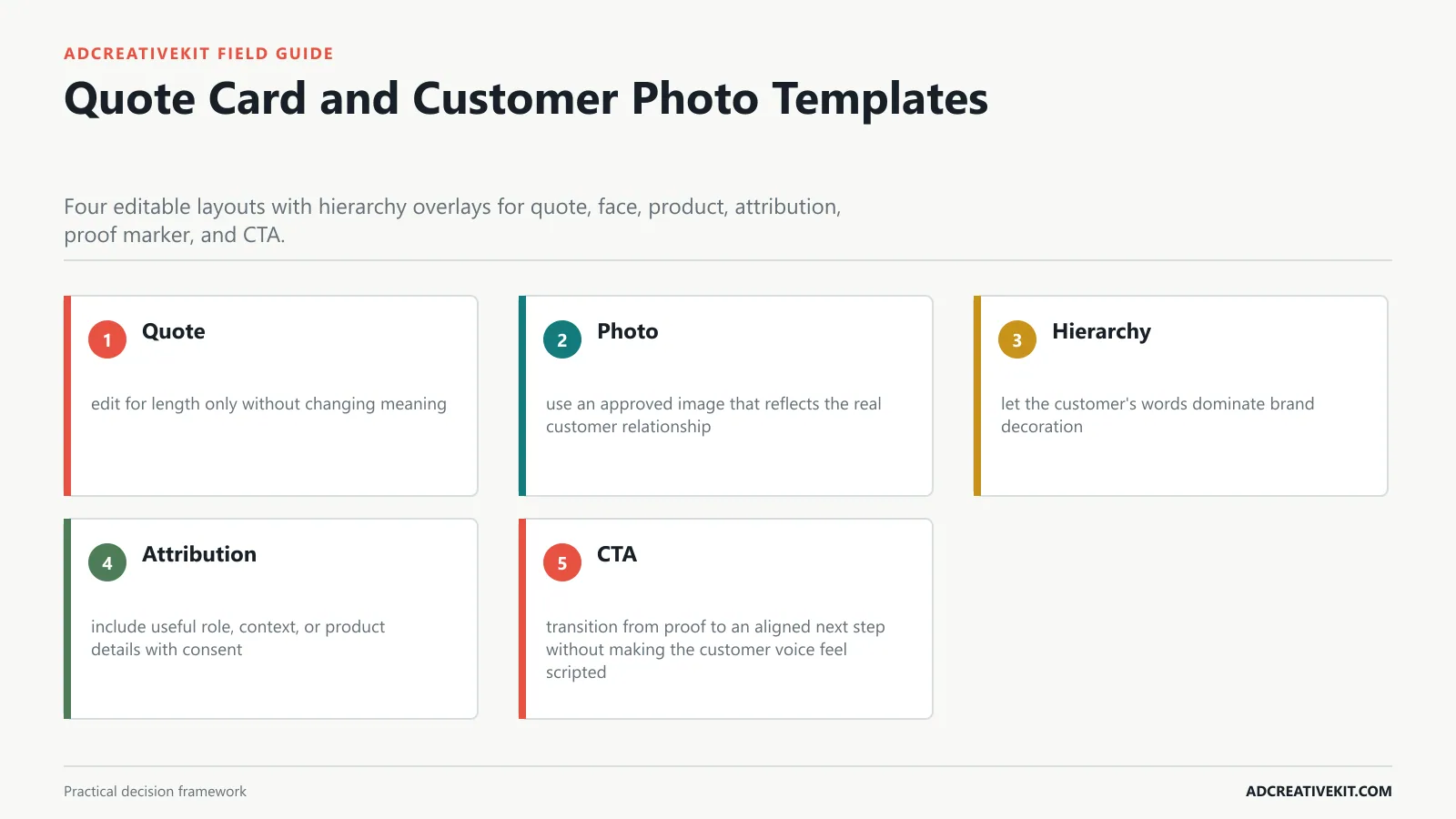
Show clean static compositions that keep the customer’s words and attribution dominant.
Quote integrity
Begin with quote: edit for length only without changing meaning. Then inspect photo: use an approved image that reflects the real customer relationship.
- Quote: edit for length only without changing meaning.
- Photo: use an approved image that reflects the real customer relationship.
- Hierarchy: let the customer’s words dominate brand decoration.
- Attribution: include useful role, context, or product details with consent.
- CTA: transition from proof to an aligned next step without making the customer voice feel scripted.
For the adjacent workflow, use the landing page graphic templates. When this section reveals a broader conversion or production issue, continue with the repeatable ad testing system.
Review Screenshot and Rating Templates
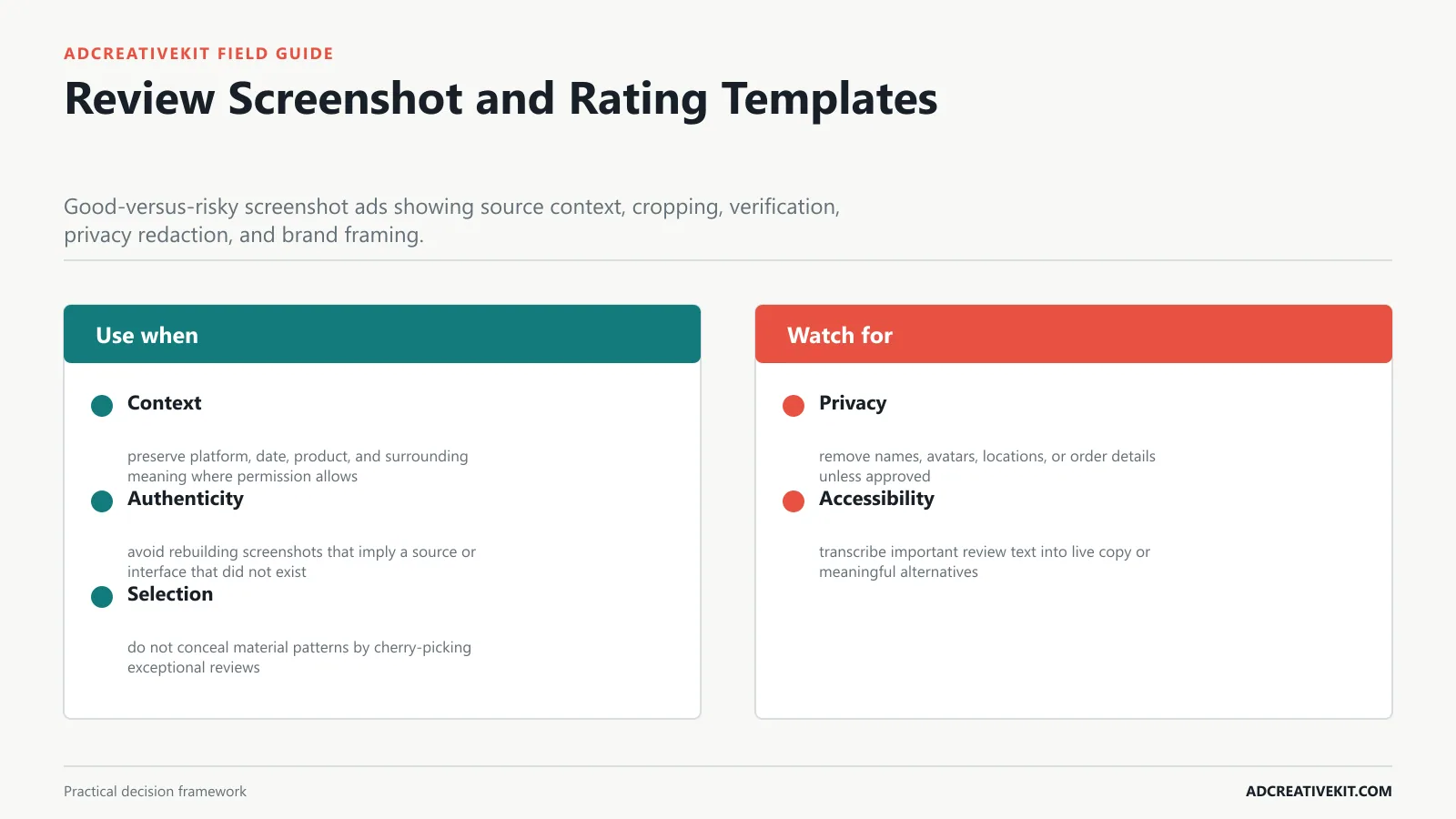
Teach when screenshots add authenticity, how to preserve context, and how to avoid fake-interface or selective-review problems.
Source integrity
Begin with context: preserve platform, date, product, and surrounding meaning where permission allows. Then inspect authenticity: avoid rebuilding screenshots that imply a source or interface that did not exist.
- Context: preserve platform, date, product, and surrounding meaning where permission allows.
- Authenticity: avoid rebuilding screenshots that imply a source or interface that did not exist.
- Selection: do not conceal material patterns by cherry-picking exceptional reviews.
- Privacy: remove names, avatars, locations, or order details unless approved.
- Accessibility: transcribe important review text into live copy or meaningful alternatives.
UGC Video and Story-Led Testimonial Templates
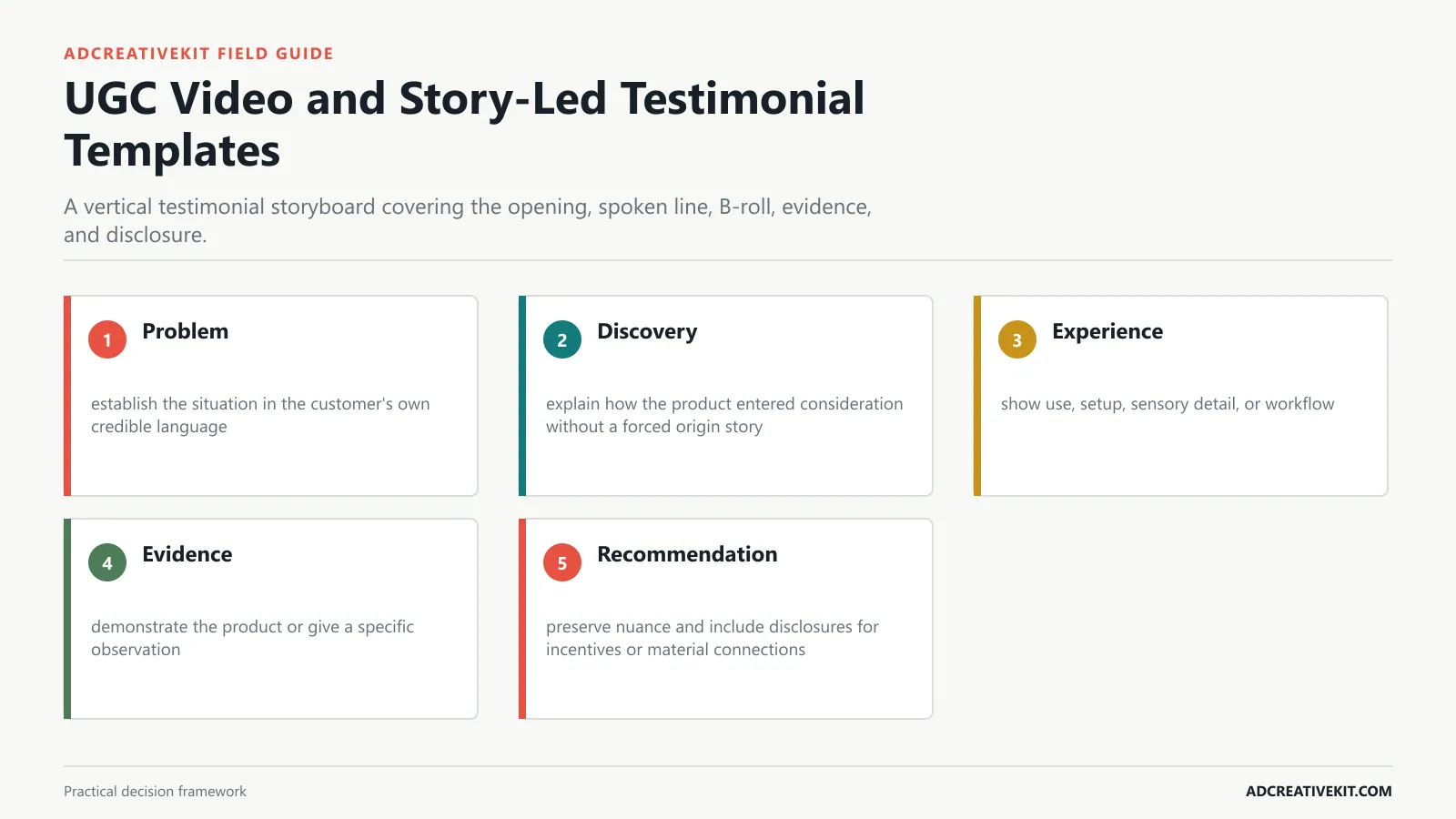
Provide narrative structures for problem, discovery, experience, evidence, objection, and recommendation.
Story structure
Begin with problem: establish the situation in the customer’s own credible language. Then inspect discovery: explain how the product entered consideration without a forced origin story.
- Problem: establish the situation in the customer’s own credible language.
- Discovery: explain how the product entered consideration without a forced origin story.
- Experience: show use, setup, sensory detail, or workflow.
- Evidence: demonstrate the product or give a specific observation.
- Recommendation: preserve nuance and include disclosures for incentives or material connections.
Transformation and Outcome Templates
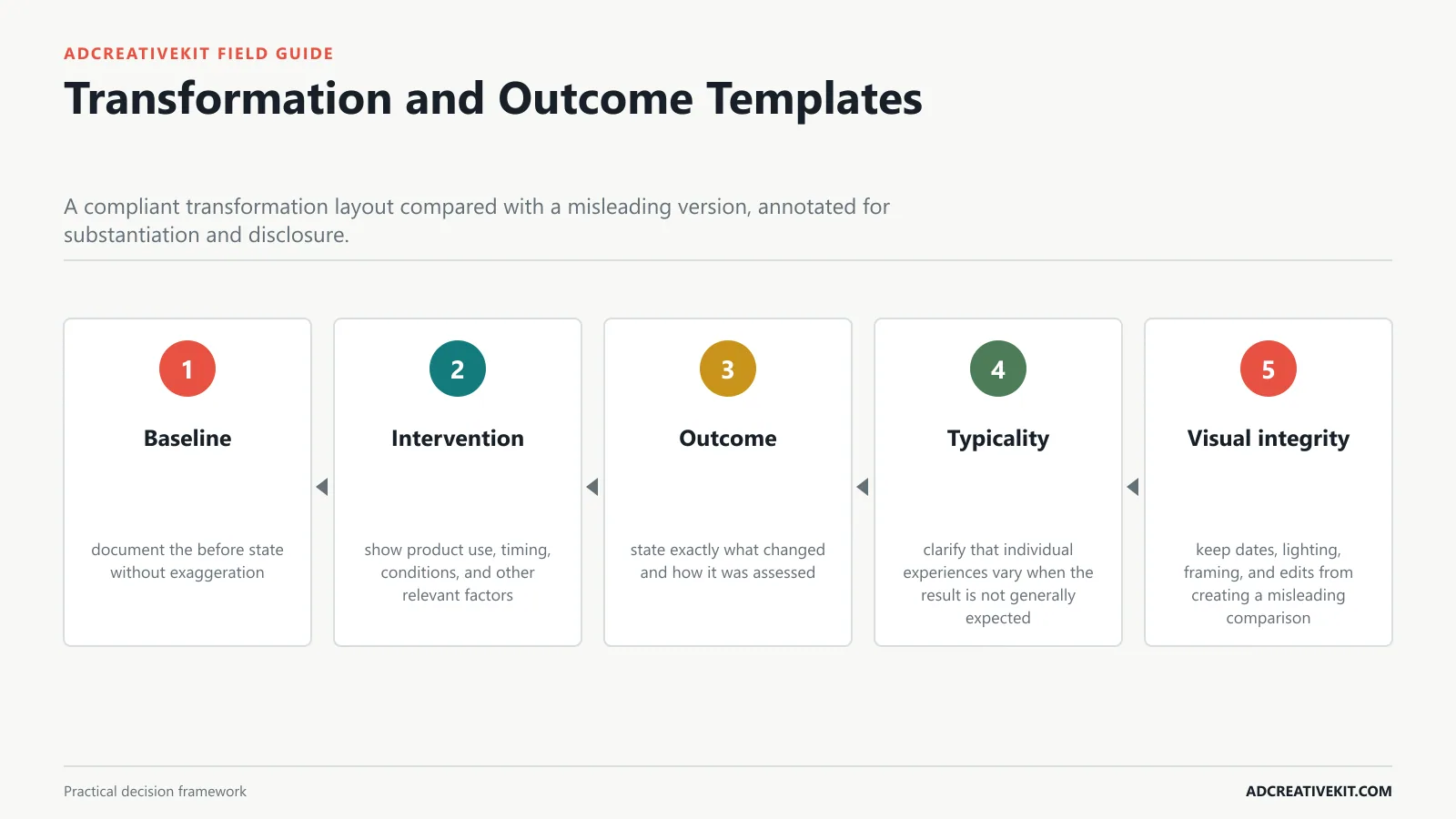
Handle measurable results and before-and-after formats with evidence, typicality context, and appropriate disclosure.
Outcome integrity
Begin with baseline: document the before state without exaggeration. Then inspect intervention: show product use, timing, conditions, and other relevant factors.
- Baseline: document the before state without exaggeration.
- Intervention: show product use, timing, conditions, and other relevant factors.
- Outcome: state exactly what changed and how it was assessed.
- Typicality: clarify that individual experiences vary when the result is not generally expected.
- Visual integrity: keep dates, lighting, framing, and edits from creating a misleading comparison.
For the adjacent workflow, use the Facebook creative review checklist. When this section reveals a broader conversion or production issue, continue with the landing page graphic templates.
Collect Better Testimonials and Permissions
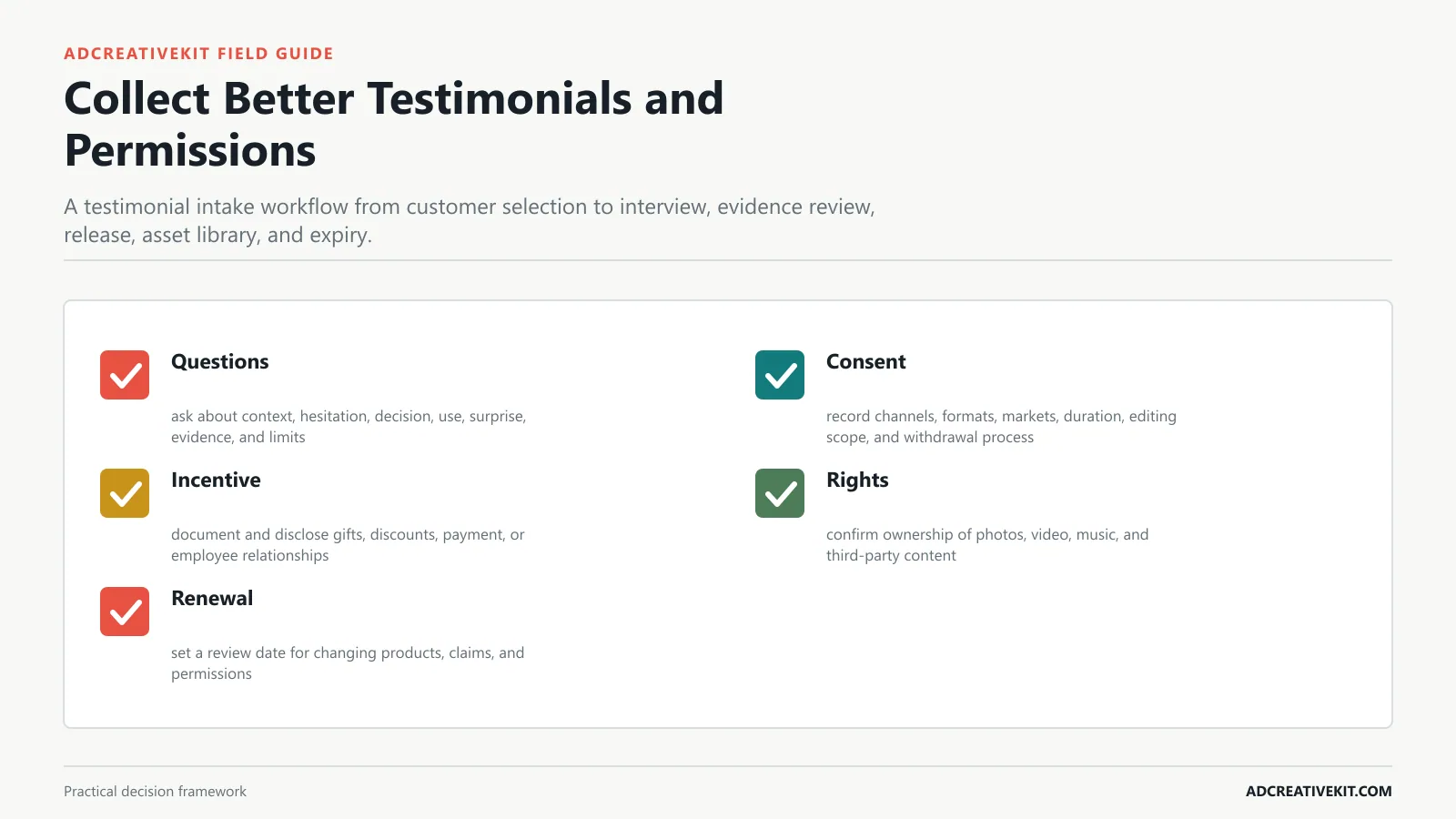
Supply interview questions, consent fields, usage scope, incentive disclosure, asset rights, and renewal dates.
Permission record
Begin with questions: ask about context, hesitation, decision, use, surprise, evidence, and limits. Then inspect consent: record channels, formats, markets, duration, editing scope, and withdrawal process.
- Questions: ask about context, hesitation, decision, use, surprise, evidence, and limits.
- Consent: record channels, formats, markets, duration, editing scope, and withdrawal process.
- Incentive: document and disclose gifts, discounts, payment, or employee relationships.
- Rights: confirm ownership of photos, video, music, and third-party content.
- Renewal: set a review date for changing products, claims, and permissions.
Adapt One Customer Story Across the Funnel
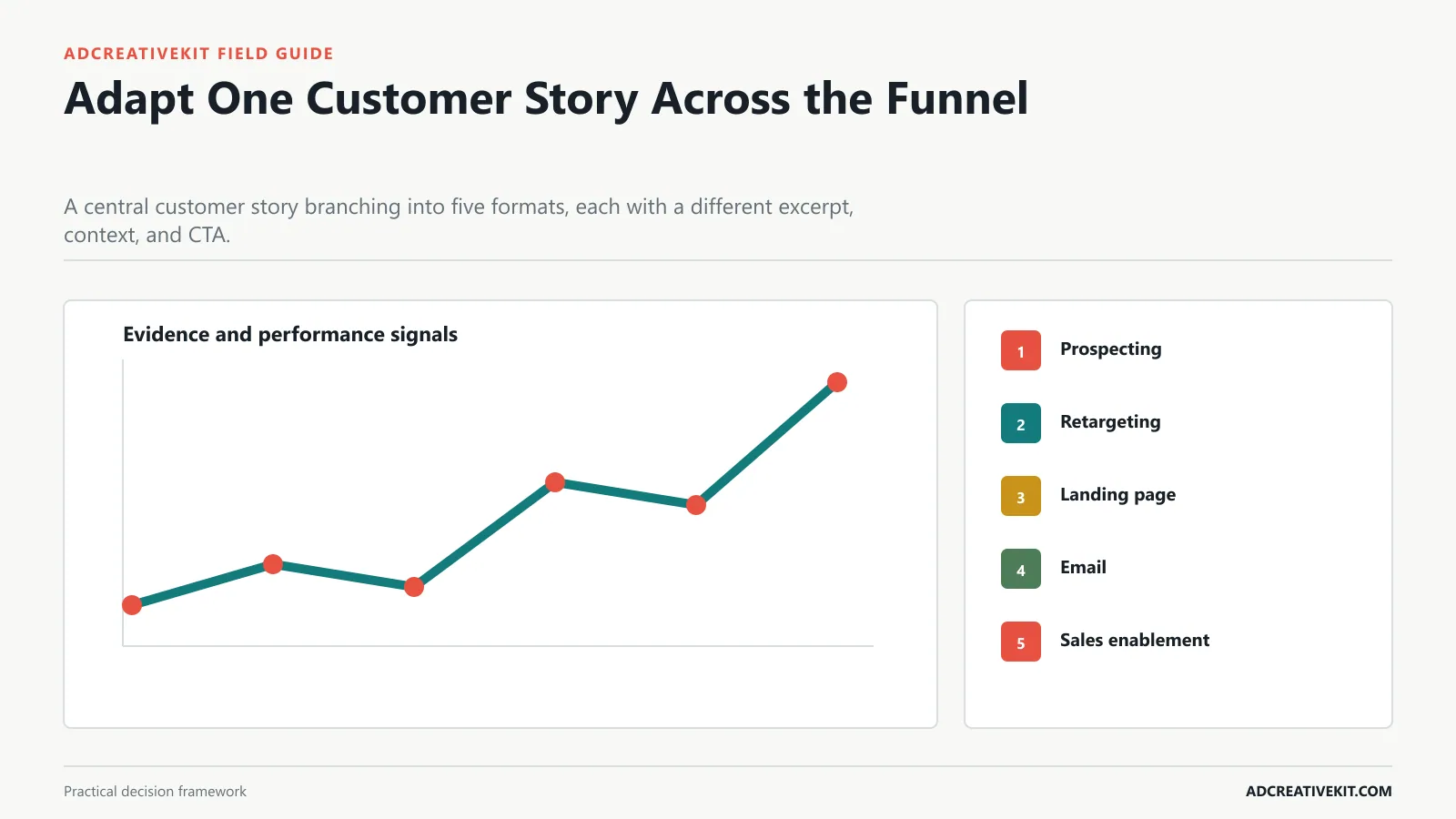
Repurpose one verified story into prospecting, retargeting, landing-page, email, and sales-enablement assets.
Funnel adaptation
Begin with prospecting: use the problem and recognizable customer context. Then inspect retargeting: use specific objection resolution and product evidence.
- Prospecting: use the problem and recognizable customer context.
- Retargeting: use specific objection resolution and product evidence.
- Landing page: expand the story beside the relevant claim.
- Email: use a concise proof module linked to fuller context.
- Sales enablement: preserve nuance and make the source easy to verify internally.
For implementation details, consult FTC Consumer Reviews and Testimonials Rule Q&A. Requirements and platform behavior change, so review the current primary documentation before launch rather than relying on a static checklist alone.
Test the Proof, Not Just the Decoration
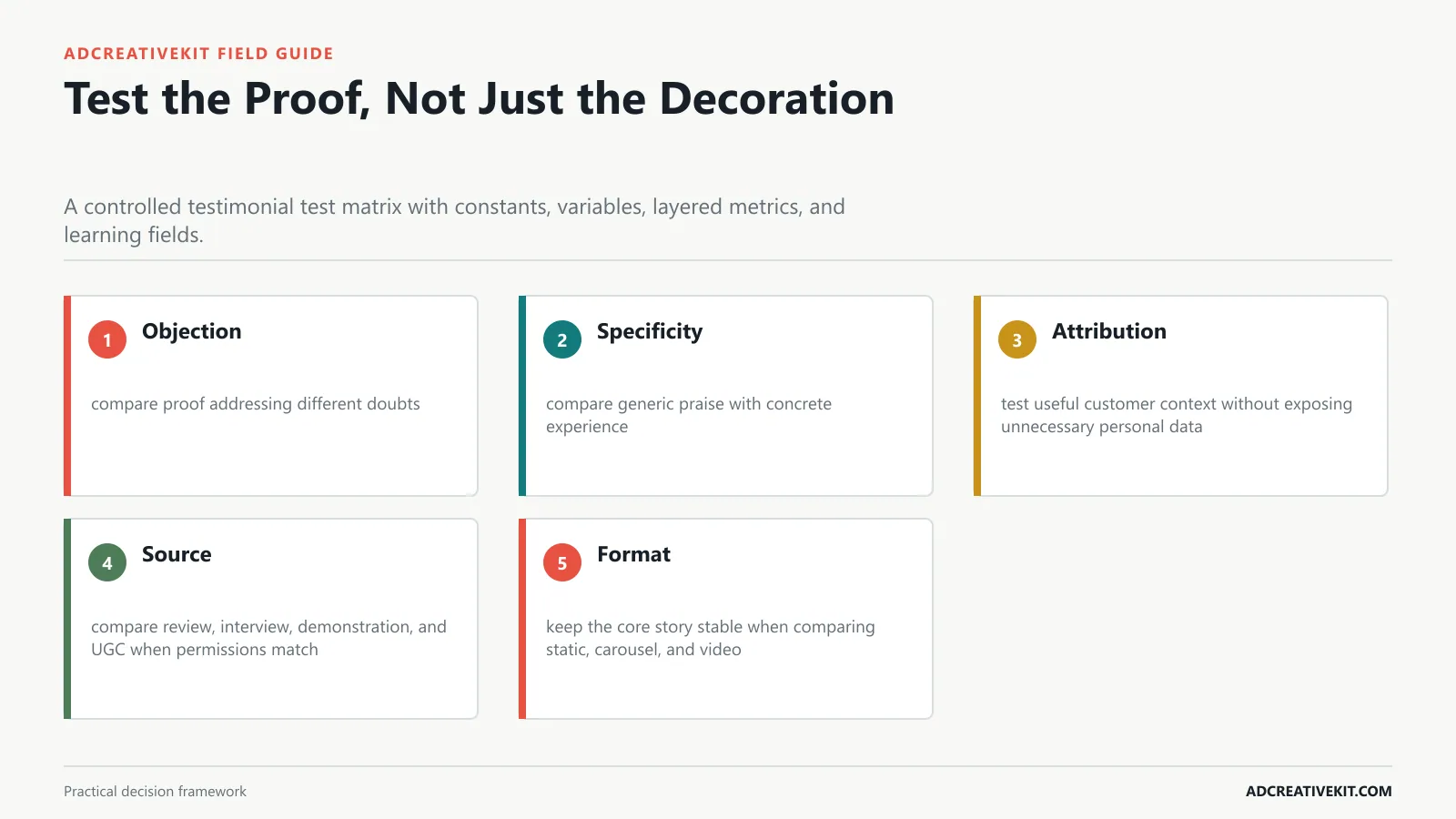
Define tests for objection, quote specificity, attribution, proof source, customer identity, format, and offer while preserving interpretability.
Proof experiment
Begin with objection: compare proof addressing different doubts. Then inspect specificity: compare generic praise with concrete experience.
- Objection: compare proof addressing different doubts.
- Specificity: compare generic praise with concrete experience.
- Attribution: test useful customer context without exposing unnecessary personal data.
- Source: compare review, interview, demonstration, and UGC when permissions match.
- Format: keep the core story stable when comparing static, carousel, and video.
| Proof experiment element | Practical requirement | Review question |
|---|---|---|
| Objection | compare proof addressing different doubts | Record the observable evidence, any failure, and the owner of the next action. |
| Specificity | compare generic praise with concrete experience | Record the observable evidence, any failure, and the owner of the next action. |
| Attribution | test useful customer context without exposing unnecessary personal data | Record the observable evidence, any failure, and the owner of the next action. |
| Source | compare review, interview, demonstration, and UGC when permissions match | Record the observable evidence, any failure, and the owner of the next action. |
| Format | keep the core story stable when comparing static, carousel, and video | Record the observable evidence, any failure, and the owner of the next action. |
For the adjacent workflow, use the UGC script templates. When this section reveals a broader conversion or production issue, continue with the Facebook creative review checklist.
Prelaunch Credibility and Compliance Checklist
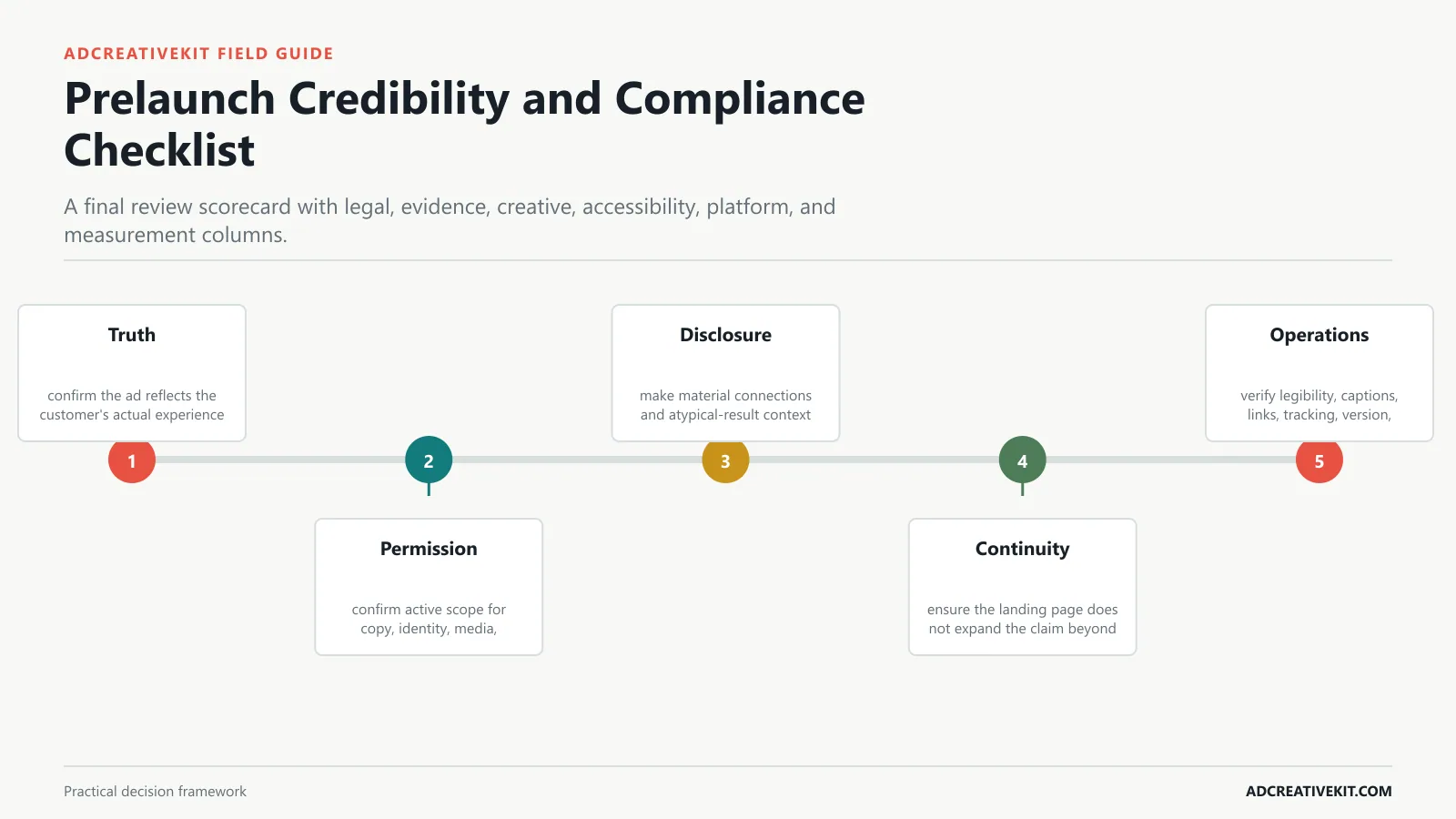
Verify truthfulness, permissions, typical-results context, material connections, legibility, landing-page continuity, and tracking.
Credibility gate
Begin with truth: confirm the ad reflects the customer’s actual experience. Then inspect permission: confirm active scope for copy, identity, media, edits, channels, and duration.
- Truth: confirm the ad reflects the customer’s actual experience.
- Permission: confirm active scope for copy, identity, media, edits, channels, and duration.
- Disclosure: make material connections and atypical-result context clear and proximate.
- Continuity: ensure the landing page does not expand the claim beyond the proof.
- Operations: verify legibility, captions, links, tracking, version, owner, and expiry.
Worked Example: Turn One Review Into Four Proof Assets
Suppose a verified customer explains that setup looked complicated but the first use took less effort than expected. Preserve the full original review and permission record in the library. For a static ad, use a short faithful excerpt beside the exact product. For UGC, let the customer or creator describe the initial concern, show the setup, and explain the experience without scripting a guaranteed result.
For a carousel, separate the objection, product moment, and outcome across cards while keeping enough context on each card to avoid changing the meaning. On the landing page, place the longer review beside setup instructions or onboarding reassurance. Test this proof against another genuine objection—not against a decorative color change—and judge it with downstream conversion quality, complaint signals, refund patterns, and customer retention as well as initial attention.
Frequently asked questions
Evidence boundary: The layouts in this guide are editorial patterns, not customer results. Use only genuine testimonials you are permitted to publish, preserve the reviewer’s meaning, disclose material incentives or relationships, and keep documentation linking each displayed claim to its source and approved version.
Can a brand shorten a customer testimonial?
Yes, with permission and only when the edit preserves the customer’s meaning and does not remove context that would make the claim misleading.
Do incentivized reviews need disclosure?
Material connections that could affect how people evaluate an endorsement should be disclosed clearly and conspicuously.
Are review screenshots stronger than designed quote cards?
They can add source context, but only when authentic, permissioned, privacy-safe, readable, and not presented through a fabricated interface.
Turn this guide into an operating asset
Save the framework with the evidence, owner, date, and decision attached. That turns a one-time article into a repeatable review system and prevents future teams from treating an old output as a universal rule.