Landing Page Optimization: Diagnose, Prioritize, and Test What Matters
Landing page optimization is not the practice of changing button colors until conversion rate moves. It is a disciplined process for finding why a specific audience is not taking a specific action, improving the weakest part of that experience, and measuring whether the change produced a better business outcome.
This guide shows you how to optimize a landing page from first diagnosis to final decision. You will learn how to separate traffic problems from page problems, match the page to the campaign, audit every important page element, choose useful evidence, prioritize fixes, and run a practical 30-day optimization cycle.
Quick answer: First define one conversion goal. Then segment performance by traffic source and device, compare the ad promise with the landing page, inspect the page for clarity and friction, and rank changes by evidence, impact, and effort. Fix defects directly. Test uncertain ideas. Measure both conversion volume and conversion quality.
What Is Landing Page Optimization?
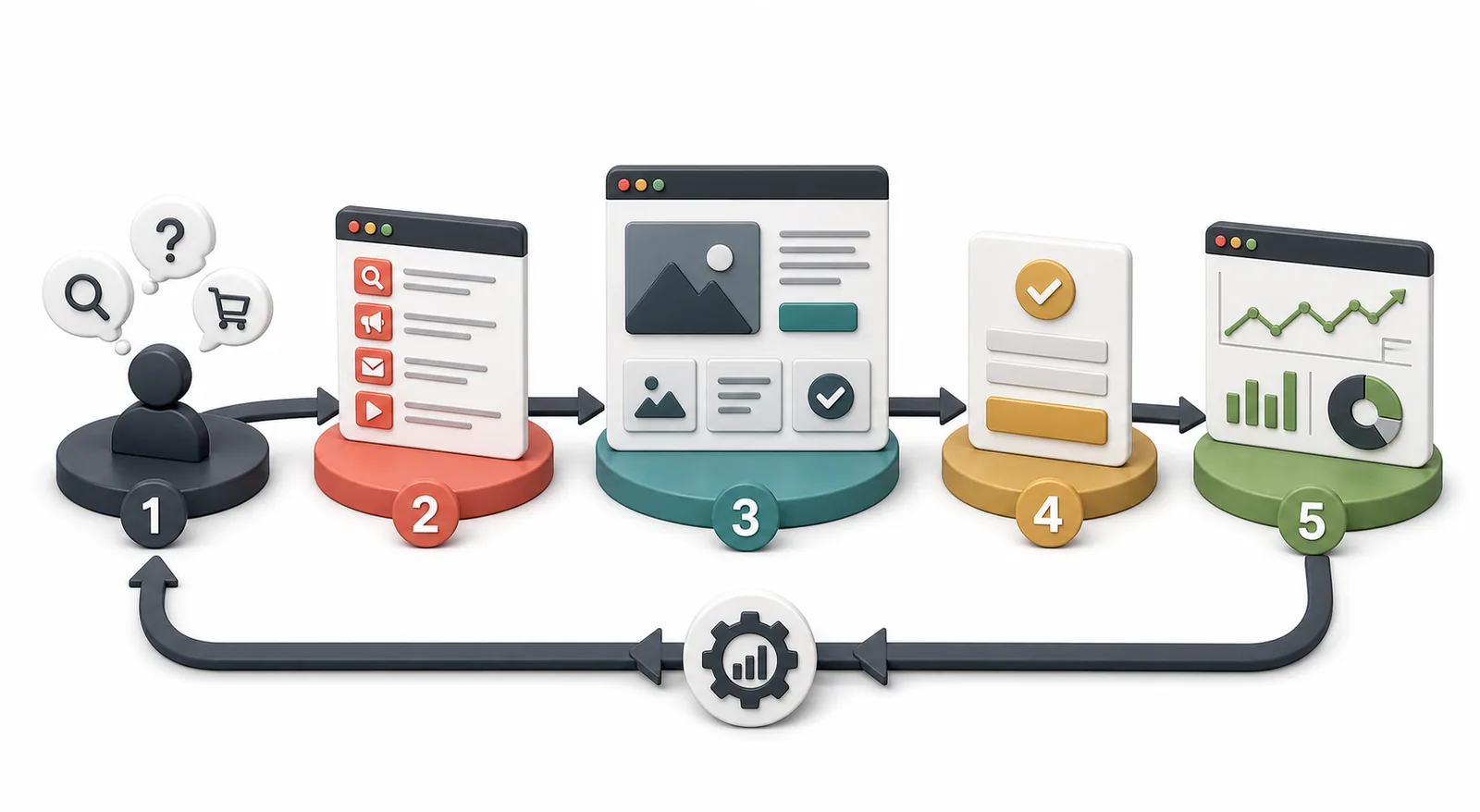
Landing page optimization, often shortened to LPO, is the ongoing process of improving a landing page so more of the right visitors complete its intended action. That action may be purchasing a product, requesting a demo, booking a consultation, registering for a webinar, starting a trial, or downloading a resource.
LPO is a focused part of conversion rate optimization. CRO can cover an entire website and customer journey. Landing page optimization concentrates on the first page in a session or a dedicated campaign destination and the transition that follows it.
Google Analytics defines a landing page as the first page a person sees during a website session. In marketing practice, the phrase often means a page created for one campaign, audience, or offer. Both meanings matter: a blog post or product page can become a landing page when it receives search, email, social, or advertising traffic.
A complete optimization process has four parts:
- Diagnosis: Determine where and why the journey is underperforming.
- Prioritization: Decide which problem is most valuable to address.
- Intervention: Fix a defect or test a credible hypothesis.
- Measurement: Evaluate conversion volume, quality, revenue, and guardrails.
The page is never optimized for everyone. It is optimized for a defined visitor, source, level of awareness, offer, device, and desired action. A concise page can be ideal for branded paid traffic and inadequate for an organic visitor comparing unfamiliar solutions.
Diagnose the Real Landing Page Problem Before Editing
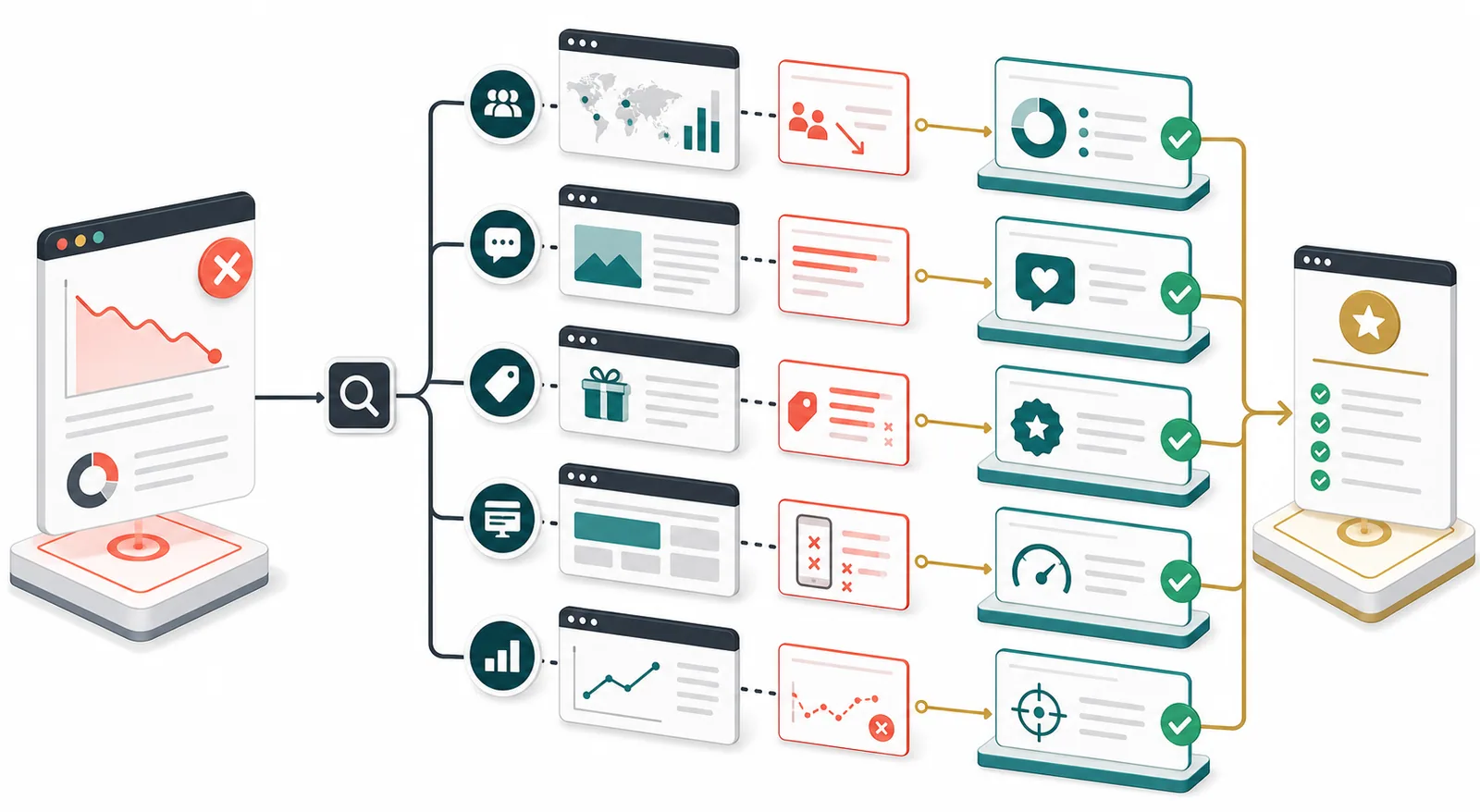
A low conversion rate does not automatically mean the landing page design is weak. The page may be receiving irrelevant traffic, presenting an unattractive offer, loading incorrectly, recording conversions inaccurately, or creating friction after the CTA click.
Use five diagnostic layers:
- Traffic: Are the visitors relevant, and what expectation brought them here?
- Message: Does the page immediately continue the promise that earned the click?
- Offer: Is the outcome valuable, credible, and appropriate for the visitor’s awareness?
- Experience: Can the visitor understand and complete the action without preventable friction?
- Measurement: Are the conversion event, attribution, and downstream result accurate?
| Observed symptom | Possible causes | Evidence to inspect first |
|---|---|---|
| Many visits, very few CTA clicks | Weak message match, unclear value proposition, irrelevant traffic, low offer credibility. | Campaign and keyword breakdown, five-second test, click map, customer interviews. |
| CTA clicks, few form starts | Form feels demanding, CTA expectation differs from form request, technical loading problem. | Form-view event, recordings, device errors, copy immediately above the form. |
| Many form starts, few completions | Too many fields, unclear errors, sensitive questions, mobile keyboard friction, CAPTCHA problems. | Field-level abandonment, error logs, recordings, mobile test submission. |
| Good conversion rate, weak lead quality | Offer attracts the wrong audience, copy overpromises, form does not qualify, campaign targeting is broad. | CRM outcomes by source, sales feedback, qualified-lead rate, close rate. |
| Desktop performs well, mobile performs poorly | Slow load, obscured CTA, small tap targets, long form, layout shift, difficult keyboard interaction. | Device segmentation, Core Web Vitals, mobile recordings, real-device QA. |
| Performance dropped suddenly | Tracking change, campaign mix change, broken integration, page release, seasonality, offer expiration. | Release log, analytics annotations, source mix, tag diagnostics, test conversion. |
Write the diagnosis as a falsifiable statement: “Paid-social visitors are not starting the form because the page changes from a free-audit promise to a sales-call request.” That is more useful than “the hero needs improvement” because it tells you what to verify.
For a broader store audit, use the 300+ point ecommerce CRO checklist. It helps separate landing-page friction from product, cart, checkout, and sitewide issues.
Set the Goal, Baseline, and Landing Page Type
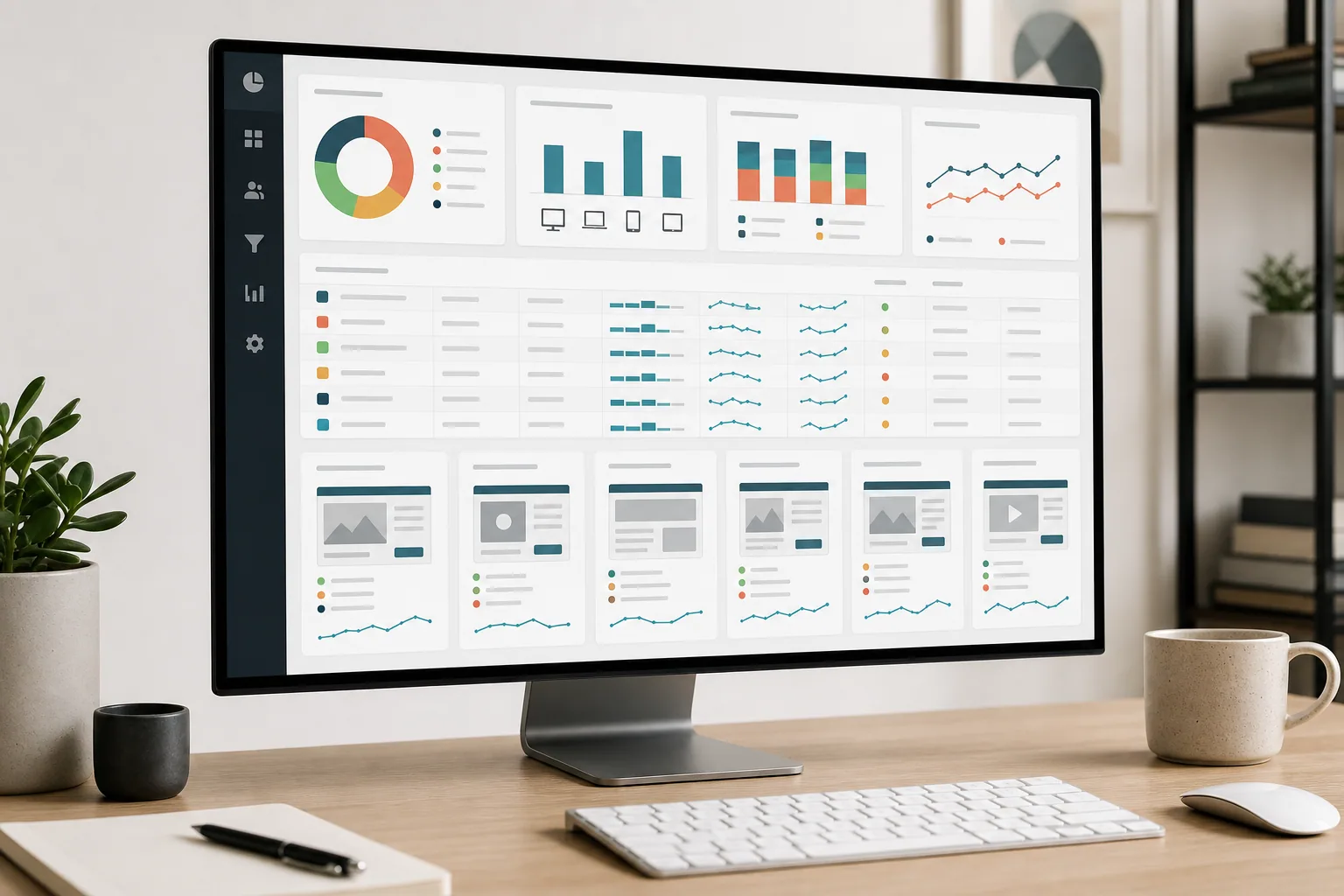
Optimization requires a precise conversion definition. “Engagement” is too broad. “Completed demo request from a target account,” “purchase with positive contribution margin,” or “webinar registration that attends” gives the team a usable outcome.
Before changing the page, record:
- Sessions and unique users
- Primary conversions and conversion rate
- CTA clicks or form starts
- Form completion rate
- Revenue or pipeline value where applicable
- Qualified-lead rate, attendance, activation, refund, or cancellation rate
- Performance by source, campaign, device, geography, and new versus returning visitor
The GA4 Landing Page report can show sessions, users, key events, revenue, and source/medium for each entry page. Use it to find meaningful volume and segment differences rather than comparing unrelated pages by one blended conversion rate.
Different landing page types need different rules
| Page type | Primary job | Optimization emphasis |
|---|---|---|
| Paid lead-generation page | Convert a known campaign promise into a qualified inquiry. | Message match, form value exchange, qualification, speed, tracking. |
| Ecommerce campaign page | Move a targeted visitor toward product selection or purchase. | Offer clarity, product proof, price, variants, shipping, CTA continuity. |
| SaaS demo or trial page | Make the next commitment credible and appropriate. | Use case, differentiation, proof, qualification, scheduling or signup friction. |
| Webinar or lead-magnet page | Exchange useful content for contact information. | Specific learning outcome, speaker or content credibility, minimal form, consent. |
| Organic SEO landing page | Satisfy a search intent and guide the visitor toward a relevant next action. | Search completeness, helpful content, internal navigation, trust, non-disruptive CTA. |
This is why “remove all navigation” is not a universal rule. A focused paid page may benefit from fewer exits. An SEO landing page often needs useful internal paths and enough content to satisfy informational intent. Optimize for the visitor’s task, not for checklist conformity.
Match the Landing Page to the Ad, Email, or Search Intent
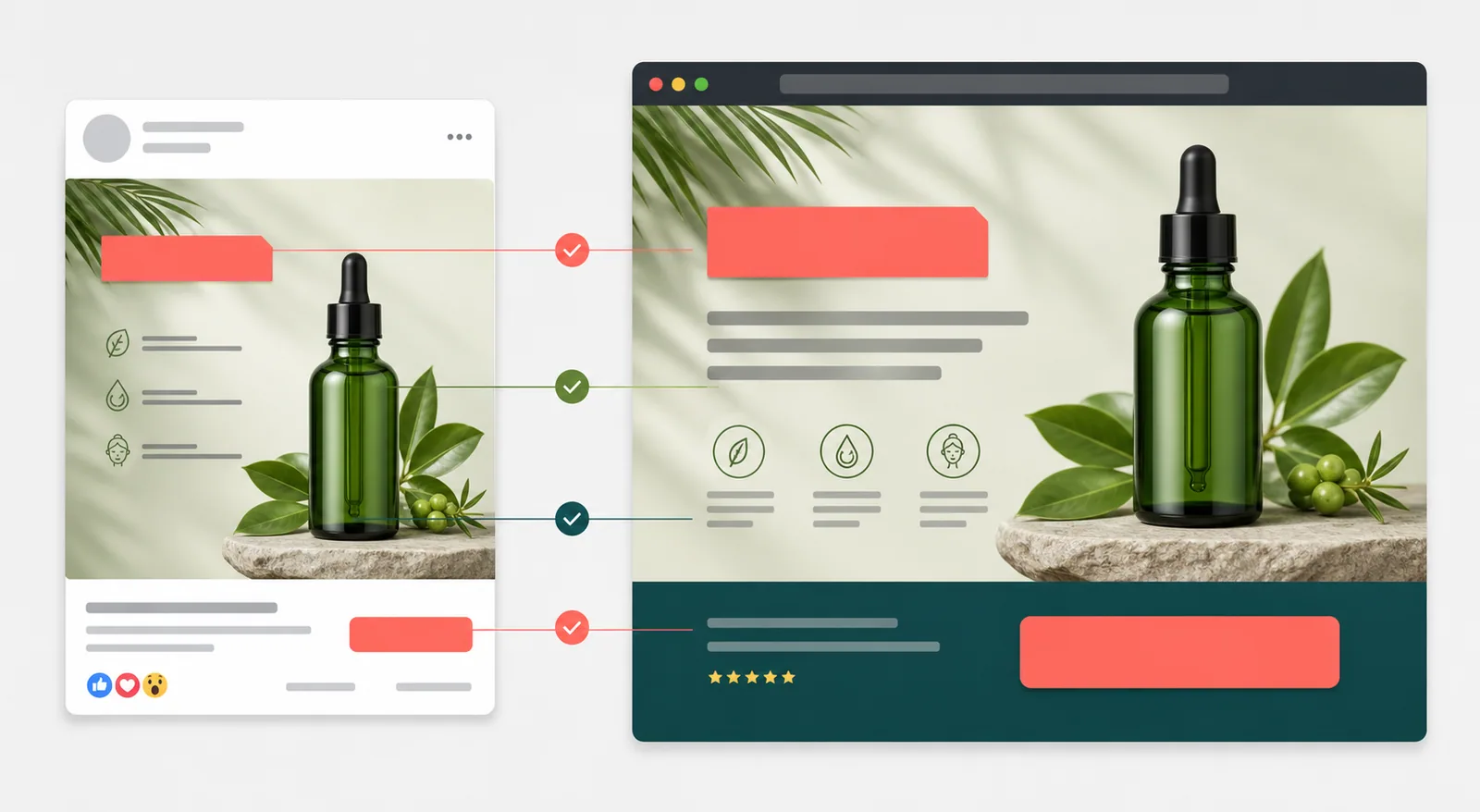
Message match is the continuity between the source of a click and the destination page. Visitors should not need to determine whether they reached the correct place.
Google Ads landing-page guidance describes the experience through relevance, usefulness, navigation, and whether the page meets expectations created by the ad. It specifically recommends matching the landing page to the ad, keywords, offer, and CTA. That alignment supports both customer confidence and campaign efficiency.
| Source promise | Landing-page requirement | Common mismatch |
|---|---|---|
| Specific product or use case | Show the same product or use case immediately. | Sending traffic to the homepage or a broad catalog. |
| Discount, bundle, or trial | Repeat the exact offer and its honest conditions. | Promotion missing, changed, or explained only after form submission. |
| Outcome or benefit | Use the same core benefit in the headline and opening proof. | Ad promises an outcome while the page leads with company features. |
| Visual demonstration | Preserve the recognizable product, person, scenario, or creative concept. | The destination looks like an unrelated campaign. |
| CTA | Continue the commitment level and action. | “Get the checklist” becomes “Book a sales call.” |
Create a simple campaign matrix with columns for audience, source, creative, promise, offer, landing URL, CTA, and conversion event. Review high-spend campaigns and high-impression search queries first.
Connect this review to your Facebook ad creative review checklist and repeatable ad testing system. A landing-page test is difficult to interpret when the ad and page are solving different problems.
Optimize the Landing Page Anatomy in Decision Order
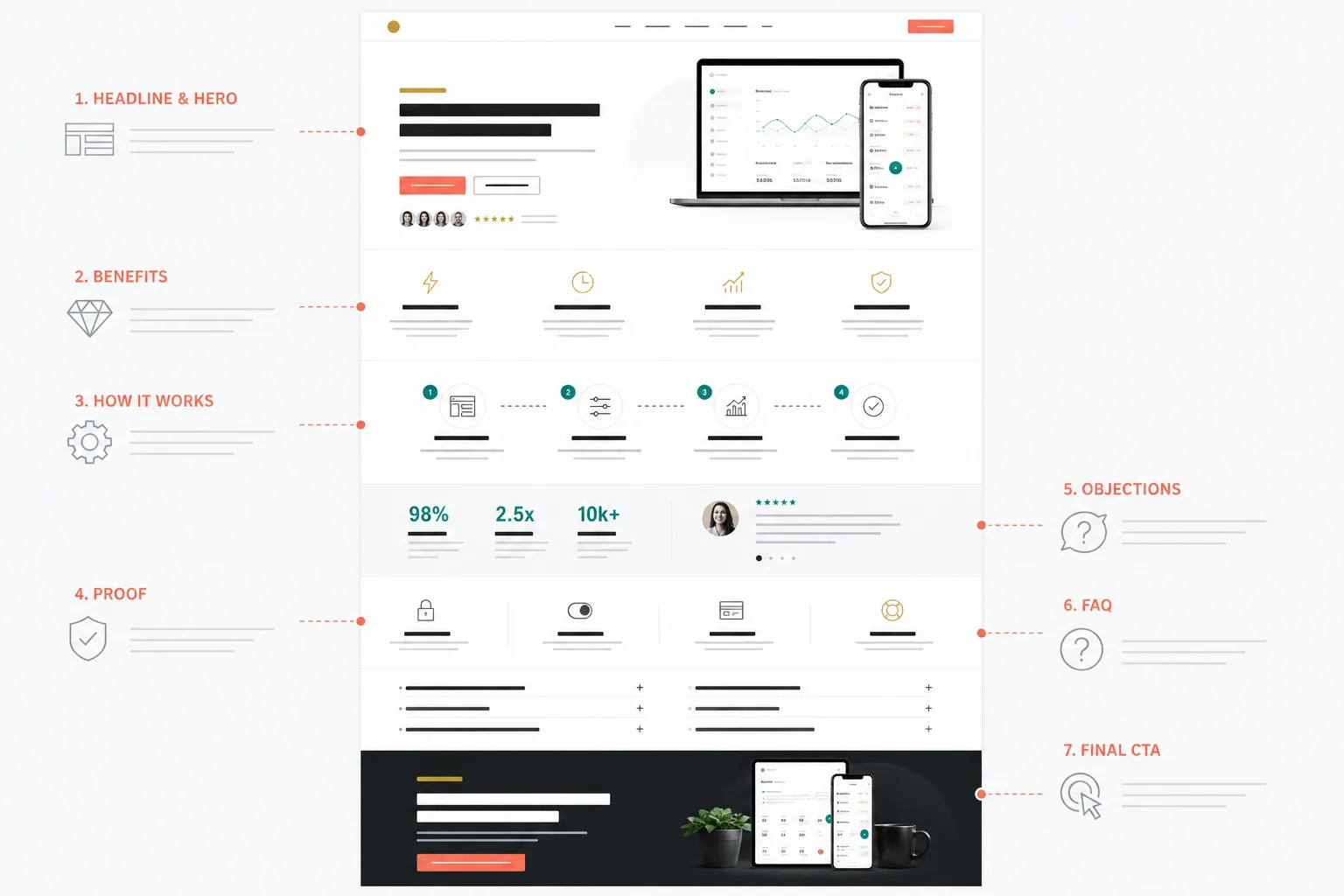
A landing page should not be assembled from a rigid block template. It should answer the visitor’s decision questions in a logical sequence: What is this? Is it relevant to me? Why should I believe it? What will happen? What does it cost me? What risk remains? What should I do next?
1. Headline and opening promise
Use the language of the campaign and customer problem. A clear headline normally identifies the outcome, category, use case, or audience. Avoid clever copy that requires interpretation. The supporting text can explain mechanism, differentiation, or qualification.
2. Hero visual or demonstration
Show the actual product, result, interface, service context, or deliverable. The visual should help the visitor inspect the offer, not merely create atmosphere. For digital products, screenshots and short demonstrations are often stronger than generic lifestyle imagery.
3. Primary CTA
The CTA should describe a meaningful next step and match the commitment created upstream. “Get the 30-page checklist” is clearer than “Submit.” Repeat the same primary action after major proof or objection sections on a longer page rather than inventing competing goals.
4. Benefits and mechanism
Explain the outcome and why the offer can produce it. Features matter when they make the mechanism credible. Translate each important capability into what it changes for the visitor.
5. Proof close to the claim
Place relevant evidence beside the statement it supports: product screenshots beside capability claims, results beside methodology, reviews beside objections, and credentials beside expertise claims. Avoid an isolated logo wall that asks visitors to infer why the logos matter.
6. Objections and risk reversal
Answer the real reasons someone may delay: price, implementation effort, compatibility, timing, privacy, cancellation, shipping, support, or suitability. Use FAQs for genuine decision questions rather than as a place to repeat marketing copy.
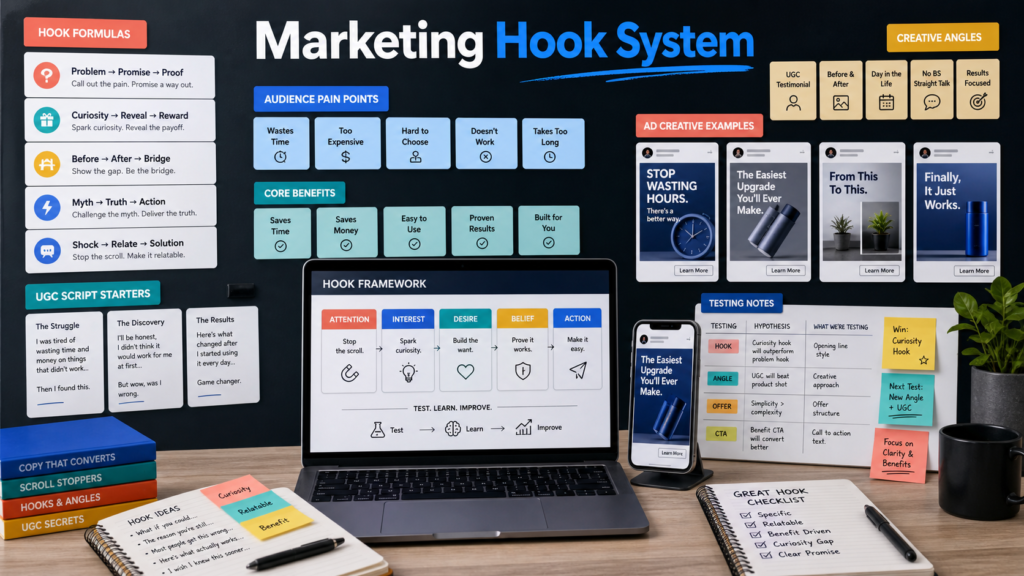
Strong hooks help visitors recognize relevance, but the page still has to substantiate them. The marketing hooks guide explains how to build attention without disconnecting the promise from the proof.
Reduce Form Friction Without Sacrificing Lead Quality or Trust
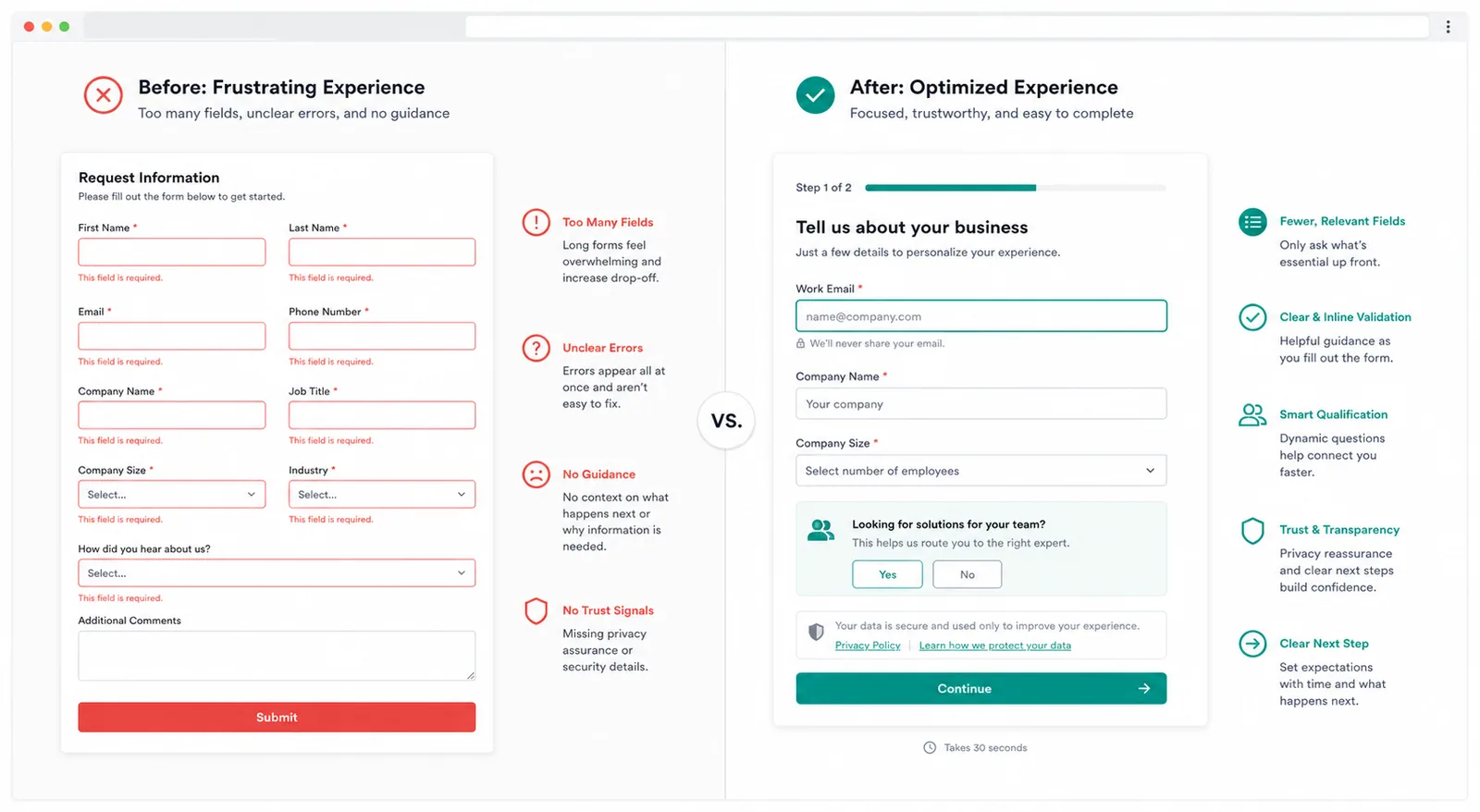
The shortest form is not automatically the best form. Removing every qualifying field can increase submissions while reducing the percentage that sales can serve. The correct form asks for the minimum information needed to deliver the promise, route the lead, and make the next interaction useful.
- Explain what the visitor receives and what happens after submission.
- Remove fields collected only from habit or internal curiosity.
- Use persistent labels instead of placeholders as the only field name.
- Match keyboard type and autofill attributes to the requested information.
- Validate fields clearly and preserve completed information after errors.
- Explain why sensitive information is necessary.
- Place consent and privacy language where it is readable without overwhelming the action.
- Test the complete delivery, scheduling, CRM, email, and thank-you flow.
For a high-value service, a multi-step form may make the process easier to scan and support conditional qualification. For a simple download, one or two fields may be sufficient. Evaluate completion rate together with qualified-lead rate, cost per qualified lead, meeting attendance, or downstream revenue.
The W3C’s accessible forms guidance recommends explicit labels, useful instructions, understandable validation, and asking only for information needed to complete the process. For ecommerce journeys, Baymard’s checkout usability research provides additional evidence-based patterns for reducing form and checkout friction.
Trust must be specific
Generic badges do not repair an unbelievable offer. Use verifiable reviews, named customer context with permission, clear company information, accurate policies, realistic screenshots, honest limitations, and support details. Do not manufacture scarcity, review counts, client logos, or countdown timers.
A secondary action can be useful when it supports the same decision, such as viewing pricing details before requesting a demo. It should remain visually subordinate and should not create an unrelated escape route.
Optimize Mobile Performance and Accessibility as Conversion Requirements
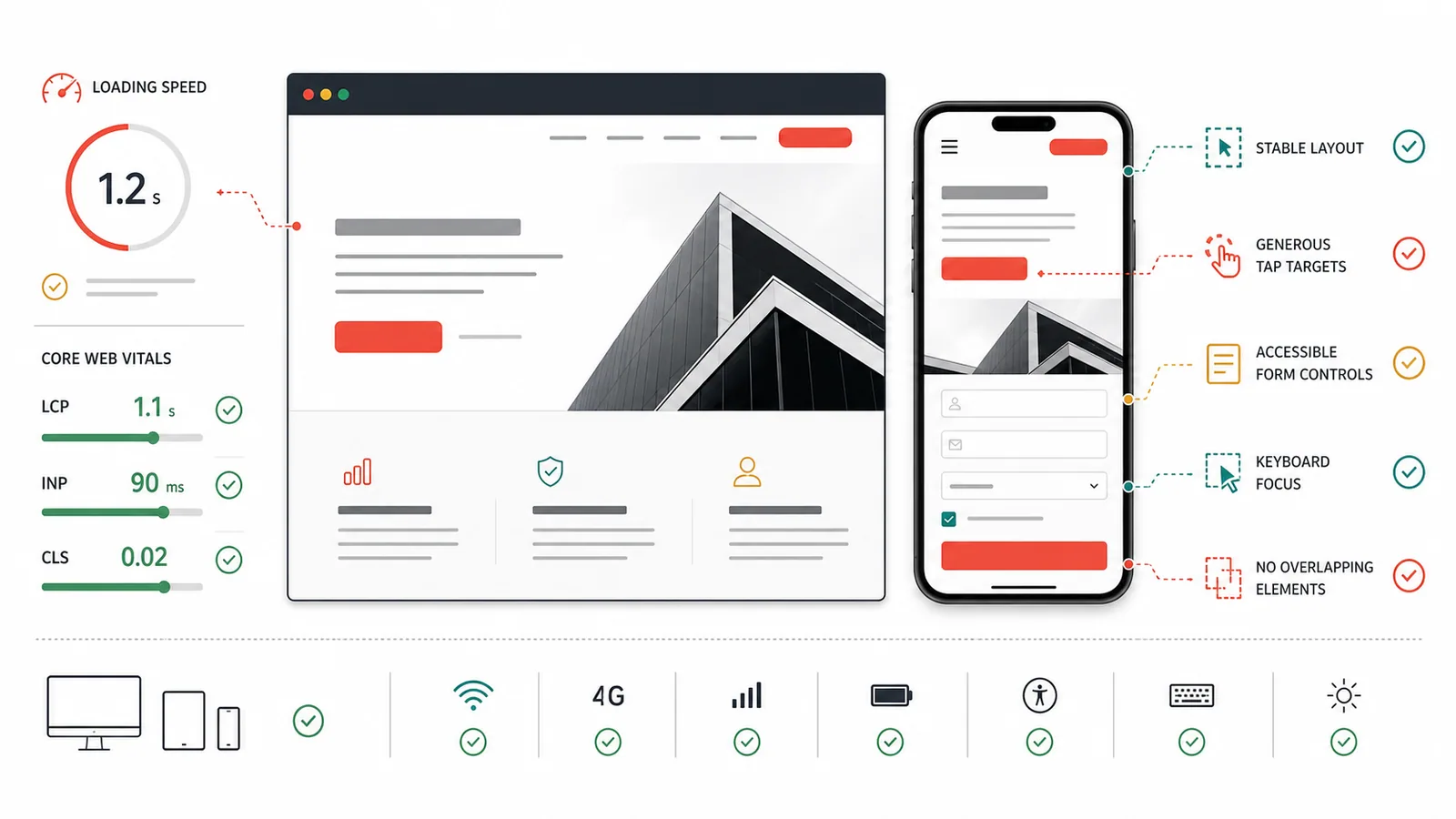
Responsive layout is only the beginning. A page can fit a phone screen and remain difficult to use because its CTA is covered, the form triggers the wrong keyboard, images delay the main content, consent banners consume the viewport, or elements move while the visitor tries to tap.
Google’s current Core Web Vitals measure loading through LCP, interaction responsiveness through INP, and visual stability through CLS. Use field data at the 75th percentile, segmented by device, rather than treating one laboratory score as the whole experience.
Mobile landing-page QA
- Load the page over a realistic mobile connection.
- Confirm that the primary promise and action are identifiable without precise zooming.
- Check tap targets, sticky elements, cookie banners, chat widgets, and browser controls for overlap.
- Complete the form using only the touchscreen and on-screen keyboard.
- Test validation, rotation, autofill, back navigation, and interrupted sessions.
- Use compressed, properly sized modern image formats and reserve image dimensions to prevent layout shifts.
- Delay nonessential scripts and remove unused third-party tools.
- Verify keyboard navigation, visible focus, labels, contrast, zoom, and screen-reader names.
Performance work should protect the message. Removing the product demonstration to improve a score may make the page faster and less persuasive. Optimize delivery first: responsive images, font loading, script cost, caching, and component stability.
Prioritize Landing Page Fixes Before Building Variants
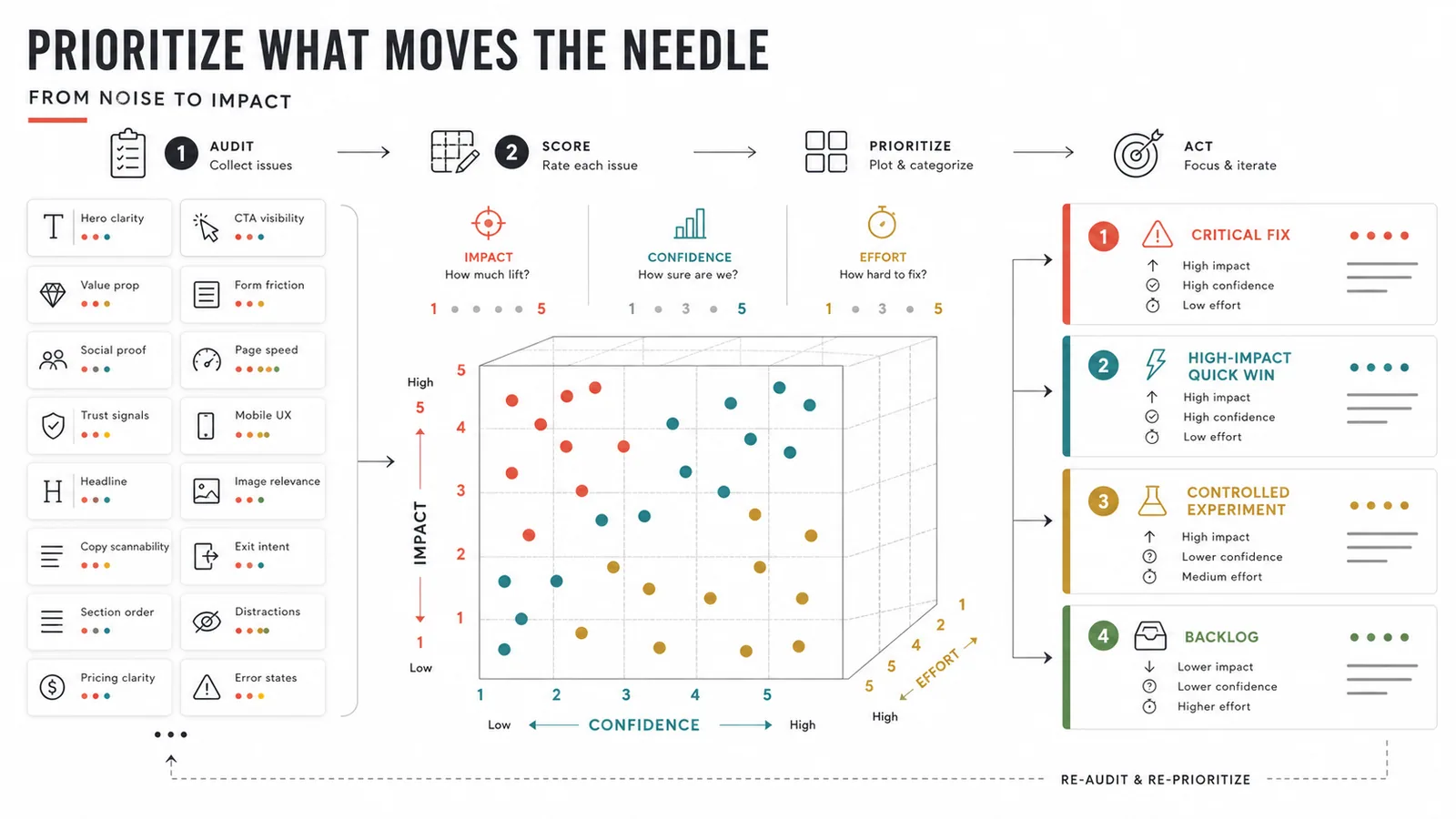
A landing-page audit can produce dozens of observations. The team needs a decision system, not a longer backlog. Rank each item using evidence, reach, business impact, confidence, effort, and proximity to the conversion.
| Priority | When to use it | Examples |
|---|---|---|
| P0: Fix now | The journey or measurement is broken. | Form does not submit, conversion event fires twice, mobile CTA is blocked, expired offer. |
| P1: High | Strong evidence, meaningful reach, and close connection to conversion. | Ad/page mismatch on the highest-spend campaign, confusing price, repeated form error. |
| P2: Experiment | There is a credible hypothesis but more than one reasonable solution. | Alternative value proposition, proof order, form structure, offer framing. |
| P3: Backlog | Low evidence, low reach, cosmetic impact, or dependency on other work. | Decorative animation, minor icon change, speculative personalization. |
Fix defects without waiting for an A/B test. Test uncertain strategic choices. Research problems that remain poorly understood. Remove ideas that do not support the page goal.
Document each P1 or P2 item with: observed evidence, affected segment, proposed change, expected behavior, primary metric, guardrail, owner, and decision date. The ad testing matrix template provides a useful model for controlling variables and recording decisions.
Test and Validate Without Fooling Yourself
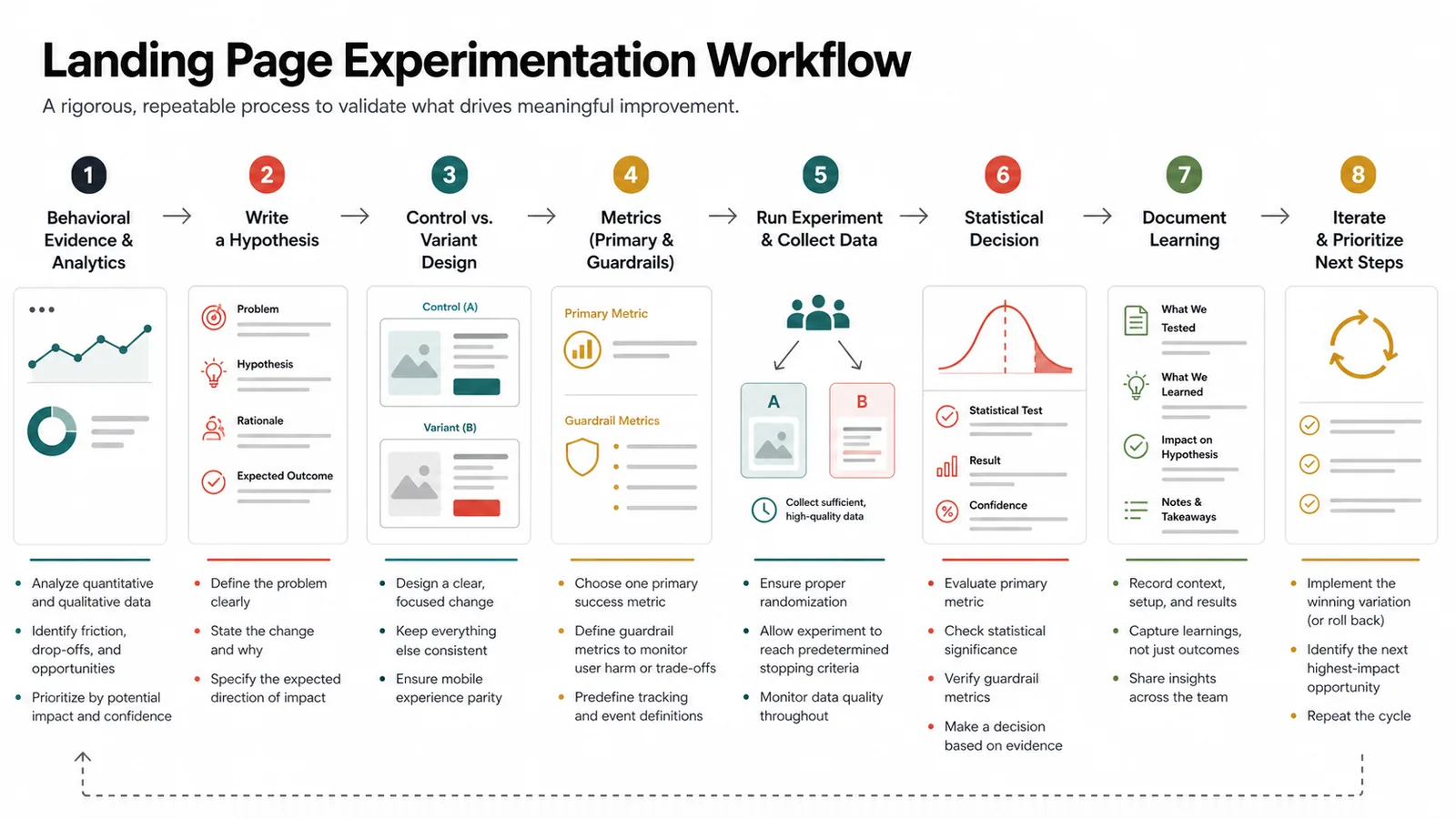
A/B testing is one method inside landing page optimization, not the definition of it. A test compares controlled experiences to reduce uncertainty. It cannot rescue a weak offer, repair unreliable analytics, or explain a result that was never connected to a hypothesis.
Write a complete hypothesis
Because we observed [evidence] among [segment], we believe changing [specific experience] will improve [behavior and primary metric]. We will protect [guardrail] and decide by [rule and date].
Example: “Because paid-search visitors repeatedly open pricing before requesting a demo, we believe showing the starting price and contract terms near the primary CTA will increase qualified demo requests without reducing meeting attendance.”
Define the test before launch
- Primary metric tied to the page goal
- Guardrails such as lead quality, revenue per visitor, refund rate, or page performance
- Eligible audience and traffic allocation
- Minimum detectable effect and required sample
- Planned duration covering normal business cycles
- QA procedure for both experiences
- Decision rules for adopt, reject, iterate, or continue collecting data
Choose the statistical method before launch and follow its decision rules. In a traditional fixed-horizon test, that includes defining the sample size and analysis plan in advance; sequential methods use different monitoring rules. Optimizely’s statistical methods overview explains the distinction. Do not stop merely because an early result looks favorable, and avoid launching during a promotion if the control baseline does not include the same promotion.
What to do with low traffic
Low-traffic pages may need months to detect a modest difference. Use stronger qualitative evidence: moderated usability sessions, first-click tests, message testing, customer interviews, form diagnostics, support themes, and session replay. Ship obvious usability fixes directly, and reserve experiments for larger changes where the expected effect is meaningful.
The principle of controlling the question also applies when comparing static ads with UGC-style ads. If the audience, promise, and landing page change simultaneously, the result cannot isolate format.
Choose Landing Page Optimization Tools by the Question
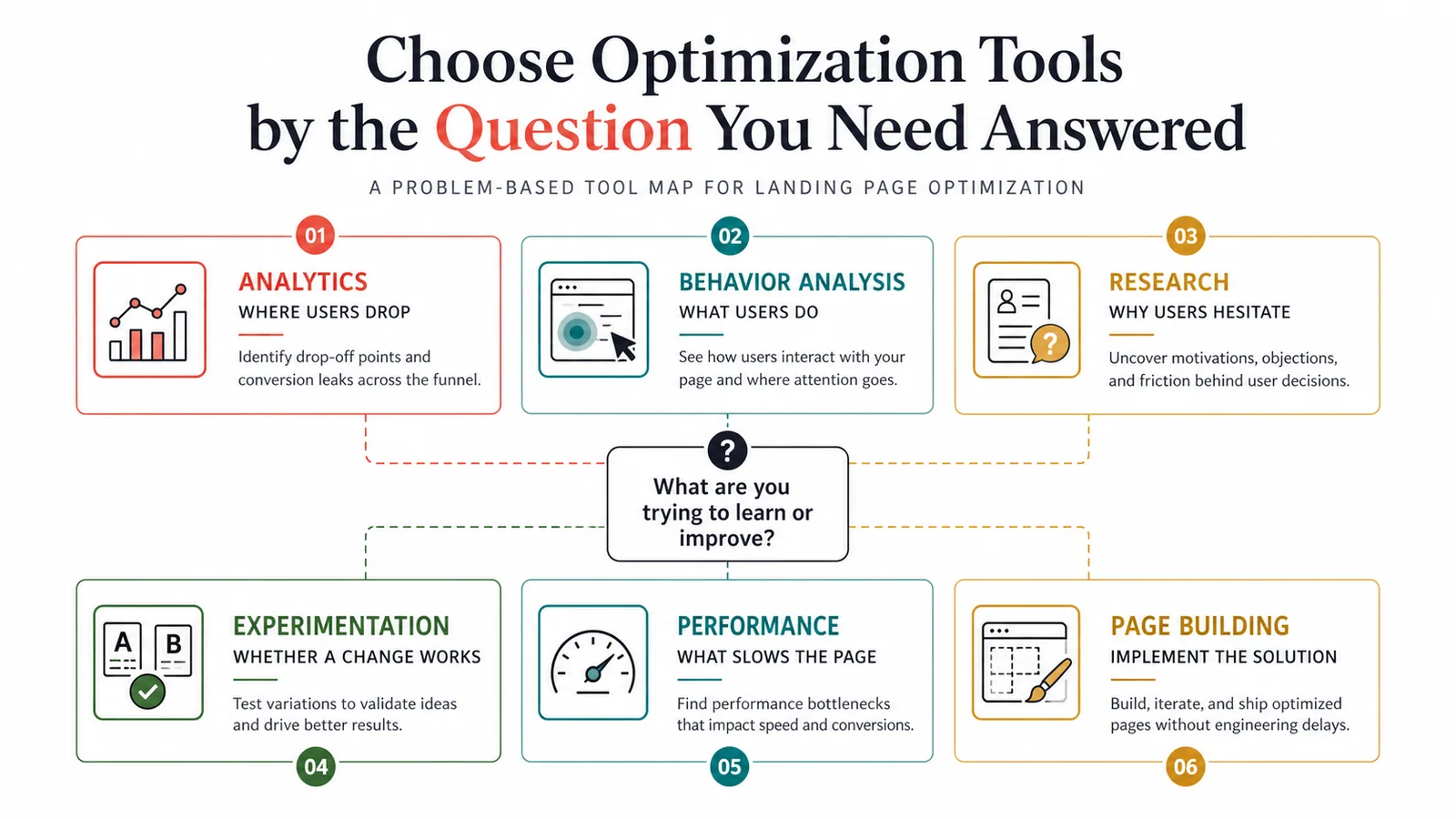
The best tool depends on the problem. Adding several scripts without a measurement plan can slow the page and create more data than the team can use.
| Question | Tool category | Common options | What it cannot prove alone |
|---|---|---|---|
| Where do sessions and conversions come from? | Web analytics | Google Analytics, Adobe Analytics, Matomo | Why a person hesitated or misunderstood. |
| What do visitors click, scroll, or struggle with? | Behavior analytics | Microsoft Clarity, Hotjar, Glassbox, Mouseflow | Whether a proposed redesign will perform better. |
| Do target customers understand the message? | Message and user research | Wynter, Lyssna, UserTesting, interviews | Live conversion impact at scale. |
| Which controlled experience performs better? | Experimentation | VWO, Optimizely, Convert, AB Tasty | The reason for a difference without supporting research. |
| What makes the page slow or unstable? | Performance diagnostics | PageSpeed Insights, Chrome DevTools, WebPageTest | Whether the message or offer is persuasive. |
| How can the team build and publish faster? | Landing-page builder | Unbounce, Leadpages, Instapage, Perspective, Webflow | Strategy, traffic quality, or a valid testing program. |
Begin with the tools already implemented correctly. A reliable analytics event, a real mobile test, five customer conversations, and a spreadsheet can produce a better decision than an expensive stack with no agreed conversion definition.
When the page needs custom campaign visuals, the landing page graphic templates guide explains how to plan hero, feature, proof, and promotional assets without losing message consistency.
A 30-Day Landing Page Optimization Plan
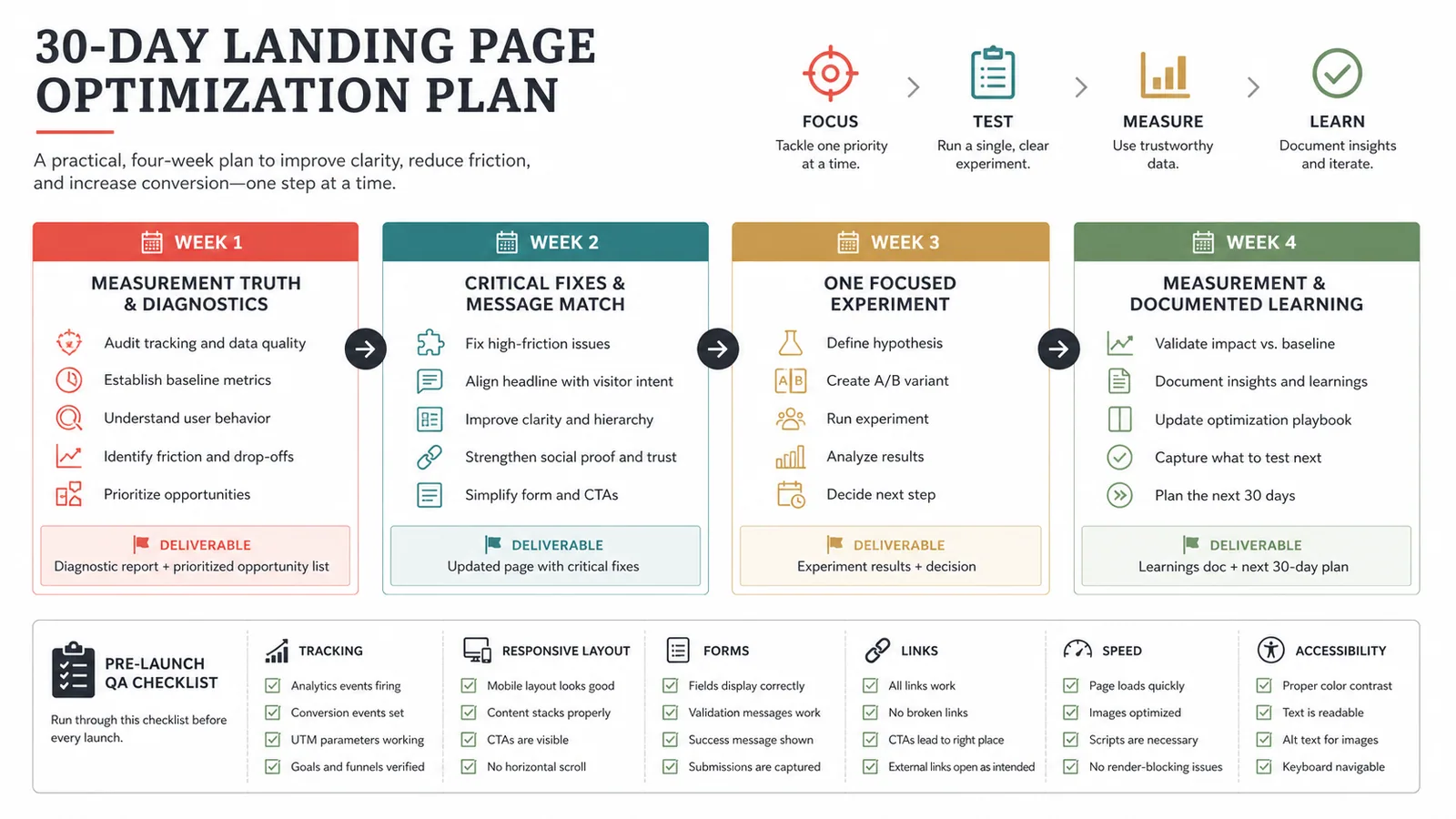
| Week | Objective | Actions | Output |
|---|---|---|---|
| Week 1 | Establish truth | Verify tracking, define the conversion, segment the baseline, compare traffic sources, test the complete journey, and gather customer evidence. | A one-page diagnosis with supporting data. |
| Week 2 | Remove preventable friction | Fix P0 defects, repair message mismatches, improve critical mobile issues, clarify the offer, and QA every integration. | A release log with before/after evidence. |
| Week 3 | Launch one focused experiment | Choose the highest-value uncertain hypothesis, write the test plan, build variants, validate instrumentation, and start the experiment. | A live test with documented metrics and guardrails. |
| Week 4 | Measure and decide | Review data quality, analyze segment effects, collect qualitative feedback, document the decision, and reprioritize the backlog. | An adopt, reject, iterate, or continue decision. |
Pre-launch landing page checklist
- The headline, offer, imagery, and CTA match the campaign.
- The primary conversion and downstream quality event are tracked once.
- Forms, buttons, links, scheduling, checkout, CRM, and email delivery work.
- UTM parameters and campaign attribution persist correctly.
- Price, conditions, inventory, dates, policies, and legal statements are accurate.
- The page is usable with keyboard, zoom, screen-reader labels, and visible focus.
- Mobile layouts are checked on real devices and realistic connections.
- Images have useful alt text and appropriate dimensions.
- There is one clear primary action and no accidental dead ends.
- The thank-you experience tells the visitor exactly what happens next.
Record every release date. Without a change log, a conversion increase may be credited to copy when the actual cause was a campaign shift, restored integration, seasonal demand, or pricing change.
Landing Page Optimization FAQ
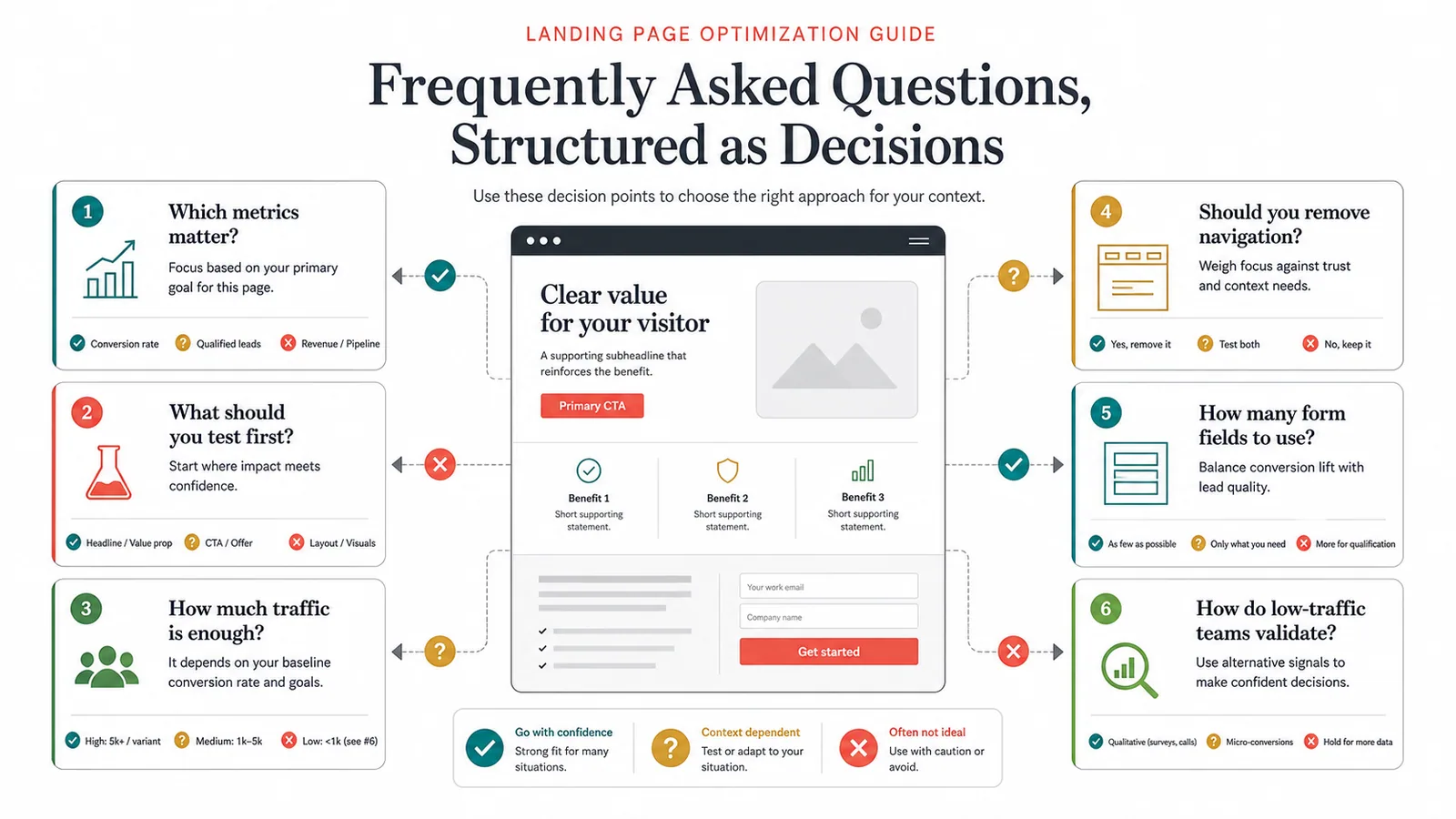
What should I optimize first on a landing page?
Fix broken functionality and measurement first. Then address the highest-reach, best-supported problem closest to the primary conversion. For paid traffic, ad-to-page message mismatch is often one of the first areas worth checking.
What is a good landing page conversion rate?
There is no universal good rate. Conversion rate changes with offer, traffic source, device, industry, price, commitment, brand awareness, and how a conversion is defined. Establish a trustworthy baseline and compare like-for-like segments while monitoring conversion quality.
Is landing page optimization the same as A/B testing?
No. A/B testing is one validation method. Landing page optimization also includes analytics, customer research, usability, performance, accessibility, copy, design, technical QA, prioritization, and direct defect correction.
Should a landing page remove navigation?
Not automatically. A highly focused paid-campaign page may benefit from fewer competing links. An organic SEO landing page may need internal navigation and supporting content to satisfy search intent. Measure whether navigation supports or distracts from the visitor’s task.
How many form fields should a landing page use?
Use the minimum fields needed to deliver the offer, route or qualify the lead, and make the next interaction useful. Evaluate form completion together with qualified-lead rate and downstream outcomes rather than optimizing submission volume alone.
How often should landing pages be optimized?
Monitor important pages continuously and review them after campaign, offer, tracking, design, platform, or audience changes. Run a deeper audit when performance shifts or when enough new evidence supports a meaningful hypothesis.
Can a low-traffic landing page be optimized?
Yes. Use test conversions, usability sessions, message testing, interviews, recordings, form analytics, support themes, and direct fixes. Avoid pretending that a small number of conversions provides a reliable A/B-test conclusion.
Premium landing page optimization is not a collection of fashionable tactics. It is the habit of connecting a customer problem to evidence, selecting the most valuable intervention, and learning from the result. Diagnose first, protect message continuity, remove preventable friction, and test only when the answer is genuinely uncertain.
Continue Your Audit Beyond the Landing Page
Use the free 300+ point ecommerce CRO spreadsheet to audit product pages, navigation, cart, checkout, trust, and the complete buying journey.