Landing Page Graphic Templates: A Conversion-First Selection Guide
A landing page graphic template is useful only when it makes the visitor’s next decision easier. An attractive mockup can still fail when it hides the offer, separates proof from the claim it supports, or collapses badly on mobile. This guide turns template browsing into a conversion decision system. It keeps the useful visual roles from the existing article—hero confirmation, feature explanation, proof, comparison, offer reinforcement, and CTA support—but connects each role to traffic intent, evidence, implementation, and measurement.
Quick answer: Choose a landing page template by the decision it must help a visitor make, not by visual style alone. Start with conversion job and traffic context, preserve the promise-to-proof-to-action sequence, then score the layout for message match, friction, mobile clarity, accessibility, speed, and testability.
Important implementation claims in this guide are grounded in primary guidance, including Google Ads landing-page optimization guidance and Google Core Web Vitals. The frameworks below translate those requirements into decisions a working creative or growth team can review.
How to use this template library: Each section pairs an annotated layout pattern with a selection test. Choose the pattern that matches the conversion job, rebuild it as live responsive content in your preferred page builder, and replace every sample claim, proof element, and CTA with verified campaign material. The diagrams are planning templates, not screenshots that should be exported as finished pages.
Choose a Landing Page Template by Conversion Job
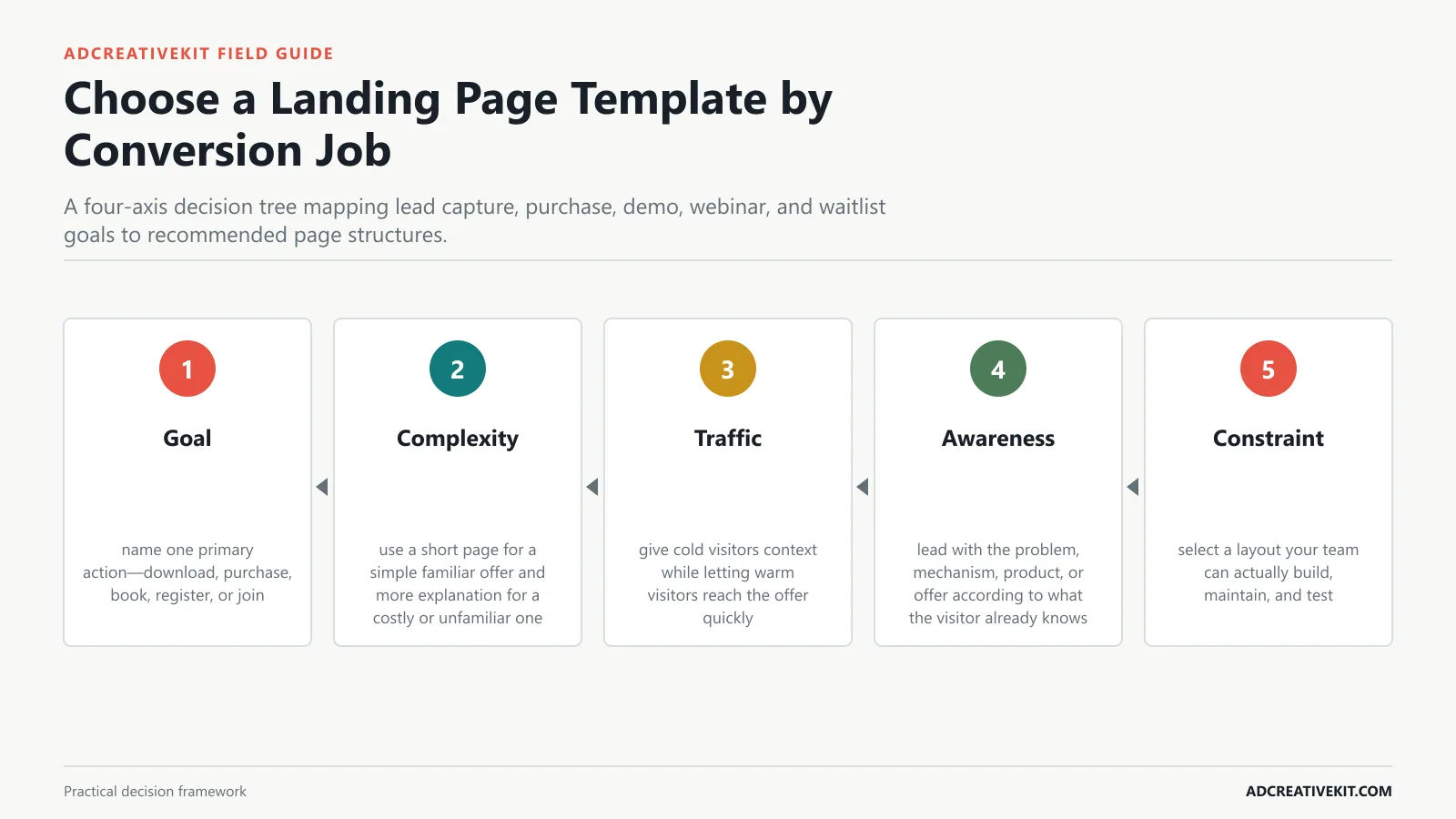
Establish a decision tree based on the desired action, offer complexity, traffic temperature, and visitor awareness before showing designs.
Selection test
Begin with goal: name one primary action—download, purchase, book, register, or join. Then inspect complexity: use a short page for a simple familiar offer and more explanation for a costly or unfamiliar one.
- Goal: name one primary action—download, purchase, book, register, or join.
- Complexity: use a short page for a simple familiar offer and more explanation for a costly or unfamiliar one.
- Traffic: give cold visitors context while letting warm visitors reach the offer quickly.
- Awareness: lead with the problem, mechanism, product, or offer according to what the visitor already knows.
- Constraint: select a layout your team can actually build, maintain, and test.
The Anatomy of a Conversion-Ready Landing Page
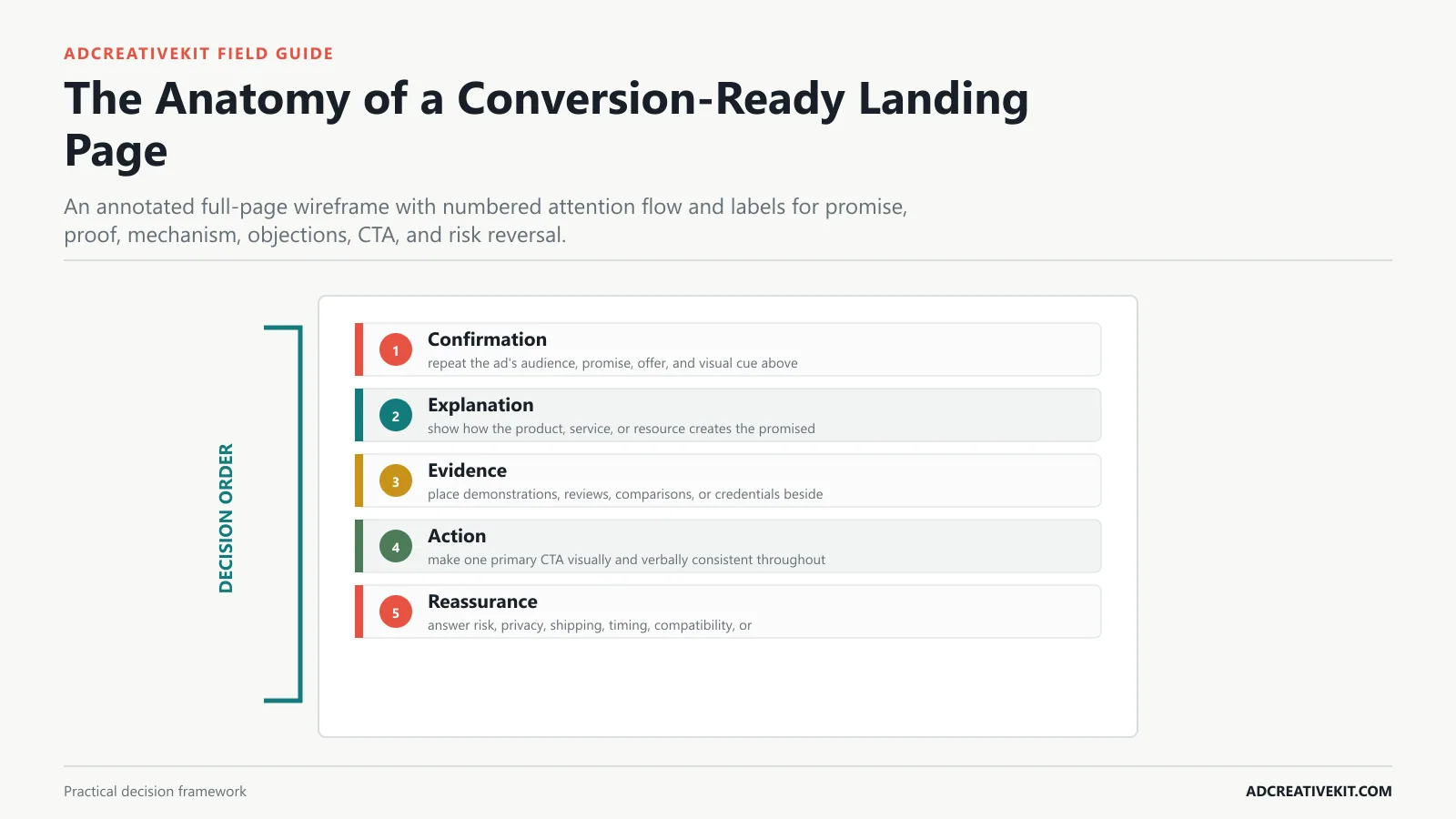
Explain decision order from message confirmation through proof, objection handling, action, and reassurance.
Page-order test
Begin with confirmation: repeat the ad’s audience, promise, offer, and visual cue above the fold. Then inspect explanation: show how the product, service, or resource creates the promised outcome.
- Confirmation: repeat the ad’s audience, promise, offer, and visual cue above the fold.
- Explanation: show how the product, service, or resource creates the promised outcome.
- Evidence: place demonstrations, reviews, comparisons, or credentials beside the claim they support.
- Action: make one primary CTA visually and verbally consistent throughout the page.
- Reassurance: answer risk, privacy, shipping, timing, compatibility, or next-step questions near commitment.
| Page-order test element | Practical requirement | Review question |
|---|---|---|
| Confirmation | repeat the ad’s audience, promise, offer, and visual cue above the fold | Record the observable evidence, any failure, and the owner of the next action. |
| Explanation | show how the product, service, or resource creates the promised outcome | Record the observable evidence, any failure, and the owner of the next action. |
| Evidence | place demonstrations, reviews, comparisons, or credentials beside the claim they support | Record the observable evidence, any failure, and the owner of the next action. |
| Action | make one primary CTA visually and verbally consistent throughout the page | Record the observable evidence, any failure, and the owner of the next action. |
| Reassurance | answer risk, privacy, shipping, timing, compatibility, or next-step questions near commitment | Record the observable evidence, any failure, and the owner of the next action. |
Lead Generation and Lead Magnet Templates
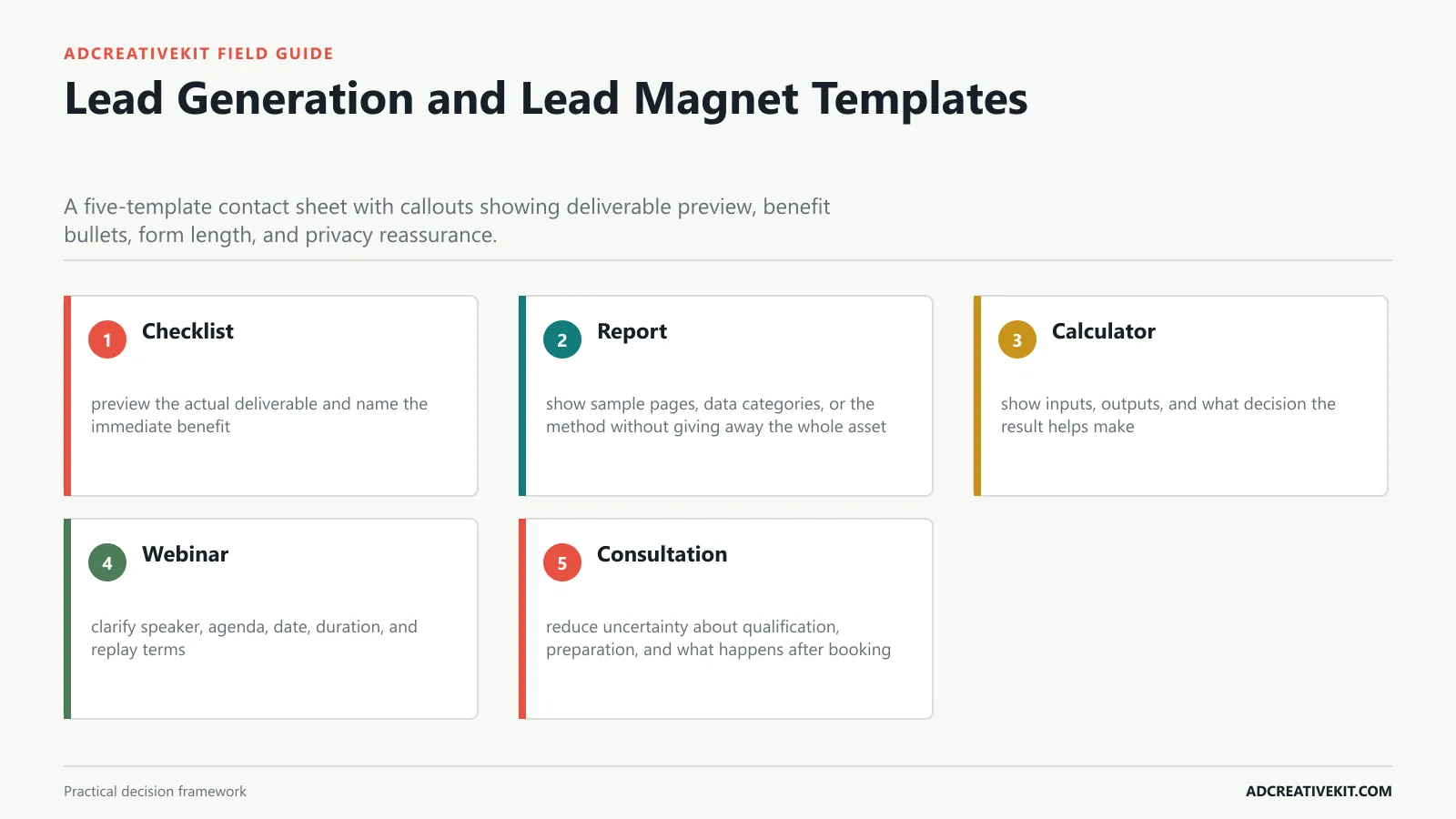
Show layouts for checklists, reports, calculators, webinars, and consultations with guidance on form friction.
Lead-capture test
Begin with checklist: preview the actual deliverable and name the immediate benefit. Then inspect report: show sample pages, data categories, or the method without giving away the whole asset.
- Checklist: preview the actual deliverable and name the immediate benefit.
- Report: show sample pages, data categories, or the method without giving away the whole asset.
- Calculator: show inputs, outputs, and what decision the result helps make.
- Webinar: clarify speaker, agenda, date, duration, and replay terms.
- Consultation: reduce uncertainty about qualification, preparation, and what happens after booking.
For the adjacent workflow, use the customer testimonial ad templates. When this section reveals a broader conversion or production issue, continue with the ecommerce CRO checklist.
Ecommerce Product and Offer Templates
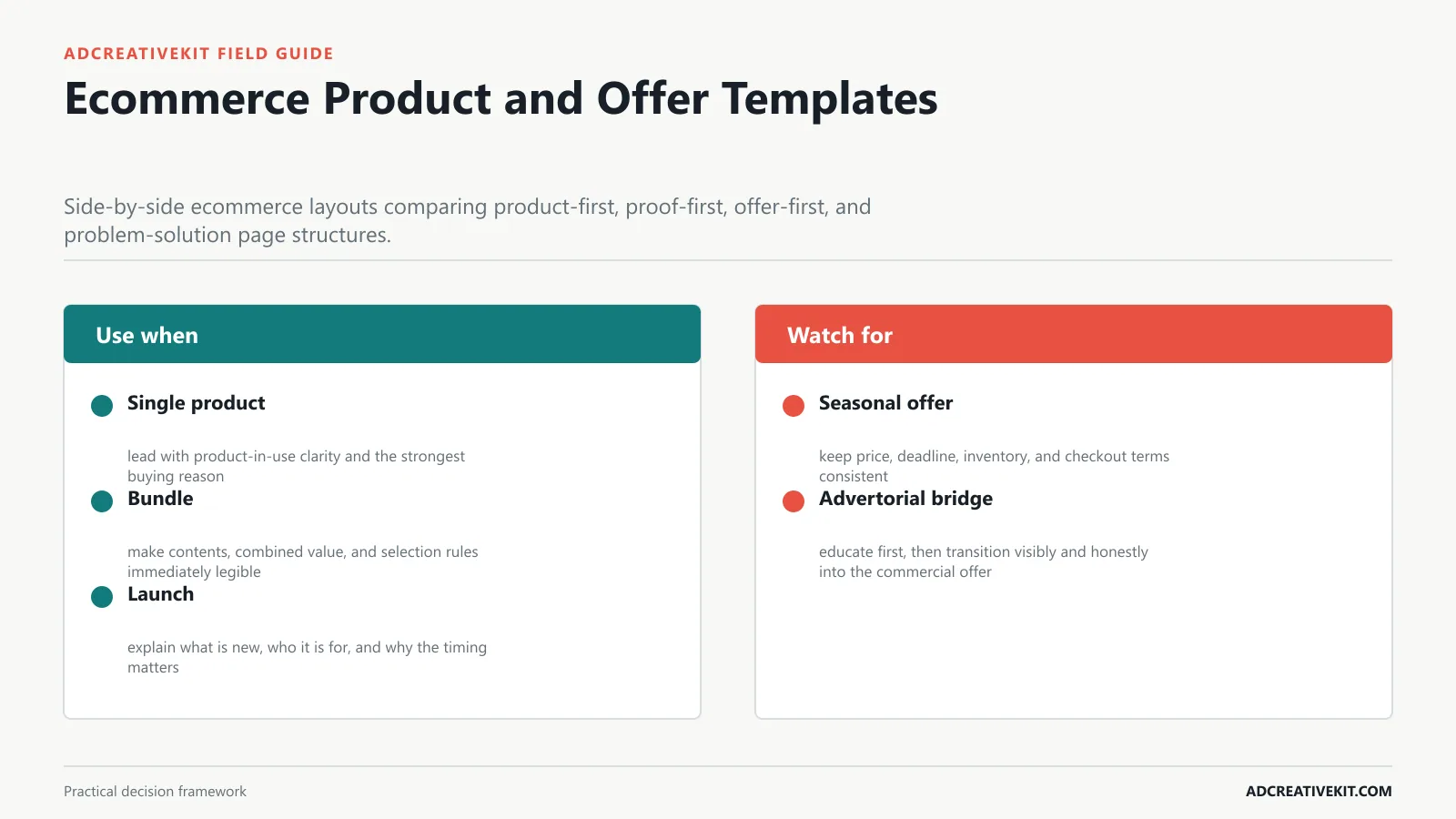
Demonstrate layouts for single products, bundles, launches, seasonal offers, and advertorial transitions.
Commerce test
Begin with single product: lead with product-in-use clarity and the strongest buying reason. Then inspect bundle: make contents, combined value, and selection rules immediately legible.
- Single product: lead with product-in-use clarity and the strongest buying reason.
- Bundle: make contents, combined value, and selection rules immediately legible.
- Launch: explain what is new, who it is for, and why the timing matters.
- Seasonal offer: keep price, deadline, inventory, and checkout terms consistent.
- Advertorial bridge: educate first, then transition visibly and honestly into the commercial offer.
SaaS Demo, Trial, and Waitlist Templates
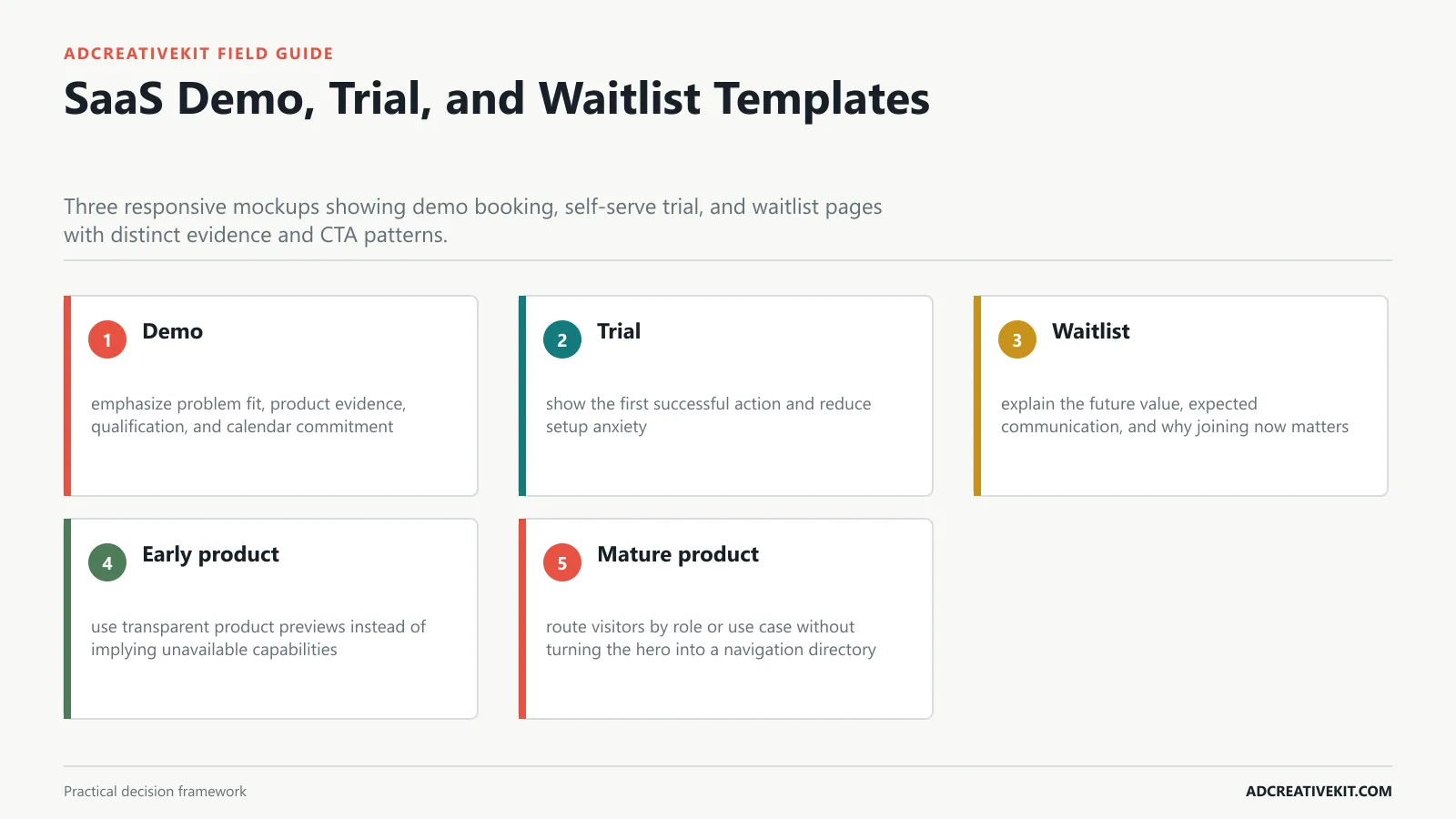
Connect SaaS page structures to product maturity and user commitment level.
Commitment test
Begin with demo: emphasize problem fit, product evidence, qualification, and calendar commitment. Then inspect trial: show the first successful action and reduce setup anxiety.
- Demo: emphasize problem fit, product evidence, qualification, and calendar commitment.
- Trial: show the first successful action and reduce setup anxiety.
- Waitlist: explain the future value, expected communication, and why joining now matters.
- Early product: use transparent product previews instead of implying unavailable capabilities.
- Mature product: route visitors by role or use case without turning the hero into a navigation directory.
Match the Template to the Ad That Sends the Click
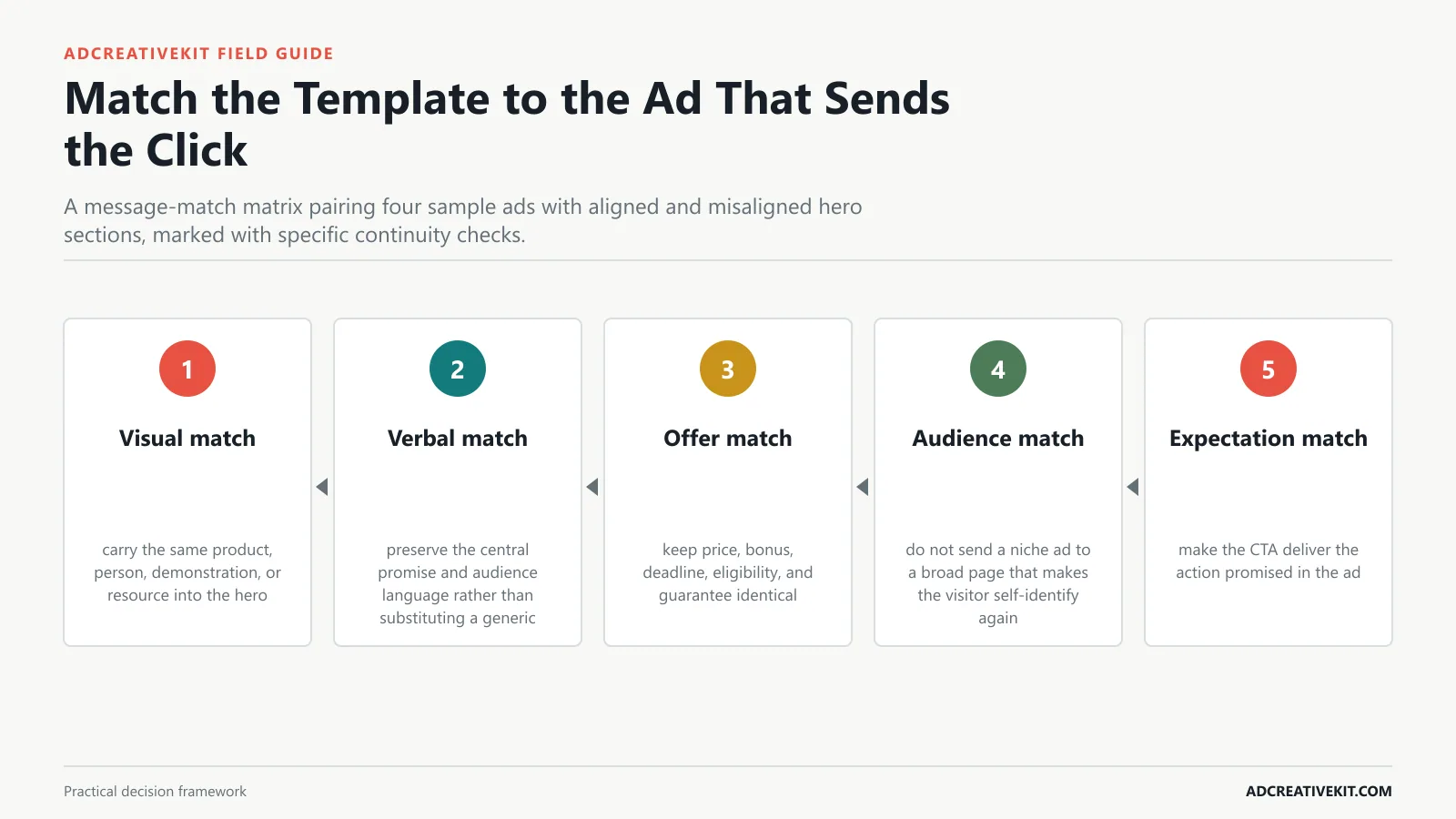
Teach visual, verbal, offer, and audience message match between paid creative and the landing page.
Continuity test
Begin with visual match: carry the same product, person, demonstration, or resource into the hero. Then inspect verbal match: preserve the central promise and audience language rather than substituting a generic headline.
- Visual match: carry the same product, person, demonstration, or resource into the hero.
- Verbal match: preserve the central promise and audience language rather than substituting a generic headline.
- Offer match: keep price, bonus, deadline, eligibility, and guarantee identical.
- Audience match: do not send a niche ad to a broad page that makes the visitor self-identify again.
- Expectation match: make the CTA deliver the action promised in the ad.
For the adjacent workflow, use the product image ad templates. When this section reveals a broader conversion or production issue, continue with the customer testimonial ad templates.
Customize Without Breaking the Conversion Hierarchy
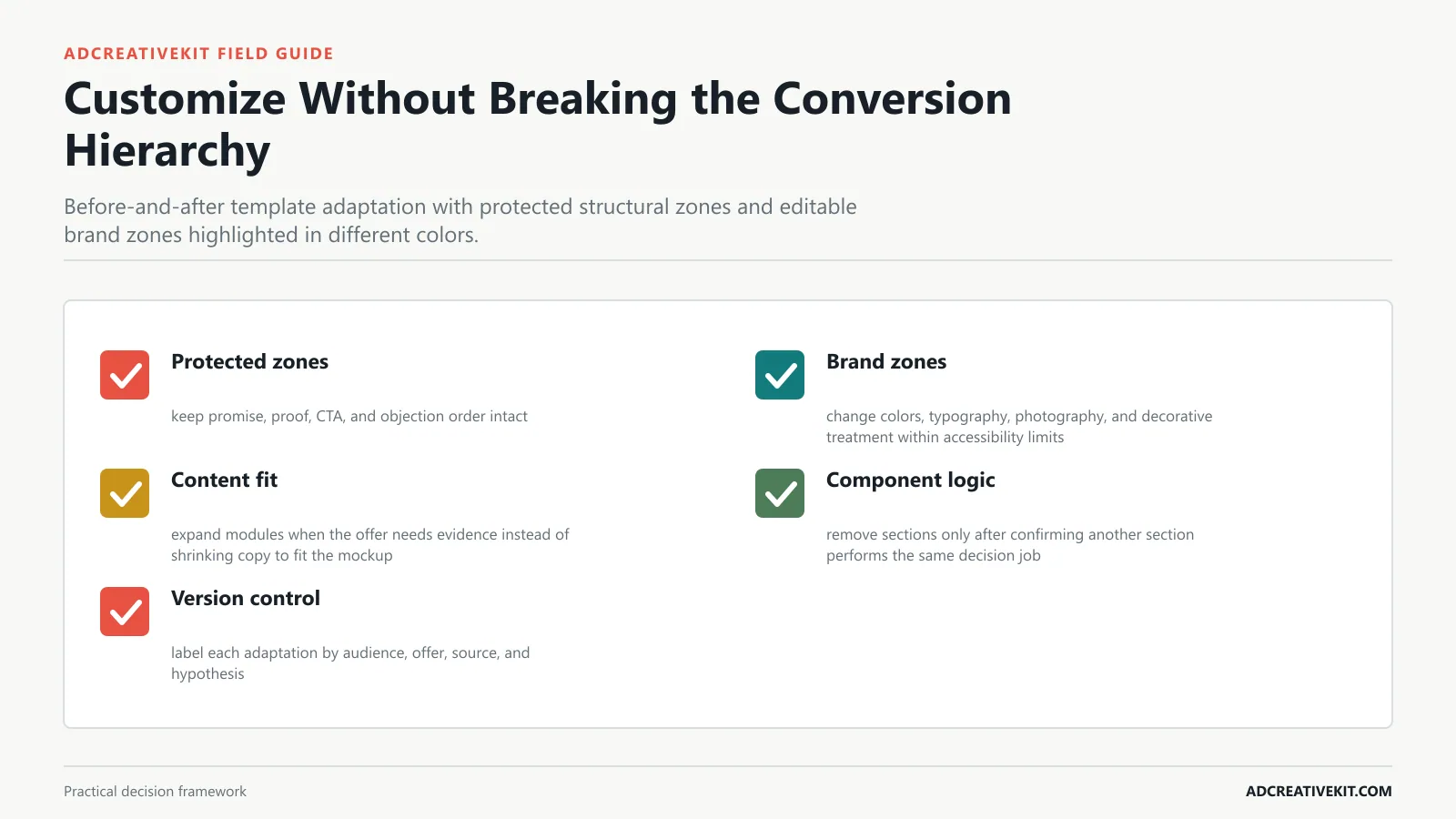
Show which elements can be safely restyled and which strategic relationships must remain intact.
Adaptation test
Begin with protected zones: keep promise, proof, CTA, and objection order intact. Then inspect brand zones: change colors, typography, photography, and decorative treatment within accessibility limits.
- Protected zones: keep promise, proof, CTA, and objection order intact.
- Brand zones: change colors, typography, photography, and decorative treatment within accessibility limits.
- Content fit: expand modules when the offer needs evidence instead of shrinking copy to fit the mockup.
- Component logic: remove sections only after confirming another section performs the same decision job.
- Version control: label each adaptation by audience, offer, source, and hypothesis.
Mobile, Speed, and Accessibility Requirements
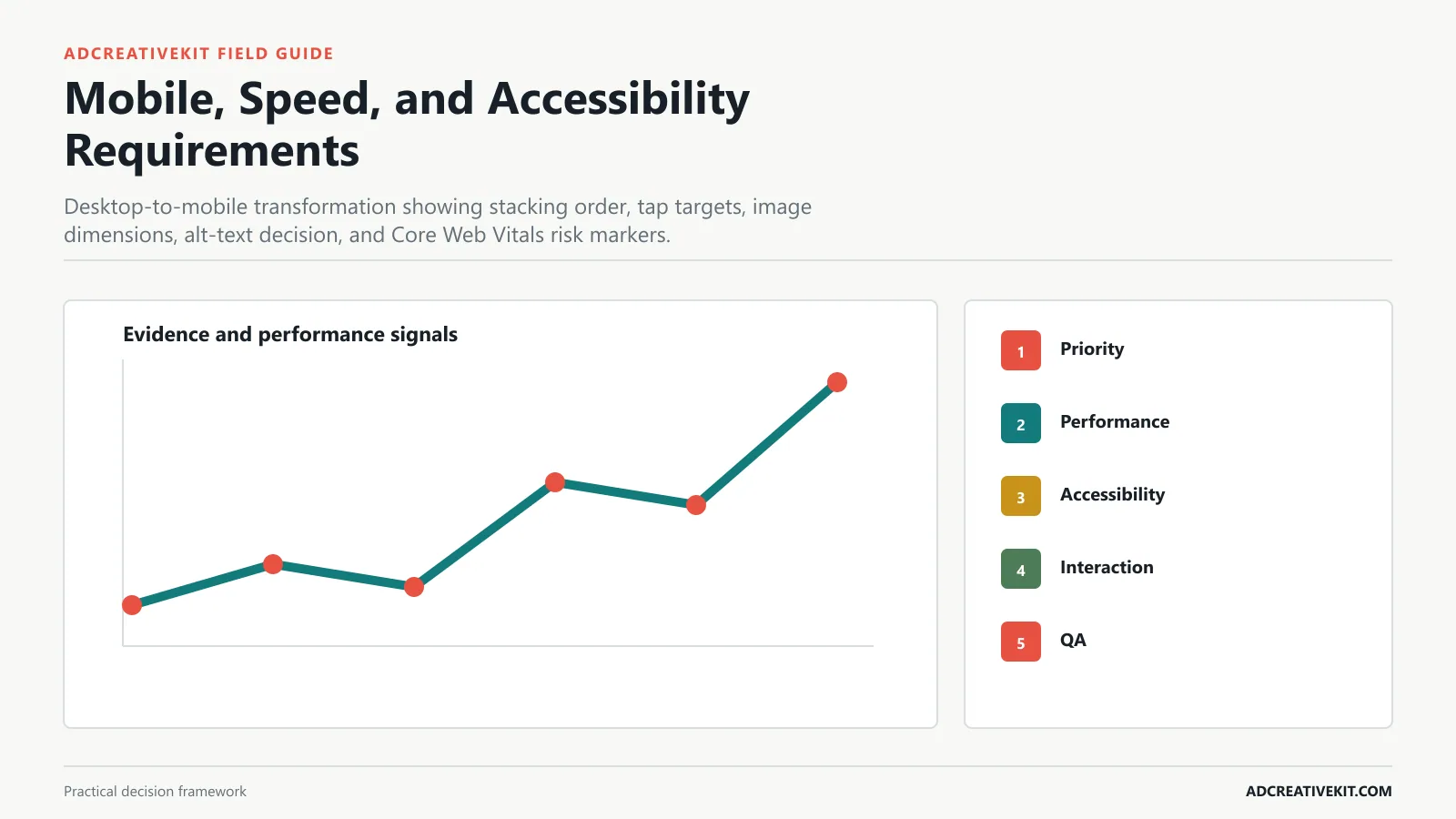
Turn a desktop graphic into a usable mobile page with responsive priority, reserved media space, readable contrast, and accessible alternatives.
Build test
Begin with priority: stack the promise, proof cue, and CTA before secondary navigation or decoration. Then inspect performance: compress media, reserve dimensions, avoid autoplay weight, and monitor Core Web Vitals.
- Priority: stack the promise, proof cue, and CTA before secondary navigation or decoration.
- Performance: compress media, reserve dimensions, avoid autoplay weight, and monitor Core Web Vitals.
- Accessibility: use live text, meaningful alternatives, sufficient contrast, keyboard access, and visible focus.
- Interaction: make tap targets clear and prevent sticky elements from covering content.
- QA: test real devices, slow connections, zoom, orientation, errors, and form completion.
For implementation details, consult W3C WAI images tutorial. Requirements and platform behavior change, so review the current primary documentation before launch rather than relying on a static checklist alone.
Score a Template Before You Build It
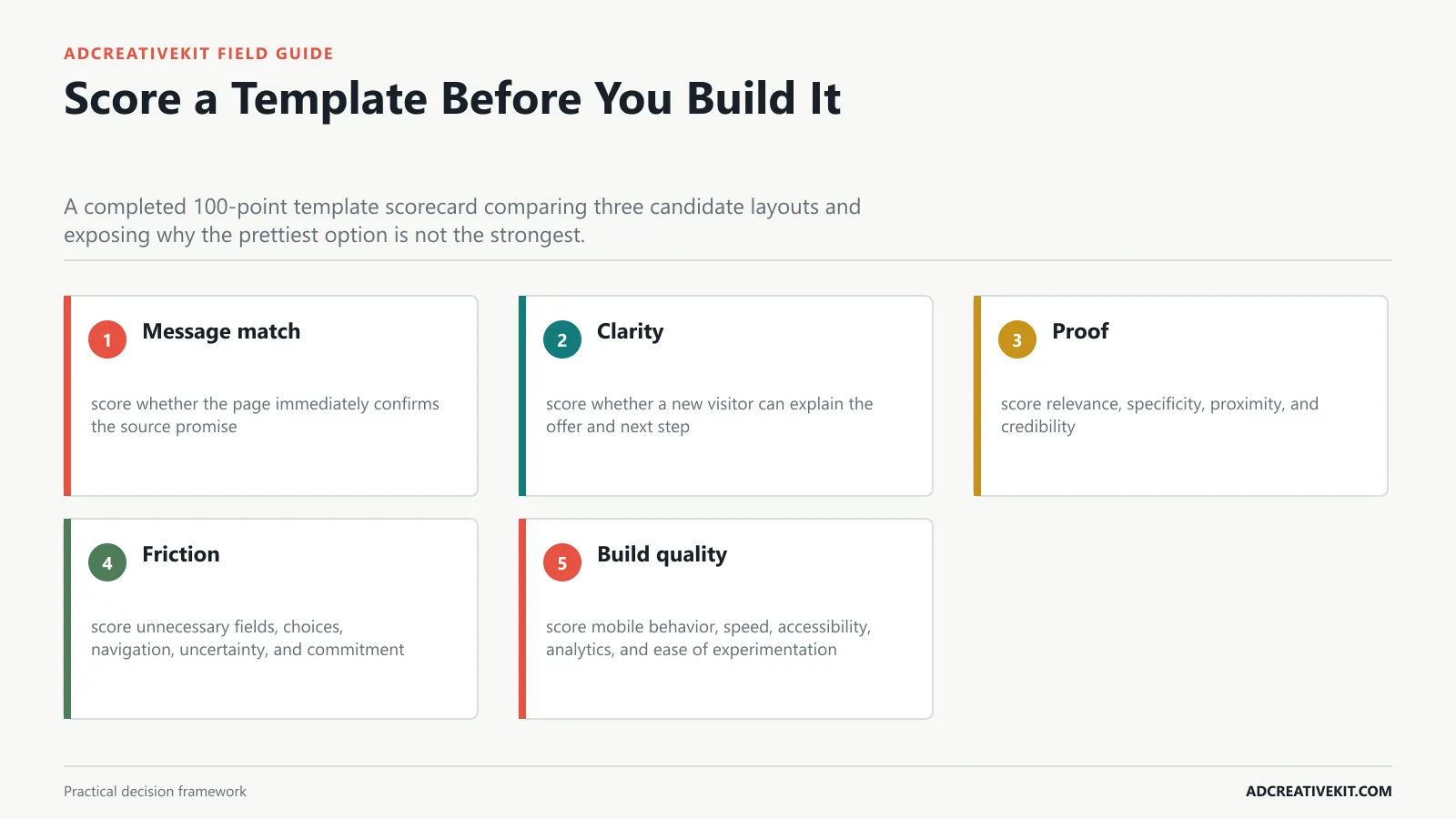
Provide a weighted scorecard for message match, clarity, proof, friction, mobile behavior, performance, accessibility, and testability.
Scorecard test
Begin with message match: score whether the page immediately confirms the source promise. Then inspect clarity: score whether a new visitor can explain the offer and next step.
- Message match: score whether the page immediately confirms the source promise.
- Clarity: score whether a new visitor can explain the offer and next step.
- Proof: score relevance, specificity, proximity, and credibility.
- Friction: score unnecessary fields, choices, navigation, uncertainty, and commitment.
- Build quality: score mobile behavior, speed, accessibility, analytics, and ease of experimentation.
| Scorecard test element | Practical requirement | Review question |
|---|---|---|
| Message match | score whether the page immediately confirms the source promise | Record the observable evidence, any failure, and the owner of the next action. |
| Clarity | score whether a new visitor can explain the offer and next step | Record the observable evidence, any failure, and the owner of the next action. |
| Proof | score relevance, specificity, proximity, and credibility | Record the observable evidence, any failure, and the owner of the next action. |
| Friction | score unnecessary fields, choices, navigation, uncertainty, and commitment | Record the observable evidence, any failure, and the owner of the next action. |
| Build quality | score mobile behavior, speed, accessibility, analytics, and ease of experimentation | Record the observable evidence, any failure, and the owner of the next action. |
For the adjacent workflow, use the landing page optimization guide. When this section reveals a broader conversion or production issue, continue with the product image ad templates.
Launch, Measure, and Improve the Template
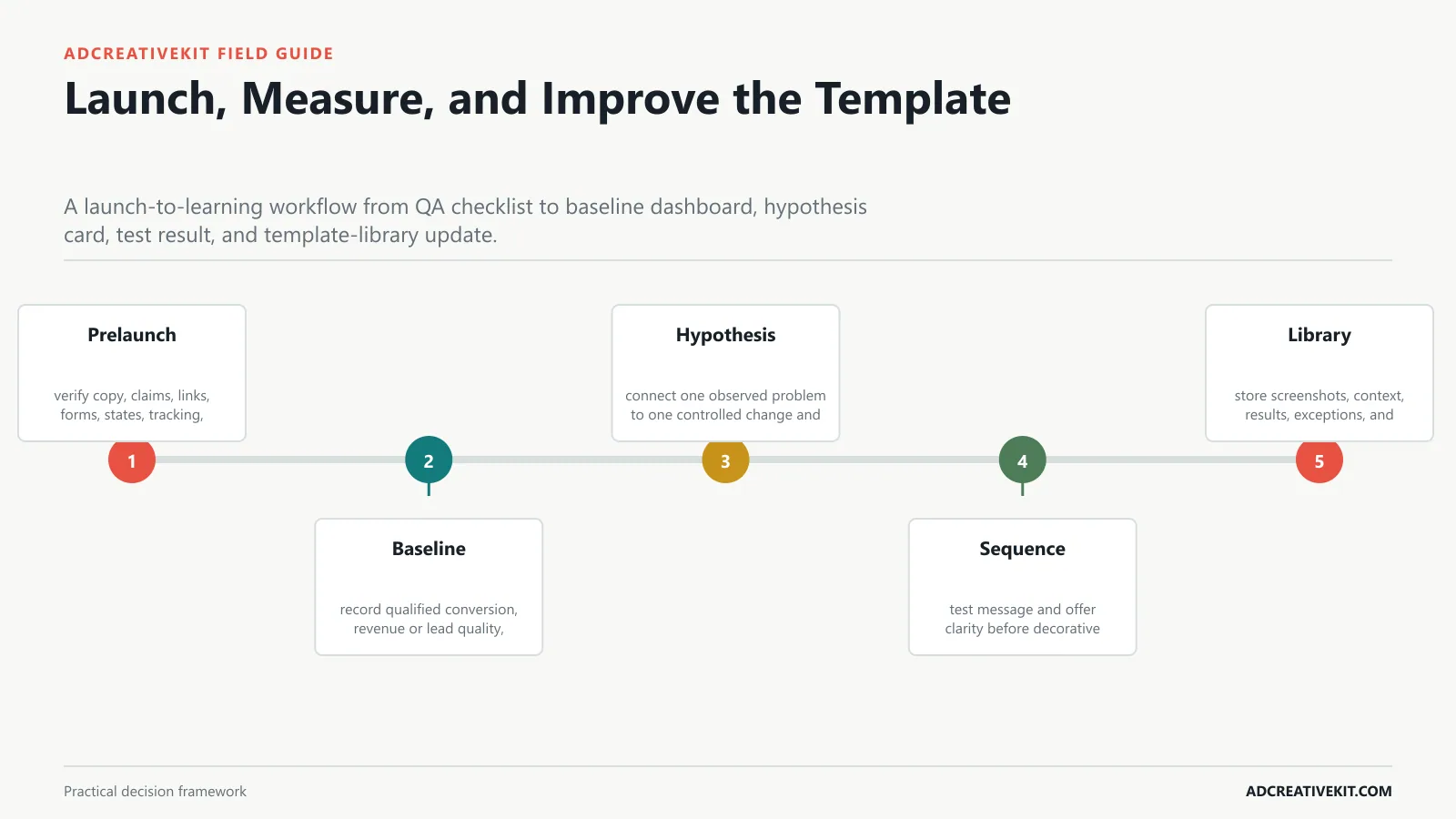
Define prelaunch QA, baseline metrics, test hypotheses, and the first three sensible experiments.
Learning test
Begin with prelaunch: verify copy, claims, links, forms, states, tracking, responsive behavior, and legal terms. Then inspect baseline: record qualified conversion, revenue or lead quality, errors, speed, and source mix.
- Prelaunch: verify copy, claims, links, forms, states, tracking, responsive behavior, and legal terms.
- Baseline: record qualified conversion, revenue or lead quality, errors, speed, and source mix.
- Hypothesis: connect one observed problem to one controlled change and expected metric movement.
- Sequence: test message and offer clarity before decorative details.
- Library: store screenshots, context, results, exceptions, and reusable learning.
Frequently asked questions
What makes a landing page template high converting?
No template converts by appearance alone. A strong candidate fits the offer, traffic intent, evidence needs, mobile context, and measurement plan.
Should a landing page remove navigation?
Sometimes. Remove distracting routes when the page serves one focused campaign, but retain necessary utility, trust, legal, and accessibility paths.
Can a graphic mockup be published as a landing page?
A mockup is a design reference. It still needs semantic HTML, responsive behavior, accessible controls, analytics, performance work, and tested form states.
Turn this guide into an operating asset
Save the framework with the evidence, owner, date, and decision attached. That turns a one-time article into a repeatable review system and prevents future teams from treating an old output as a universal rule.