AI Ad Creative Generator for Facebook Ads: How to Create Better Hooks, Copy, Angles, and Layouts
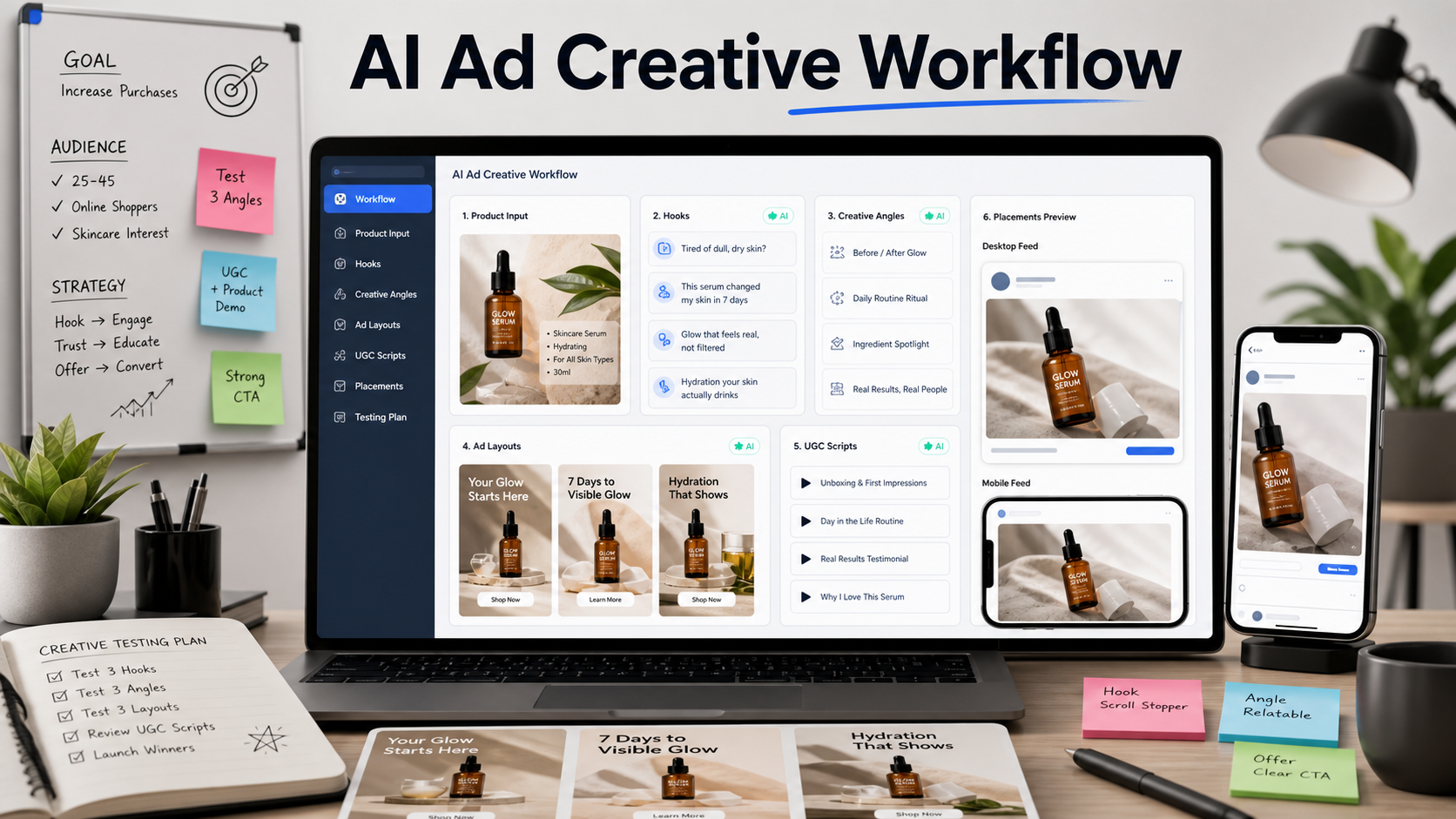
An AI ad creative generator for Facebook ads is most useful when it helps you think like a creative strategist, not when it simply spits out generic ad copy. The point is not to let AI replace judgment. The point is to turn a product, offer, audience, and funnel stage into a structured batch of hooks, angles, layouts, and scripts that a human marketer can review, improve, and test.
This guide explains how to use AI to create better Facebook ad ideas, how to judge the output, what to fix before launching, and how to turn generated ideas into real assets. If you want to try the workflow while reading, use the Free Facebook Ad Creative Generator; then build the final creatives with the free editable Meta ad templates.
TL;DR: Use AI to generate more options, not final truth. Give it precise product, audience, offer, funnel, platform, and tone inputs. Ask for hooks, primary text, headlines, CTA ideas, creative angles, static layouts, and UGC scripts. Then review claims, simplify the message, match the landing page, and test a clean batch of variations.
Table of Contents
What Is an AI Ad Creative Generator for Facebook Ads?
An AI ad creative generator is a tool that turns campaign inputs into ad ideas. For Facebook ads, that usually means hooks, primary text, headlines, calls to action, creative angles, layout suggestions, and sometimes UGC-style scripts. A strong generator does more than rewrite the product description. It changes the angle based on audience awareness, funnel stage, offer type, and placement.
For example, the same skincare product could produce very different outputs depending on whether the campaign is awareness, conversion, or retargeting. Awareness creative might lead with a problem or education hook. Conversion creative may highlight the offer and product benefit. Retargeting creative should answer the buyer’s remaining objection: price, trust, routine fit, shipping, or timing.
Google’s guidance on AI-generated content is useful here: AI can help with structure and research, but scaled low-value content created only for rankings can violate spam policies. For ad creative, the same principle applies: AI should help you produce better work, not more empty variations. Source: Google Search Central guidance on generative AI content.
Why Facebook Ads Need Creative Systems, Not Random Ideas
Facebook ads rarely fail because a marketer could not think of one headline. They fail because the creative system is weak: unclear hooks, mismatched landing pages, repeated visual formats, untested objections, generic proof, or no plan for iterating after the first batch.
Meta’s own ad resources emphasize that creative should fit the objective, format, and placement. That matters because a story placement, feed ad, carousel, and short-form video all ask the viewer to pay attention in different ways. The creative idea may be the same, but the layout and script should change. For current placement specs, check the official Meta Ads Guide.
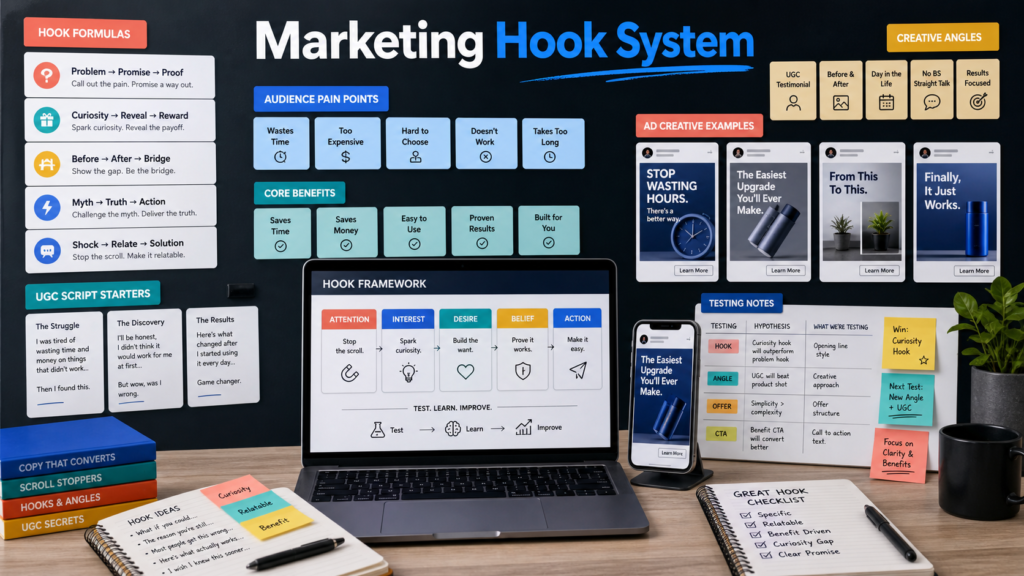
A useful AI workflow creates structured variety. Instead of asking for twenty random ads, you ask for a controlled batch: three hooks around one pain point, three angles around one offer, three layouts around one product image, and three UGC scripts around one objection. That gives you options without making the test unreadable.
What an AI Ad Creative Generator Should Create
A complete Facebook ad creative generator should produce more than copy. Copy is only one layer of the ad. The idea, visual structure, proof, CTA, and format are just as important.
| Output | What it does | How to use it |
|---|---|---|
| Ad hooks | Earn attention in the first second. | Test different opening ideas before changing the whole ad. |
| Primary text | Explains the offer and creates context. | Use short, medium, and longer versions for different funnel stages. |
| Headlines | Clarify the benefit near the CTA. | Keep them specific and mobile-readable. |
| CTA ideas | Set the next action. | Use CTAs that match the funnel stage and landing page. |
| Creative angles | Define the persuasion path. | Choose whether the ad leads with pain, outcome, proof, comparison, or urgency. |
| Static layouts | Turn the message into a visual structure. | Use size, hierarchy, proof, and CTA placement guidance in Canva or Figma. |
| UGC scripts | Create creator-style video concepts. | Use scene-by-scene scripts for 15 to 30 second videos. |
The AI-Assisted Facebook Ad Creative Workflow
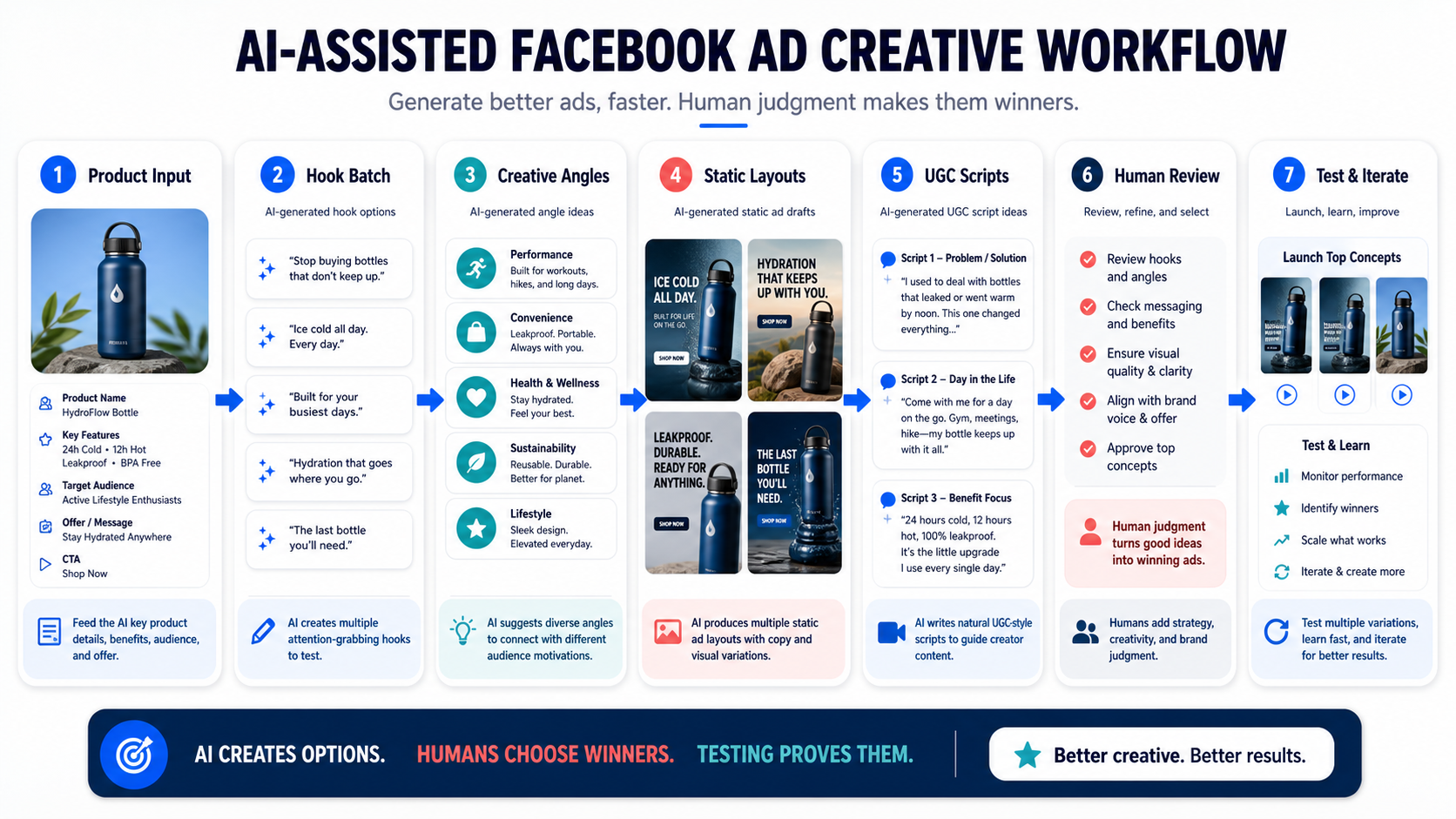
The best workflow is simple: AI creates options, humans choose winners, and testing proves them. You do not need the AI to be perfect. You need it to give you enough structured ideas that you can spot promising angles faster.
- Product input: describe the product, category, benefit, offer, target customer, objections, funnel stage, ad goal, platform, and tone.
- Hook batch: generate varied hooks across problem, benefit, curiosity, proof, transformation, urgency, and audience-callout angles.
- Creative angles: group hooks into strategic paths like problem-solution, offer stack, social proof, comparison, and product demonstration.
- Static layouts: turn the best angles into clear visual structures for feed, story, reel, or carousel placements.
- UGC scripts: create short creator-style scripts for angles that need demonstration, objection handling, or social proof.
- Human review: remove unsupported claims, simplify copy, match the offer to the landing page, and adjust brand voice.
- Test and iterate: launch a clean batch, read the results, then build more variations around the winning angle.
The Inputs That Make AI Ad Ideas Better
Most weak AI ad output comes from weak input. If you ask for ‘ads for my store,’ you will get generic copy. If you provide product details, audience pain, offer, funnel stage, and brand tone, the output becomes more useful.
| Input | Weak version | Stronger version |
|---|---|---|
| Product | Vitamin C serum | Lightweight vitamin C serum for dull-looking skin and uneven tone |
| Audience | Women | Busy women 25-45 who want a simple morning skincare routine |
| Offer | Discount | 20% off first order this week |
| Funnel | Sales | Conversion campaign for warm product page visitors |
| Tone | Friendly | Friendly, educational, not exaggerated |
| Instruction | Make it catchy | Avoid medical claims; focus on glow, routine, texture, and ease |
A good rule: if a human strategist could not write a useful brief from your inputs, the AI will probably struggle too.
Creative Frameworks to Request From an AI Generator
The best AI prompts ask for specific creative frameworks instead of vague ad ideas. These are the frameworks I would request for most ecommerce Facebook campaigns:
- Problem-solution: name the problem, show the product as the simple next step.
- Product benefit: put the outcome first and keep the ad visually clear.
- Social proof: use real reviews, ratings, customer language, or trust cues without inventing proof.
- Comparison: compare the old way with the new way, or generic alternatives with your product category.
- Offer stack: show the bundle, discount, free gift, shipping, or guarantee clearly.
- Before-and-after: use transformation carefully and avoid exaggerated or policy-sensitive claims.
- UGC demo: show how the product fits into a real routine or situation.
- Objection handler: address price, effort, trust, fit, quality, timing, or complexity.
How to Evaluate AI-Generated Facebook Ads Before Publishing
Do not publish AI-generated ads without review. The tool can create useful ideas, but it does not know your legal requirements, inventory reality, customer support policies, product proof, or ad account history.
- Claim check: remove anything you cannot prove.
- Offer check: make sure discounts, deadlines, bonuses, and shipping claims are real.
- Audience check: avoid sensitive or discriminatory targeting language.
- Brand voice check: make the copy sound like your brand, not a generic AI assistant.
- Visual check: confirm the layout can be read on mobile.
- Landing page check: repeat the ad’s promise quickly after the click.
- Platform check: review current Meta specs and policy-sensitive categories before launch.
Meta’s creative guidance also points marketers toward objective-fit creative and engaging formats rather than expensive production alone. Start with message clarity, format fit, and mobile readability. Source: Meta creative best practices.
How to Test AI-Generated Ad Concepts
The mistake is launching ten unrelated ads and calling it a test. A better system is to keep one product, offer, audience, and funnel stage stable, then test a small number of creative variables.
| Test batch | Keep constant | Change | What you learn |
|---|---|---|---|
| Hook test | Product, layout, offer, audience | Opening line | Which message earns attention |
| Angle test | Product, offer, audience | Problem vs. proof vs. comparison | Which persuasion path is strongest |
| Layout test | Product, hook, offer | Static layout structure | Which visual hierarchy makes the idea clearer |
| UGC script test | Product, offer, audience | Creator scenario and first frame | Which story feels most natural |
| Retargeting test | Audience stage, product | Objection answered | What holds warm visitors back |
Read early results carefully. High attention but low clicks may mean the hook is interesting but the offer is unclear. High clicks but weak conversion may point to landing page mismatch, price, trust, or a product-market problem. A good AI generator helps you create the next test faster, but it cannot replace diagnosis.
Common AI Ad Creative Generator Mistakes
- Asking for generic ads: the output becomes generic because the input is generic.
- Publishing without review: AI can invent claims, urgency, proof, or wording that needs correction.
- Testing too many variables: if everything changes at once, you cannot read the result.
- Ignoring the visual idea: Facebook ads are not just text; layout and imagery carry the message.
- Using one winning hook forever: fatigue still happens. Create variations around the same winning angle.
- Skipping the landing page: the ad and landing page need message match.
- Treating AI as strategy: AI can generate options, but human judgment chooses what fits the brand and buyer.
Try the Free Facebook Ad Creative Generator
If you want a practical starting point, use the Free Facebook Ad Creative Generator. Enter your product, category, offer, target audience, funnel stage, ad goal, tone, and platform. The tool generates hooks, primary text, headlines, CTAs, creative angles, static layout recommendations, and UGC scripts.
After that, use the free editable Meta ad templates to turn the best ideas into real Facebook and Instagram ad creatives. This workflow gives you strategy first, design second, and testing after that.
Generate Your First Ad Creative Batch
Use the free generator to create campaign hooks, copy, angles, static layouts, and UGC scripts. Then customize the strongest ideas inside editable templates.
FAQ: AI Ad Creative Generators for Facebook Ads
What is an AI ad creative generator?
It is a tool that uses AI to generate ad hooks, copy, headlines, creative angles, layouts, and scripts from campaign inputs such as product, audience, offer, funnel stage, and platform.
Can AI create complete Facebook ads?
AI can create the idea, copy, layout direction, and script, but you still need to review claims, design the final asset, check platform requirements, and test performance.
Is AI-generated ad copy safe to publish?
Only after review. Check every claim, proof point, offer, deadline, and policy-sensitive statement before publishing.
What should I enter into an AI ad generator?
Include product details, product category, strongest benefit, target audience, offer, funnel stage, ad goal, platform, tone, and any claims or wording to avoid.
What is the best AI-generated output to test first?
Start with hooks and creative angles. If the core angle is weak, better layout and polish will not save the ad.
Can I use AI for UGC ad scripts?
Yes. AI is useful for outlining creator-style scripts, scene structure, spoken lines, on-screen text, and B-roll ideas. Keep the final script natural and honest.
Does AI guarantee better ROAS?
No. AI can improve speed and structure, but results depend on offer, audience, product, creative quality, landing page, budget, tracking, and media buying.
How many AI-generated ad ideas should I test?
Start with a controlled batch: three to five creative angles and two to three hooks per angle. Keep the product, offer, and audience consistent where possible.
Should I use AI for Facebook, Instagram, and TikTok the same way?
No. The core idea can be shared, but format, pacing, copy length, and layout should change by platform and placement.
What should I do after generating ad ideas?
Choose the strongest angles, edit the copy, create the visuals, review claims, match the landing page, launch a clean test, and iterate from the winner.