TikTok Ad Templates for Ecommerce: Hooks, Scenes, Scripts, and Creative Checks
TikTok ad templates are not just visual layouts. For ecommerce, the template is the sequence: what happens in the first second, what problem appears, how the product is demonstrated, what proof makes it believable, and what the viewer should do next.
Sections
- Why TikTok templates work differently
- The five-part TikTok ad structure
- Seven ecommerce TikTok ad formats
- Hook examples by angle
- UGC creator brief checklist
- How to test TikTok ads without reshooting everything
- FAQ
TL;DR: Ecommerce TikTok ads need a fast hook, visible product moment, believable proof, and simple CTA. Treat the ad like a storyboard. Test different hooks before rebuilding the full video.
The worst TikTok ads look like product pages squeezed into a vertical video. They show packaging, list features, add upbeat music, and hope the format does the work. It rarely does.
What usually works is a clear sequence. The viewer sees a situation they recognize, then a product solving it, then enough proof to believe it is worth tapping. The video can feel casual, but the structure should be intentional.
Why TikTok Templates Work Differently
A static ad template controls layout. A TikTok ad template controls time. Seconds 0-3 decide whether the viewer gives you permission to explain the product. The middle of the ad must justify the hook. The final scene must make the next step feel obvious.
This is why a TikTok template should include scene order, spoken lines, visual actions, overlays, and CTA direction. If it only includes a pretty vertical frame, it is not enough.
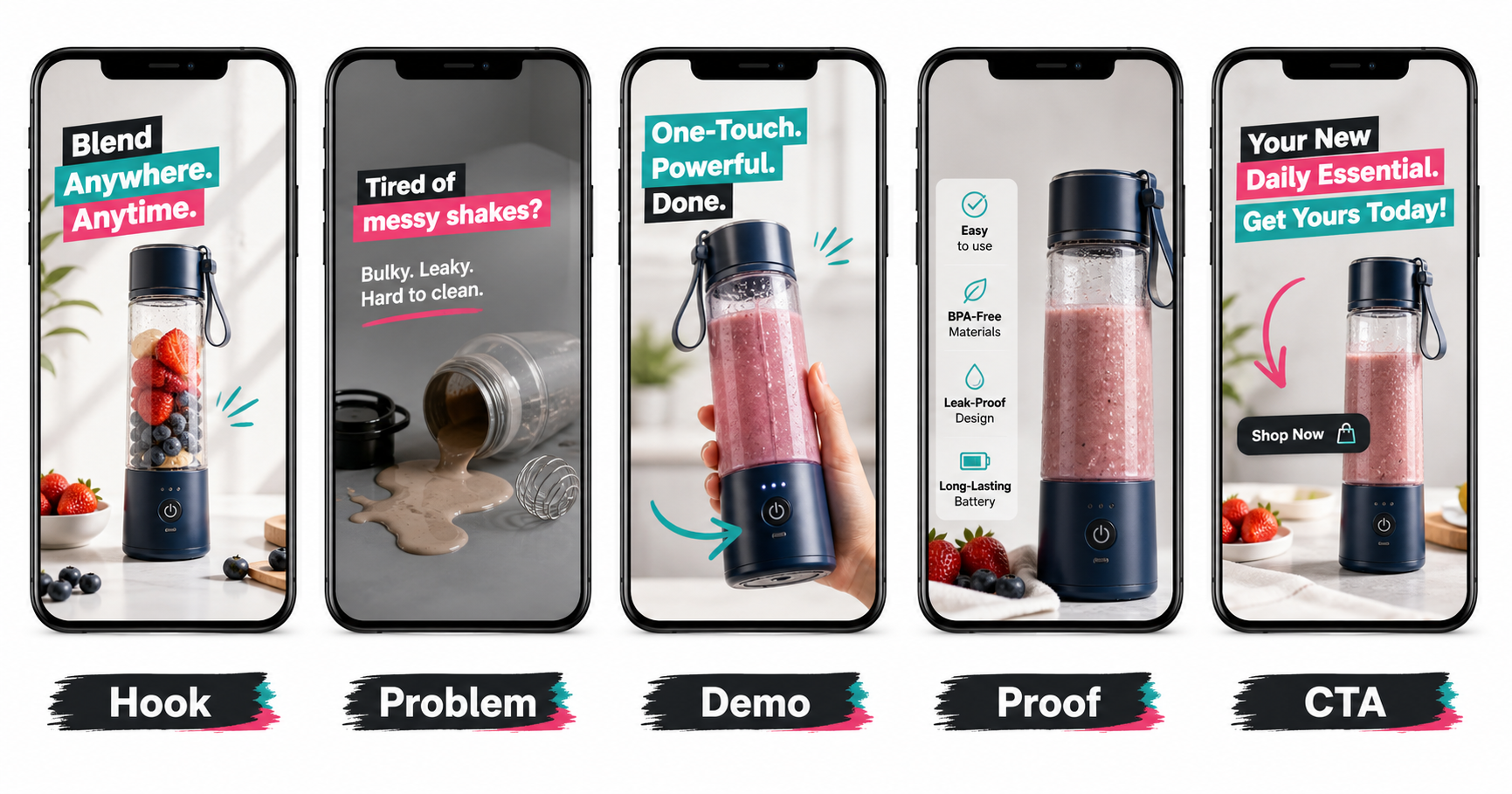
The Five-Part TikTok Ad Structure
| Scene | Job | Example |
|---|---|---|
| Hook | Stop the scroll | “If your ads all look different but say the same thing, watch this.” |
| Problem | Show why the viewer should care | Show a messy creative board or repeated ad concepts. |
| Demo | Show the product or process in action | Show different ad angles being created. |
| Proof | Reduce doubt | Show examples, reviews, before-after, or included assets. |
| CTA | Give the next step | “See the examples,” “View the bundle,” or “Try the workflow.” |
Seven Ecommerce TikTok Ad Formats
1. Problem-First Demo
This format starts with a frustration the shopper already understands. It works for products that solve a visible or repeated problem.
Structure: problem hook, old way, product demo, result, CTA.
2. Product-in-Use Demo
This is best when the product becomes clearer once someone sees it working. Do not wait until second eight to show the product. Put the use case on screen early.
Structure: product appears, product is used, detail close-up, final result, CTA.
3. UGC Discovery
UGC-style ads work because they feel closer to a recommendation than a brand announcement. The script still needs discipline. “I found this” is not enough; the viewer needs the reason it matters.
Structure: discovery hook, personal context, product use, proof, CTA.
4. Myth-Busting Ad
This format works when your category has a common misconception. The hook challenges the old belief, then the demo shows the better approach.
Structure: “Stop doing X,” why X fails, new method, proof, CTA.
5. Before-and-After
Useful for visual transformation categories, but be careful with restricted claims in beauty, health, fitness, and weight-loss categories. The before state should be specific and realistic.
Structure: before state, friction, product, after state, CTA.
6. Comparison Ad
Comparison ads work when buyers are stuck between an old process and a new solution. Keep the comparison simple enough to understand without sound.
Structure: old way vs new way, old friction, new benefit, proof, CTA.
7. Offer-Led Ad
Use this for launches, bundles, drops, and seasonal campaigns. The offer should be clear, but the product still needs context.
Structure: offer hook, what is included, who it is for, proof, CTA.
Hook Examples by Angle
Problem Hooks
- “If [problem] keeps happening, try this.”
- “This is why your [process] feels harder than it should.”
- “Stop doing [old way] when you need [outcome].”
Outcome Hooks
- “How to get [result] without [friction].”
- “The easier way to [job].”
- “For [audience] who want [result] faster.”
Proof Hooks
- “I tested [thing], and this was the simplest version.”
- “Here is what changed when I used .”
-
Uncategorized
1,300+ Viral Video Hooks
Original price was: $ 29,00.$ 9,00Current price is: $ 9,00. Add to cart
-
- “Why [audience] are switching to .”
UGC Creator Brief Checklist
If you work with creators, do not only send a product link. Send a brief that protects the message without making the video feel over-scripted.
- Target buyer
- Main problem
- Product moment that must appear
- One proof point
- One objection to answer
- Words or claims to avoid
- CTA direction
- Three hook options
How to Test TikTok Ads Without Reshooting Everything
The most efficient TikTok tests keep the middle of the video mostly the same and change the first three seconds. If the product demo is clear, hook testing can teach you which angle deserves a larger production round.
| Test | Keep | Change |
|---|---|---|
| Hook test | Demo, proof, CTA | First spoken line and first frame |
| Proof test | Hook, demo, CTA | Review, result, or demonstration |
| Offer test | Hook and product demo | Bundle, discount, bonus, trial |
| CTA test | Hook, demo, proof | Final prompt and destination |
TikTok Production System for Ecommerce
TikTok ad templates should define the sequence, not lock the creator into stiff copy. Plan each video as a set of reusable parts: hook, problem, product moment, demonstration, proof, objection answer, and CTA. This lets you reshoot or re-edit one part without rebuilding the whole concept.
| Script part | What it does | Testing idea |
|---|---|---|
| Hook | Earns the first seconds | Problem hook vs curiosity hook |
| Demo | Shows product in context | Handheld demo vs routine demo |
| Proof | Makes the claim believable | Review quote vs visual result |
| Objection | Reduces hesitation | Price concern vs use concern |
| CTA | Directs the next action | Shop now vs see the routine |
TikTok Brief Examples by Product Type
- Beauty: show texture, routine order, skin concern, and result expectation without overclaiming.
- Apparel: show fit, movement, fabric detail, sizing confidence, and styling context.
- Digital templates: show screen preview, before/after organization, editing speed, and final output.
- Home goods: show scale, room context, setup, material detail, and before/after use.
Where TikTok Templates Fit
Use UGC script templates when you need exact creator lines. Use video ad script templates for broader scene planning. Use static ads vs UGC-style ads when deciding what format to test first.
TikTok Editing Rules
Keep the first frame visually clear, cut quickly to the product moment, and avoid long setup before the viewer understands the point. Captions should support the spoken idea rather than repeat every word. When testing, keep the same footage and change hook text, first frame, or CTA before reshooting everything.
TikTok KPI Readout
Use hold rate to judge the hook, click-through rate to judge the message and CTA, and conversion rate to judge landing page and offer match. A video can have strong watch time but weak sales if the hook entertains people who are not likely buyers.
FAQ
What is a TikTok ad template?
It is a repeatable video structure that organizes the hook, scene order, product demo, proof, and CTA.
How long should a TikTok ecommerce ad be?
Many ecommerce ads work in 15-30 seconds. The first few seconds matter most, but the rest of the video must justify the hook.
Can TikTok ad scripts be reused for Reels?
Yes, but adapt captions, safe zones, pacing, and CTA language for each placement.
Conclusion
TikTok ad templates work when they help you plan scenes, not just decorate a vertical frame. Start with a clear hook, show the product quickly, prove the claim, and test the first few seconds before rebuilding the entire video.