Ad Copy Templates for Ecommerce: Hooks, Offers, Proof, and CTA Examples
Ad copy templates are useful only when they help you test a clearer buying reason. The goal is not to sound clever. The goal is to make the product, promise, proof, and next step obvious enough that the right shopper understands why the ad matters.
Sections
- Why ad copy templates work
- The anatomy of ecommerce ad copy
- Templates by funnel stage
- Copy angles with examples
- Before-and-after rewrites
- How to test ad copy without guessing
- FAQ
TL;DR: Ecommerce ad copy works when it names a specific buyer problem, gives a believable outcome, supports the claim with proof, and matches the CTA to the landing page. Start by testing different angles, not tiny wording changes.
Most weak ecommerce ads do not fail because the words are ugly. They fail because the message is vague. “Shop now,” “limited time,” and “high quality” can be true, but they do not explain why this product is relevant to this buyer right now.
A good ad copy template forces a decision. Are you leading with a problem? A product benefit? A discount? A customer review? An objection? A comparison? Once that decision is clear, the writing gets easier and the test becomes easier to read.
Why Ad Copy Templates Work
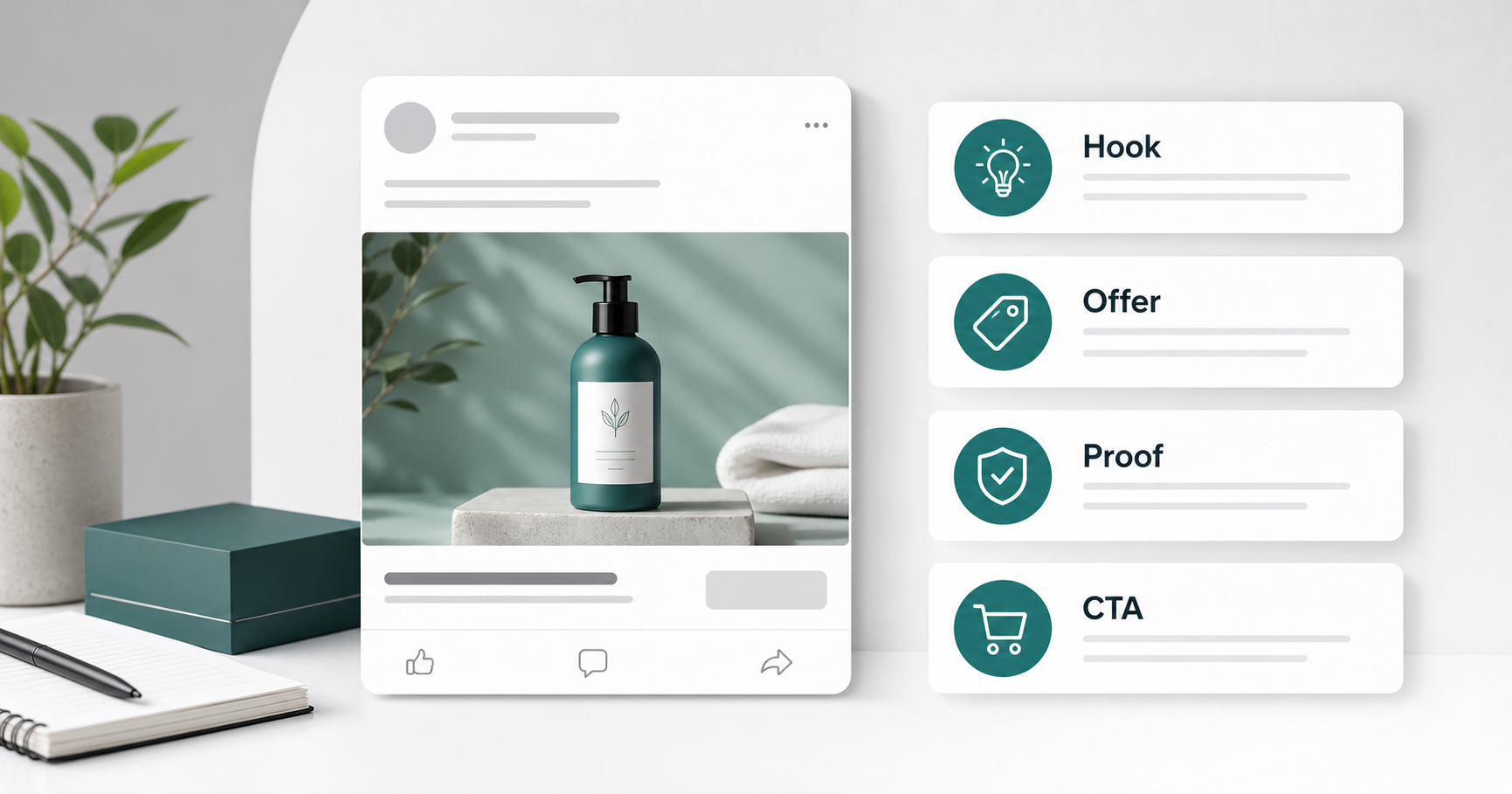
Templates work because ecommerce advertising is repetitive in a useful way. Most ads need the same core parts: a hook, a product promise, a reason to believe, and a next step. The details change by product, audience, and funnel stage, but the structure stays familiar.
The danger is using templates as fill-in-the-blank shortcuts without thinking. “Get [benefit] without [pain]” is not automatically persuasive. It becomes useful only when the benefit and pain are specific enough that the shopper recognizes themselves.
The Anatomy of Ecommerce Ad Copy
| Element | Job | Weak version | Stronger version |
|---|---|---|---|
| Hook | Earn attention | New arrivals are here | Still rebuilding every ad from scratch? |
| Promise | Explain the outcome | Better templates | Build more campaign variations without starting from a blank file |
| Proof | Reduce doubt | Trusted quality | Includes layouts for hooks, offers, proof, and CTAs |
| Offer | Create a reason to act | Buy today | Get the launch bundle before the campaign starts |
| CTA | Clarify the next step | Learn more | View the campaign assets |
The copy should not try to do everything at once. If the visual already shows the product clearly, the copy can focus on the promise. If the product is unfamiliar, the copy may need to explain the use case first. If the buyer has already visited the product page, proof and objections may matter more than education.
Templates by Funnel Stage
Cold Audience Templates
Cold audiences need relevance before persuasion. They do not know the product yet, so the first line should filter for a problem, desire, or recognizable situation.
- “Still [pain point] every time you try to [job]?”
- “The easier way to [desired outcome] without [old friction].”
- “For [audience] who need [result] but do not want [annoyance].”
- “If [problem] keeps slowing down [process], start here.”
Example: “Still making new ad designs that all test the same message? Start by separating your hooks, offers, proof, and CTAs.”
Warm Audience Templates
Warm audiences have seen something already. They need clarity, comparison, or a reason to return.
- “You saw . Here is what is actually included.”
- “Not sure if fits [use case]? Here is the simplest way to use it.”
- “Compare [old way] with [new way].”
- “Before you decide, check [proof/detail/feature].”
Retargeting Templates
Retargeting copy should answer hesitation. If someone viewed a product and left, the ad should not behave like they know nothing. It should remove the next likely objection.
- “Still thinking about ? Here is what you get.”
- “Wondering if works for [use case]? Start with [proof].”
- “Before you close the tab, compare what is included.”
- “Complete your [campaign/order/setup] with [specific asset].”
Copy Angles With Examples
1. Problem Angle
This angle works when the buyer already feels the frustration. The key is to avoid generic pain. “Need better ads?” is too broad. “Your ad designs changed, but your message did not” is more useful because it names a real creative-testing problem.
Template: “Still [specific frustration]? Try [new approach/product] for [specific outcome].”
2. Outcome Angle
Outcome copy focuses on the after-state. It is stronger when it includes a constraint: faster, simpler, fewer steps, less waste, less confusion.
Template: “Build [desired output] without [common bottleneck].”
3. Proof Angle
Proof copy should lower risk. It can use reviews, usage numbers, examples, screenshots, ingredient details, creator notes, or a clear “what’s included” breakdown. Avoid unsupported claims like “high converting” unless you have real evidence.
Template: “See how [audience] use to [job].”
4. Objection Angle
Objection copy is useful when buyers hesitate because of time, cost, complexity, trust, or fit. It should not sound defensive. It should make the next step feel safer.
Template: “No [common fear] needed. Start with [simple action].”
Before-and-After Rewrites
| Weak copy | Better copy | Why it is better |
|---|---|---|
| High-converting templates | Build campaign variations around hooks, offers, proof, and CTAs | Specific and believable |
| Boost your sales today | Turn one product offer into five message angles | Explains the mechanism |
| Don’t miss out | Launch assets are ready before your next promo window | Gives context for urgency |
| Best templates for ads | Editable layouts for testing product, proof, and offer messages | Names the use case |
How to Test Ad Copy Without Guessing
Do not start by testing tiny wording changes. Start by testing different reasons to care. A problem hook and a proof hook can teach you more than five versions of the same discount headline.
| Test | Keep the same | Change |
|---|---|---|
| Hook angle | Image, audience, offer | Problem vs outcome vs proof |
| Offer framing | Hook, image, audience | Discount vs bundle vs bonus |
| Proof type | Hook, product, CTA | Review vs stat vs use case |
| CTA | Hook, product, offer | Shop vs view vs download vs compare |
Build a Reusable Ecommerce Copy Bank
Ad copy templates become more useful when every hook, offer, proof point, and CTA is stored by funnel stage. Keep separate banks for cold prospecting, product education, retargeting, sale campaigns, and repeat buyer campaigns. That keeps this page focused on copy, while ad creative templates handles visual testing and UGC script templates handles creator delivery.
| Copy asset | Best use | Example direction |
|---|---|---|
| Hook | First line of ad | Problem, curiosity, comparison, or outcome |
| Offer line | Conversion push | Bundle, discount, bonus, guarantee, or deadline |
| Proof line | Trust building | Review, feature, result, or product fact |
| CTA | Next step | Shop, compare, get the set, see the routine |
FAQ
What is an ecommerce ad copy template?
It is a reusable writing structure for product ads. It helps organize the hook, promise, proof, offer, objection answer, and CTA.
How many copy variations should I test?
Start with five to eight meaningful variations. Change the angle first, then refine wording after you know which angle is working.
Should ecommerce ad copy be short?
It should be as short as clarity allows. Cold ads often need a fast hook. Retargeting ads can use more detail because the audience already has context.
Conclusion
Good ecommerce ad copy does not come from louder claims. It comes from sharper thinking. Pick the buyer, choose the angle, support the promise, and make the next step clear. Templates are useful when they help you make those decisions faster.