Ad Creative A/B Testing: Complete Guide and Templates
Creative testing becomes expensive guesswork when the team launches variations before defining what each variation is supposed to teach. The platform may choose a lower-cost ad, but that does not automatically produce a reusable explanation.
This guide treats A/B testing as a decision discipline: question, hypothesis, control, delivery conditions, primary metric, guardrails, interpretation, and learning record. A lower CPA does not automatically identify why a variant won, especially when several creative and delivery variables changed together.
Quick answer: Change one principal creative variable when you need causal learning. Pre-write the expected effect and all three decisions—support, contradiction, and inconclusive—before the data arrives.
What A/B Testing Ad Creatives Actually Means
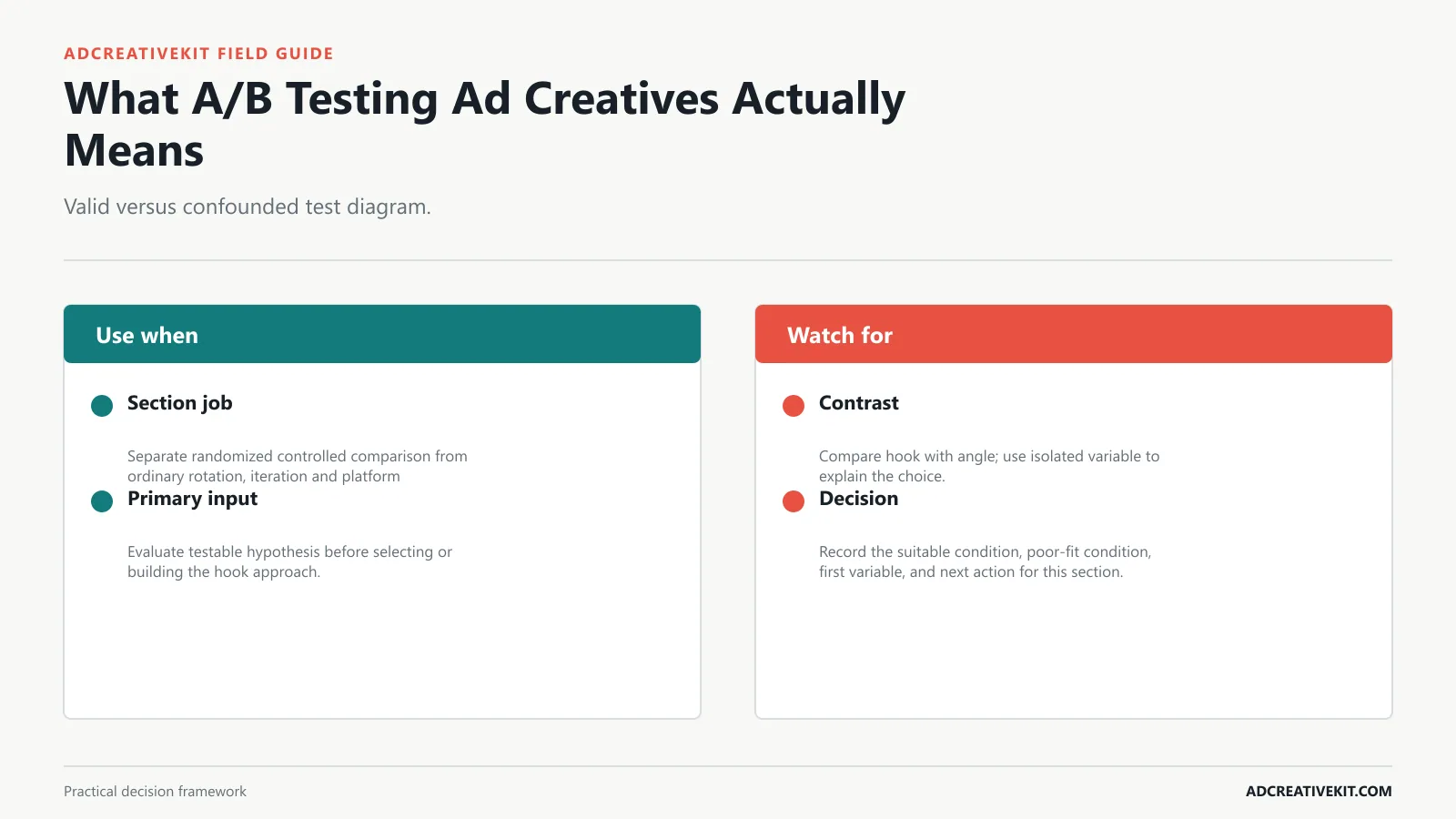
A creative A/B test is a planned comparison designed to answer a pre-written question. Ordinary ad rotation can select an execution, but unequal delivery or multiple simultaneous changes limit what the team can infer. A test of hook should predict what buyer response changes, explain why, and identify the observation that would count against the idea.
Most creative ideas will not become durable account winners, but the proportion varies by account, definition, spend, and measurement window. Track your own concept survival rate instead of importing an unsupported industry percentage.
For best results, test one variable at a time. If you change the visual and the copy simultaneously, you won’t know which change caused the difference.
Select one principal variable to test, such as image versus video. Build only as many comparable variations as the available traffic and decision justify.
Determine evidence needs from the baseline rate, minimum effect worth acting on, and acceptable error risk. Conversion and click counts alone do not guarantee precision; use an experiment calculator or statistical method with stated assumptions.
For faster testing, use static ad templates and ad hooks together. The template controls the layout, while the hook changes the reason someone stops scrolling.
Control isolated variable while examining testable hypothesis. If the variant also changes audience, offer, format, and destination, the result can choose an ad but cannot isolate a learning. Record delivery conditions and guardrails alongside the primary metric.
Replace fixed benchmark advice with an assumption-based plan that states baseline performance, minimum useful effect, uncertainty tolerance, and the decision the evidence must support.
| Experiment field | Pre-launch entry | Decision use |
|---|---|---|
| Hypothesis | Changing the hook will increase qualified product-page visits because it names the buyer’s task | Explains why the variant exists |
| Constant | Audience, offer, body, placement logic, and destination | Protects interpretability |
| Primary metric | Qualified landing-page view rate | Answers the stated question |
| Guardrail | Purchase rate and contribution margin | Prevents a click win from hiding downstream harm |
Confirm current requirements in Meta Ads Manager Campaign and A/B Test Setup. Use the source for platform or compliance facts, while keeping performance conclusions tied to your own account evidence.
When A/B Testing Is the Right Method
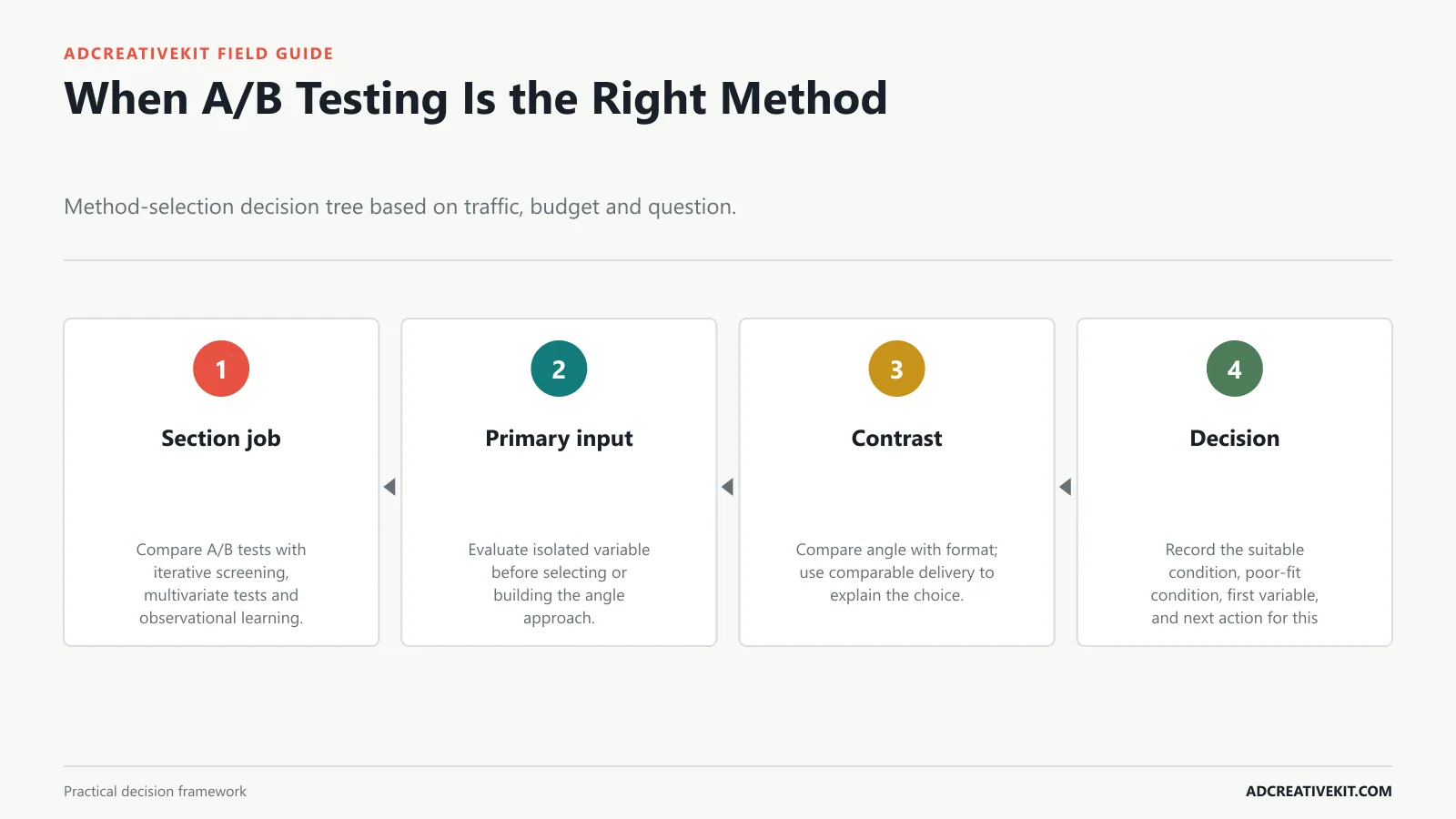
Use an A/B test when the decision is important enough to justify controlled evidence and the account can deliver both variants comparably. Use iterative screening or qualitative review when traffic is too limited for a stable comparison. A test of angle should predict what buyer response changes, explain why, and identify the observation that would count against the idea.
A/B testing is one strong method for estimating a controlled difference. Qualitative research, incrementality studies, observational account data, and iterative screening answer different questions, so the method should follow the decision rather than habit.
Reusable templates can reduce production time, but variants still need one documented difference and comparable message quality. A large asset count does not by itself create a valid experiment.
Use Meta’s current experiment workflow when it can create comparable groups. Budget and duration must be calculated from the account’s expected outcome rate, practical effect threshold, delivery conditions, and business cycle rather than a universal daily-spend rule.
Prioritize the uncertainty with the greatest expected business impact. Creative is often a strong early candidate, but audience, offer, tracking, and destination problems can make a creative-first rule wasteful.
Ad creatives final SEO note: Ad creatives should be tested with one variable at a time. Strong ad creatives make it easier to compare hooks, product visuals, offers, and CTAs without confusing the results.
Control comparable delivery while examining isolated variable. If the variant also changes audience, offer, format, and destination, the result can choose an ad but cannot isolate a learning. Record delivery conditions and guardrails alongside the primary metric.
Separate randomized experiments from ordinary ad rotation; both can be useful, but only the former is designed to estimate a controlled contrast.
Control checklist
- Write the null and alternative explanation for angle.
- Choose a metric connected to isolated variable.
- Hold comparable delivery constant.
- Record how inconclusive delivery will be handled.
Write a Testable Creative Hypothesis
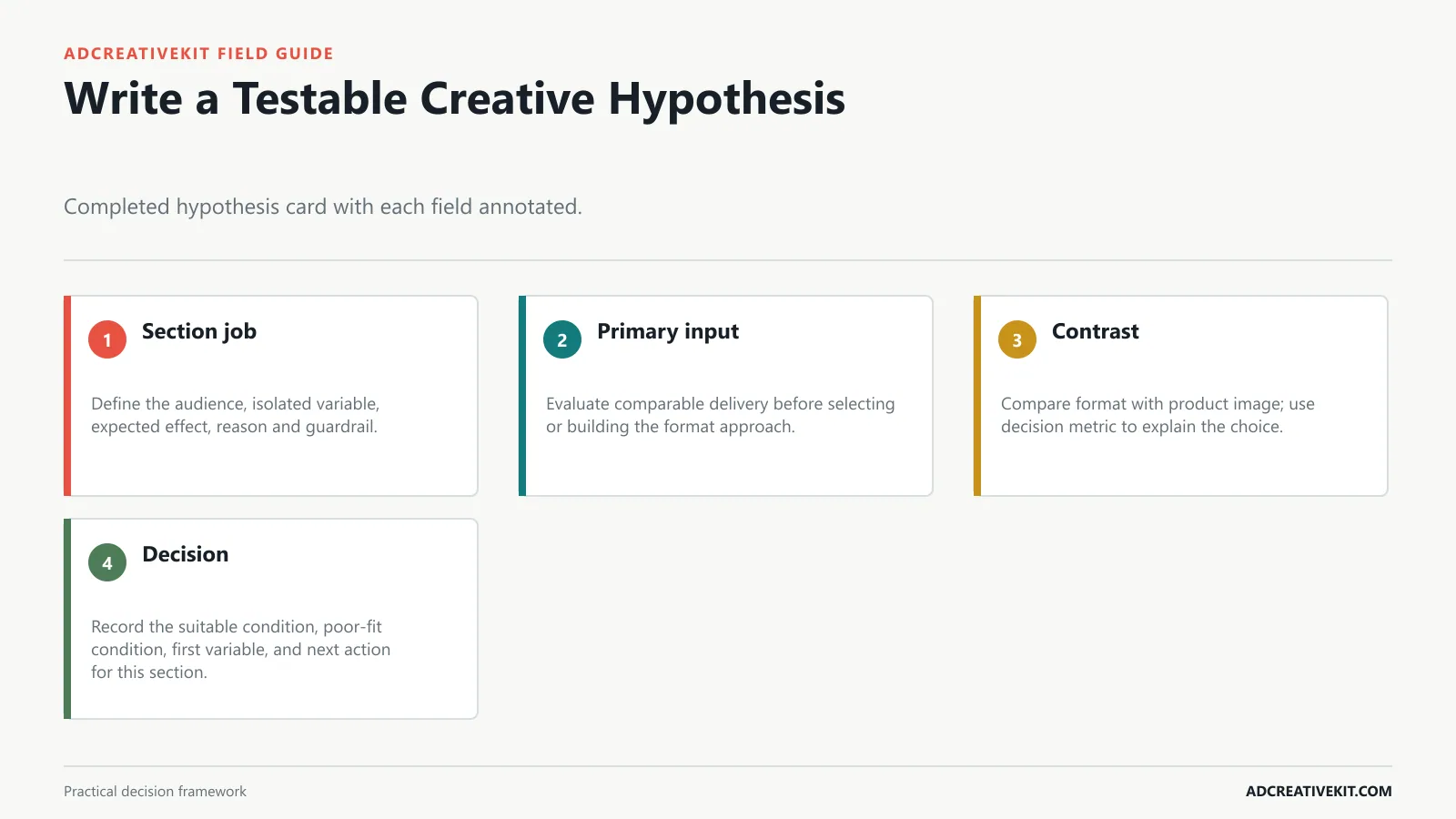
A useful hypothesis names the audience, creative variable, expected behavioral effect, and reason. It should also state what evidence would contradict the explanation rather than only describing a hoped-for win. A test of format should predict what buyer response changes, explain why, and identify the observation that would count against the idea.
This guide covers what to test, how to set up a defensible comparison, how to handle limited evidence, and how to record a decision. Templates support production, while the experiment plan protects interpretation.
Before you test, write down: "If I change [variable], I expect [metric] to improve by [amount]." This forces clarity and makes results meaningful.
Avoid unplanned changes that break comparability. If operational conditions require an intervention, log the time and reason, then decide whether the contrast remains interpretable.
The number of variants should follow available traffic and the value of each comparison. With limited evidence, a focused control-versus-one-variant test is often easier to interpret than a broad batch.
Control decision metric while examining comparable delivery. If the variant also changes audience, offer, format, and destination, the result can choose an ad but cannot isolate a learning. Record delivery conditions and guardrails alongside the primary metric.
For low traffic, accumulate qualitative evidence, run larger concept contrasts, use sequential learning, or prioritize higher-volume proxy behavior without presenting it as purchase proof.
Choose What to Test First
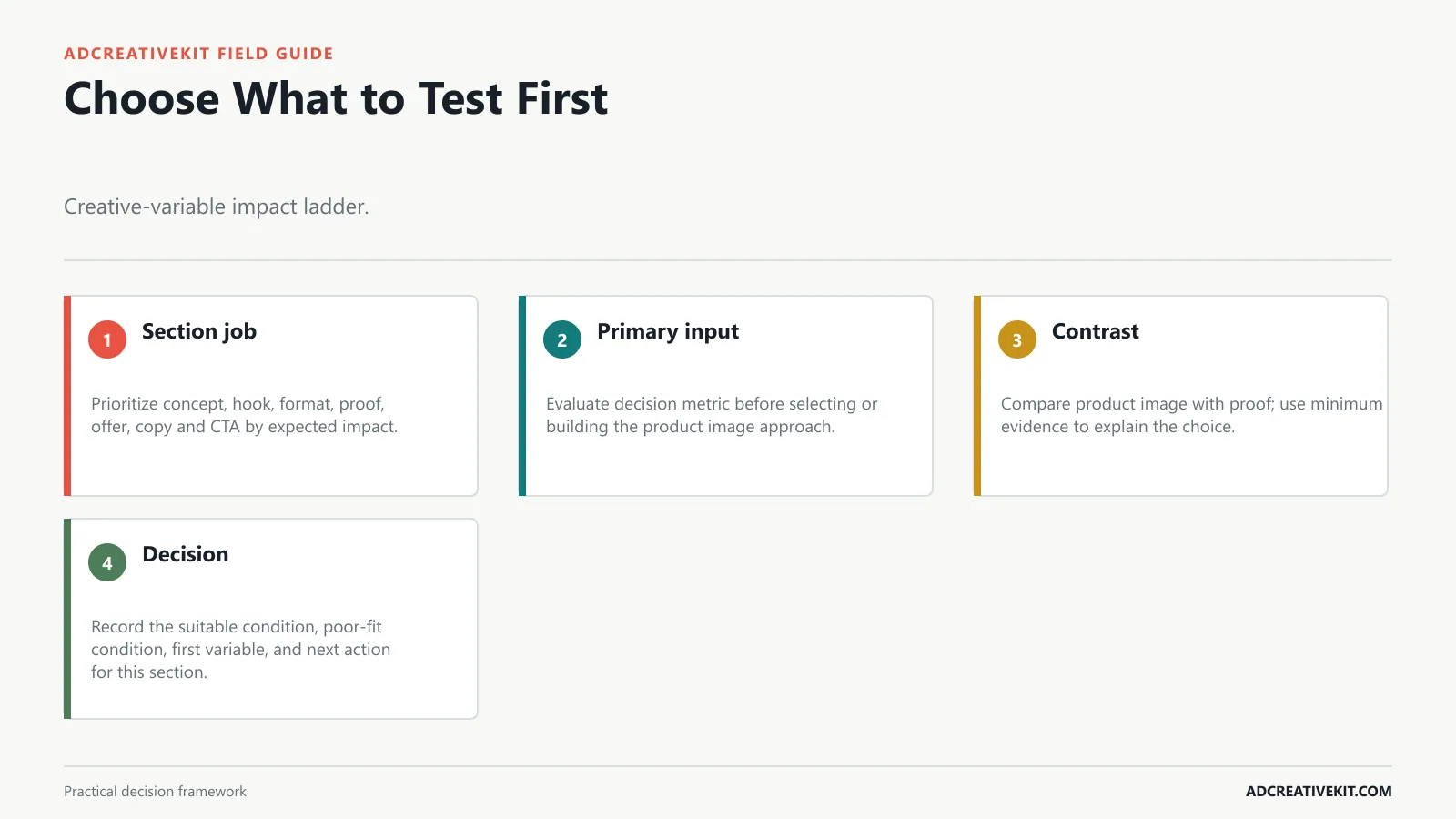
Test the largest unresolved decision first. Concept and angle usually precede headline styling or CTA wording because small execution wins cannot rescue an argument the audience does not value. A test of product image should predict what buyer response changes, explain why, and identify the observation that would count against the idea.
Choose the minimum improvement that would justify changing production or spend. An observed CPA difference has little value without uncertainty, delivery context, and downstream quality.
Isolate one principal variable when the goal is causal learning. Comparing several complete executions is legitimate for screening, but the result identifies a preferred package rather than the element responsible.
Read the preselected primary metric with its uncertainty and guardrails. Do not require an arbitrary percentage lift or confidence convention without relating it to decision cost, test design, and the analysis method.
Automated creative combinations can help screen components where the current campaign type supports them, but unequal combination delivery limits clean attribution. Use a controlled experiment when the purpose is to validate a specific explanation.
Control minimum evidence while examining decision metric. If the variant also changes audience, offer, format, and destination, the result can choose an ad but cannot isolate a learning. Record delivery conditions and guardrails alongside the primary metric.
An inconclusive test preserves uncertainty. Check instrumentation and delivery, then decide whether more evidence is worth the opportunity cost.
Decide checklist
- Write the null and alternative explanation for product image.
- Choose a metric connected to decision metric.
- Hold minimum evidence constant.
- Record how inconclusive delivery will be handled.
Choose the Metric That Answers the Question
Match the primary metric to the hypothesis. Attention measures inform opening-frame questions, click behavior informs message interest, and qualified conversion or profit protects against declaring a cheap but low-quality click a winner. A test of proof should predict what buyer response changes, explain why, and identify the observation that would count against the idea.
A test creates learning only when its setup is interpretable and the result changes a decision. Delivery failure, tracking error, or insufficient evidence may leave the original question unresolved.
Both variations must have the same targeting, budget, placement, schedule, and bid strategy. If these differ, you’re not testing the creative — you’re testing the delivery settings.
Roll out cautiously according to account economics and delivery stability. Scaling can change audience mix and auction conditions, so monitor the primary outcome and guardrails instead of following a universal percentage schedule.
Testing is useful when it converts uncertainty into a better production or media decision. Creative assets provide the inputs; the brief, controls, measurement, and interpretation create the learning.
Control testable hypothesis while examining minimum evidence. If the variant also changes audience, offer, format, and destination, the result can choose an ad but cannot isolate a learning. Record delivery conditions and guardrails alongside the primary metric.
Keep the brief, naming convention, result log, and decision record in one system so interpretation survives handoffs.
Plan Budget, Duration and Sample Needs
Budget and duration depend on baseline rate, minimum effect worth detecting, desired error tolerance, traffic variability, and business cycles. Calculate with explicit assumptions; no universal spend, conversion, or day threshold makes every test valid. A test of headline should predict what buyer response changes, explain why, and identify the observation that would count against the idea.
Testing can reduce decision risk, but it still spends traffic and budget. Prioritize questions whose answer is likely to change meaningful action.
Do not declare a winner from a tiny or unrepresentative sample. Use the experiment’s chosen statistical framework, inspect delivery and tracking, and apply the decision threshold established before launch.
For methodology beyond the platform interface, review the assumptions and limitations in Meta researchers’ incrementality experiment paper. Creative response tests and incrementality tests answer different questions, but both benefit from explicit assignment and estimands.
Control isolated variable while examining testable hypothesis. If the variant also changes audience, offer, format, and destination, the result can choose an ad but cannot isolate a learning. Record delivery conditions and guardrails alongside the primary metric.
Choose the experiment method only after deciding whether the team needs selection, explanation, or incrementality evidence.
Control checklist
- Write the null and alternative explanation for headline.
- Choose a metric connected to testable hypothesis.
- Hold isolated variable constant.
- Record how inconclusive delivery will be handled.
Connect this step to the Facebook ad creative review checklist so the decision survives the handoff from concept to campaign and post-click experience.
Set Up a Controlled Test in Meta
Keep audience eligibility, objective, optimization event, placements, schedule, attribution settings, offer, and destination comparable. Use the platform’s current experiment controls where available and record any delivery imbalance. A test of offer should predict what buyer response changes, explain why, and identify the observation that would count against the idea.
A supported result justifies the decision defined for that test. It does not guarantee the same effect at higher spend, in another audience, or after creative fatigue.
Keep a testing log with the date, variable tested, sample size, results, and the winning variation. Over time, this becomes your personal playbook of what works with your audience.
A/B testing works best when every test has one clear question. Test the hook, product image, offer, CTA, or layout separately before combining winners into a new creative. This keeps your ad creative testing clean enough to learn from.
Control comparable delivery while examining isolated variable. If the variant also changes audience, offer, format, and destination, the result can choose an ad but cannot isolate a learning. Record delivery conditions and guardrails alongside the primary metric.
A hypothesis should predict a buyer response and identify a plausible mechanism, not simply say that version B will perform better.
Confirm current requirements in Meta Blueprint Creative Testing Course. Use the source for platform or compliance facts, while keeping performance conclusions tied to your own account evidence.
Use the Creative Testing Template
The test record should contain the question, hypothesis, control, variant, changed variable, primary metric, guardrails, planned decision rule, delivery notes, result, caveats, and next action. A test of CTA should predict what buyer response changes, explain why, and identify the observation that would count against the idea.
Do not promise a universal ROAS improvement from testing. The value comes from rejecting weak explanations, documenting uncertainty, and repeatedly allocating production toward ideas supported by the account’s own evidence.
Use template layouts as production scaffolds, not as proven baselines. Their performance depends on the audience, product, message, evidence, offer, placement, and destination.
Combine these with our AI copywriting prompts to generate multiple copy variations for each template, then test which combination wins.
Use AdCreativeKit templates to create controlled variants faster, then send the winning creative style to your next campaign or landing page test.
Control decision metric while examining comparable delivery. If the variant also changes audience, offer, format, and destination, the result can choose an ad but cannot isolate a learning. Record delivery conditions and guardrails alongside the primary metric.
Prioritization should reflect expected impact, current uncertainty, evidence cost, and whether the team can act on the answer.
Decide checklist
- Write the null and alternative explanation for CTA.
- Choose a metric connected to comparable delivery.
- Hold decision metric constant.
- Record how inconclusive delivery will be handled.
Connect this step to the landing page optimization guide so the decision survives the handoff from concept to campaign and post-click experience.
Decide: Winner, Loser or Inconclusive
Classify the outcome as supporting, contradicting, or inconclusive. Check tracking and delivery before extending a test, and never convert a noisy directional result into a universal creative rule. A test of landing-page match should predict what buyer response changes, explain why, and identify the observation that would count against the idea.
You can test many variables, but prioritize only those connected to a plausible buyer response and a decision the team is prepared to make.
Meta’s experiment tools can support controlled comparisons, but setup options and delivery behavior vary by campaign type and current interface. Confirm assignment, exclusions, and reporting before interpreting the result.
Plan enough time to capture representative demand and any material business cycle, but do not treat one week as universally sufficient. Use a preplanned stopping rule and document safety or cost conditions that justify early termination.
Ad creatives should be tested in controlled batches. Start with one product and one offer, then create multiple creative angles around the same campaign goal. This makes it easier to see whether the hook, visual, layout, or CTA changed performance.
Control minimum evidence while examining decision metric. If the variant also changes audience, offer, format, and destination, the result can choose an ad but cannot isolate a learning. Record delivery conditions and guardrails alongside the primary metric.
Treat upstream metrics as diagnostic signals and retain downstream guardrails so cheap attention does not hide poor customer quality.
Frequently asked questions
How long should an ad creative A/B test run?
Do not use a universal duration. Plan around sufficient and representative evidence, stable tracking, comparable delivery, business cycles, and a pre-written decision rule. Time alone does not make a test valid.
Can we test several creative elements together?
You can compare packages to choose an execution, but you will not know which element caused the difference. Use isolated tests when the goal is transferable learning.
What happens when a result is inconclusive?
Keep the hypothesis unresolved. Check delivery and instrumentation, then decide whether the expected effect matters enough to justify more evidence or whether another uncertainty deserves priority.
Close every experiment with a written decision. A test that produces numbers but no change to the next brief has consumed traffic without improving the creative system.
Use the Facebook ad creative review checklist before launch, record the hypothesis in the repeatable ad testing system, and inspect post-click continuity with the ecommerce CRO checklist.
Confirm current implementation details in Meta Blueprint Creative Testing Course before production.