Black Friday Ad Templates: A Profitable BFCM Playbook
Black Friday ad templates sit inside an unusually compressed commercial event. Discounts, inventory, delivery promises, media costs, creative fatigue, and customer expectations all move at once. The task is not to make every asset louder. It is to communicate the right offer for the current phase while keeping the economics and operations true.
Quick answer: Begin with an offer the business can support, assign a distinct creative job to each BFCM phase, build placement-specific versions from a small set of layouts, refresh planned variables without erasing the test, and judge success after discount cost, returns, customer mix, and fulfillment impact.
Choose a Black Friday Offer That Fits the Business
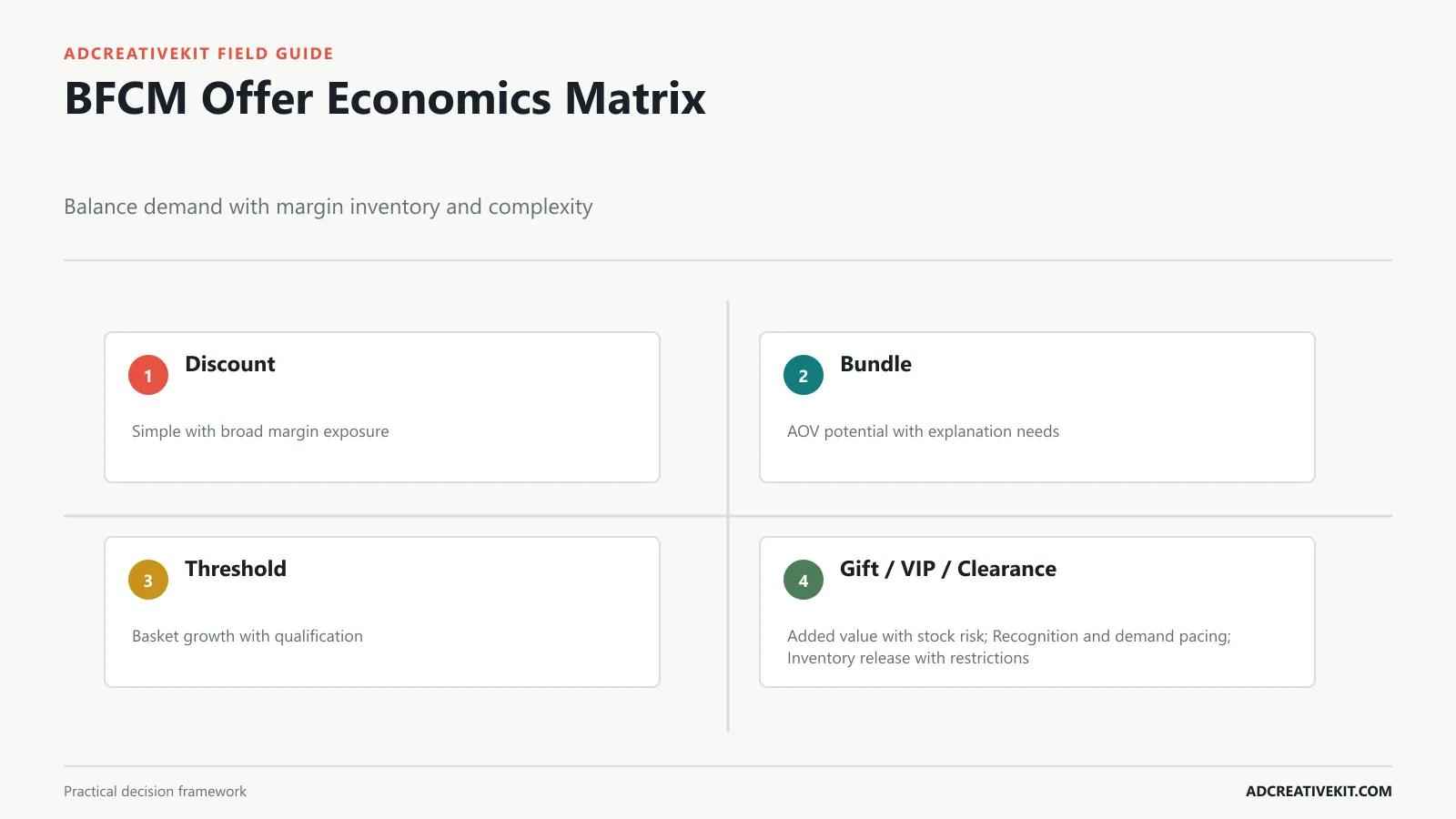
Set the commercial boundary before opening the design file. A sitewide percentage is simple but exposes more revenue to discount. A bundle can raise order value and move complementary stock, although its value needs explanation. A spending threshold can protect economics while encouraging a larger basket. A gift can preserve list price but introduces gift inventory and substitution risk. VIP early access can reward customers and smooth demand. Clearance can release aging inventory but needs accurate product scope and final-sale terms.
| Offer | Useful when | Commercial risk | Creative priority |
|---|---|---|---|
| Sitewide discount | Simplicity and broad reach matter | Margin pressure and exclusions | Value, scope, end time |
| Bundle | Products work better together | Complexity or unwanted items | Contents and combined value |
| Threshold | Larger baskets are realistic | Frustration below threshold | Spend level and reward |
| Gift | Value can be added without repricing | Gift stock and perceived quality | Gift image and eligibility |
| VIP access | Retention and demand pacing matter | Access confusion | Who qualifies and how |
| Clearance | Aged inventory needs movement | Availability and return restrictions | Products and finality |
Model contribution after product cost, discount, shipping support, payment fees, media, returns, and incremental service. The best-looking campaign cannot rescue an offer that becomes harmful when volume arrives. Google Merchant Center’s current Promotions policies are useful when offers will appear in Shopping surfaces because they define eligibility, redemption, and product-scope requirements.
Map Creative to Every BFCM Phase
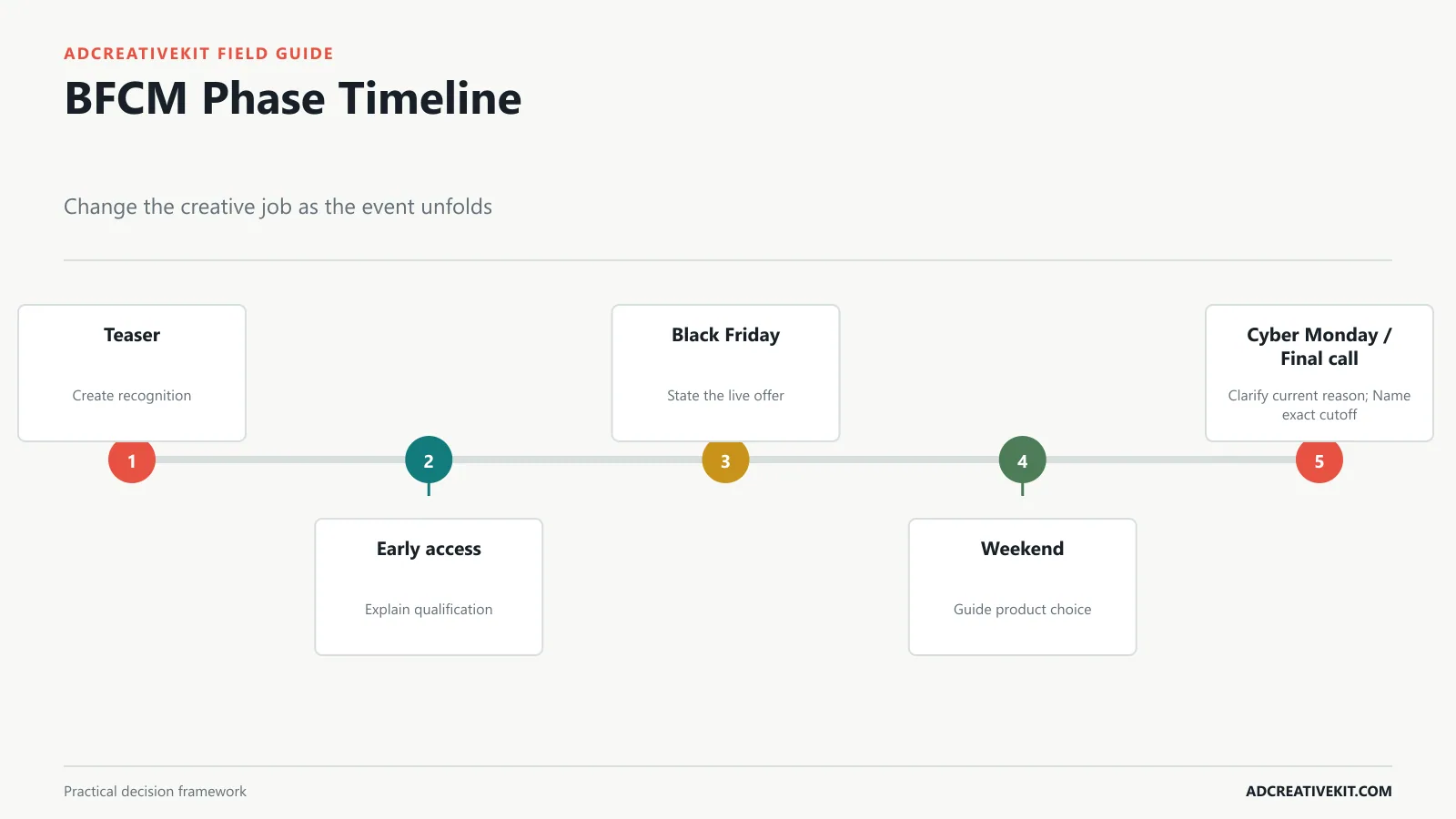
A teaser creates recognition without revealing more than the business intends. Early access explains qualification and rewards the selected audience. Black Friday launch creative states the offer and product scope plainly. Weekend creative can shift toward best sellers, proof, bundles, or category navigation. Cyber Monday may preserve the mechanic or introduce a distinct digital, online-only, or final-phase reason. Final-call creative needs an exact deadline and should not imply extension unless one is genuinely planned.
Create a phase sheet with start and stop times, active offer, eligible audience, message job, destination, asset IDs, inventory owner, and fallback. This prevents yesterday’s promise from remaining live after the campaign changes. NRF’s holiday research hub can provide current market context, but your own customer, inventory, and margin data should drive timing.
Do not make every phase more urgent than the last. Change the information as the shopper’s question changes: first “what is coming?”, then “what is the deal?”, then “which product is right?”, and finally “what ends when?”
Use the Right Black Friday Ad Layout
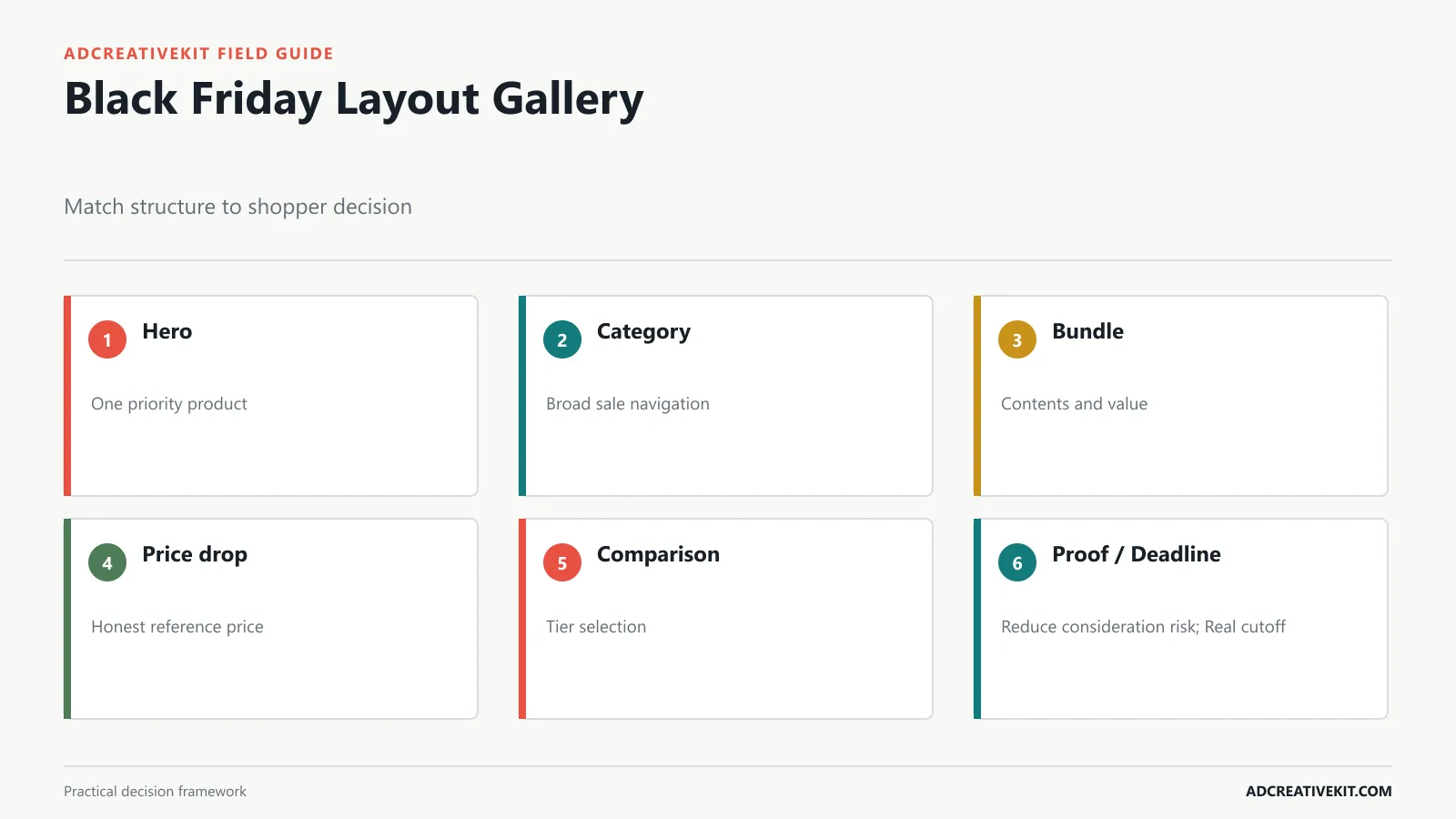
A product-hero layout is useful when one item carries demand. A category-sale layout helps shoppers navigate a wide promotion. A bundle layout needs all included items and combined value. A price-drop layout needs an honest reference price and material conditions. A comparison layout helps customers choose between tiers. A proof layout supports higher-consideration products. A deadline layout is appropriate near a real cutoff.
Keep one visual task per asset. Do not combine a category grid, testimonial, countdown, five badges, and three discount tiers into a single mobile frame. Use a carousel or sequence when the campaign needs several decisions. For slide-by-slide product education, see the Facebook carousel ad template guide.
Build a control from the strongest current hypothesis, not from the most decorative option. The layout should make the product, offer, and qualification legible at feed size. Black backgrounds and sale typography are conventions, not requirements; brand recognition and product clarity matter more.
Write Clear BFCM Copy and Conditions
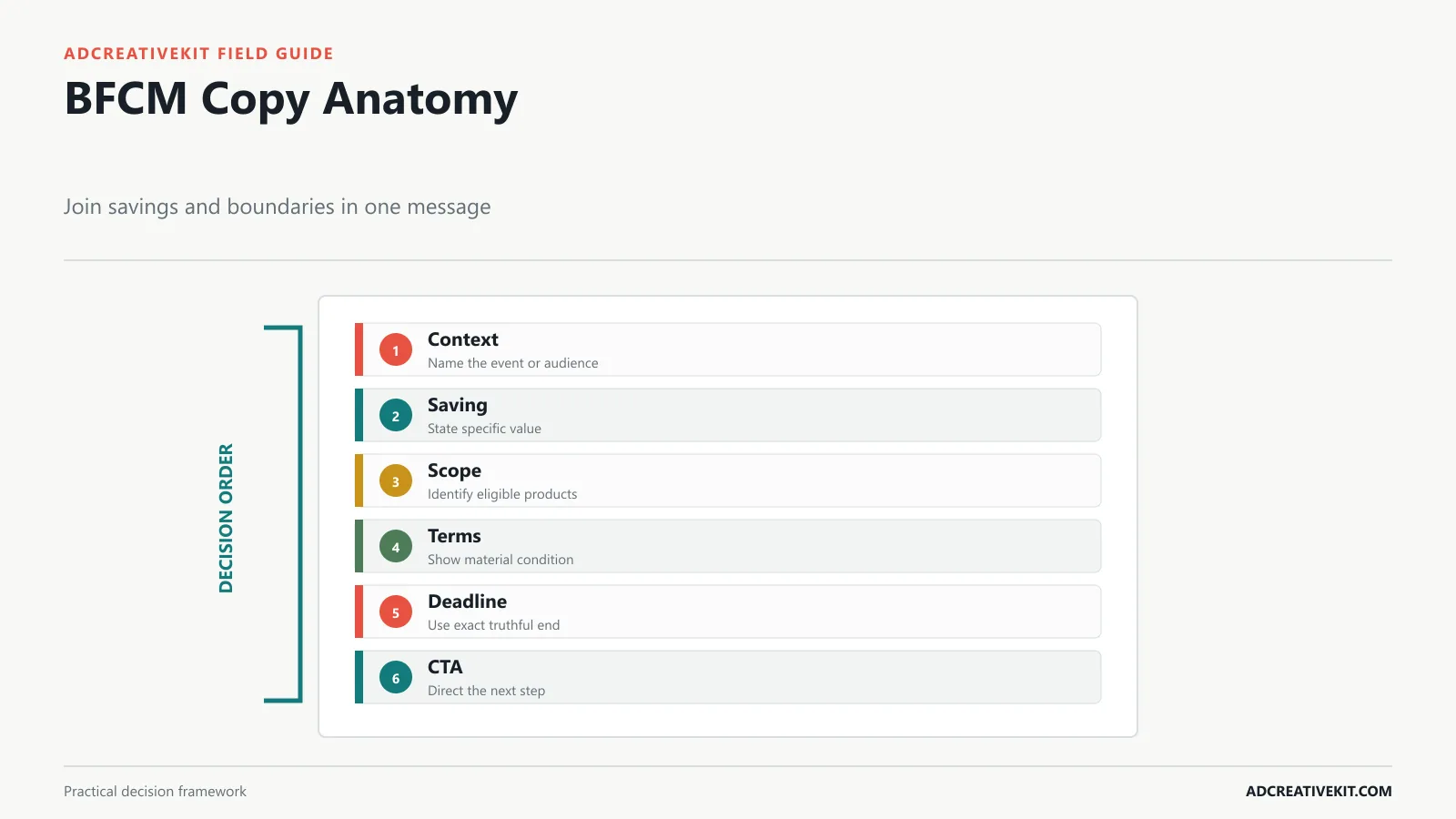
Use a compact structure: sale context, specific value, product or category scope, material condition, exact deadline with time zone where relevant, and action. “Save 25% on eligible cookware through Monday at 11:59 p.m. ET; discount applied in cart” gives the customer a usable expectation. “Biggest sale, hurry!” does not.
Be precise with “up to,” “sitewide,” “free,” “limited,” reference prices, stock, and countdowns. Do not hide exclusions that change the headline’s reasonable meaning. The FTC’s truth-in-advertising guidance is the primary starting point for claim accuracy. Treat review excerpts and endorsements as evidence that requires permission, context, and truthful presentation.
Create approved copy modules for each phase so channel teams do not invent different conditions. Include a short line for visual assets, a social caption, email explanation, onsite wording, and full terms. For hook development that remains anchored to the offer, use the marketing hooks guide.
Build Placement-Specific Creative Variants
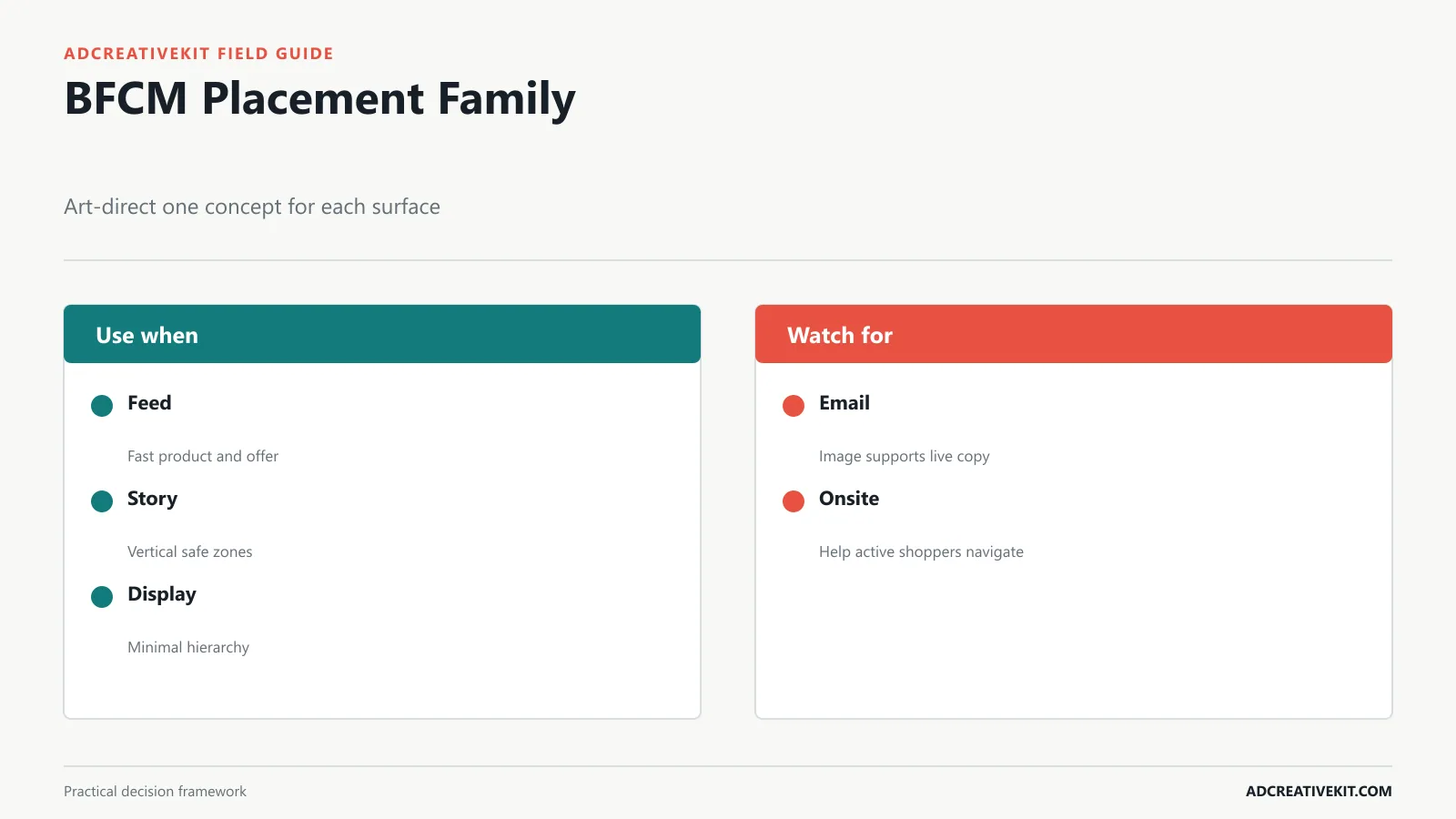
Feed square and portrait placements reward fast product and offer recognition. Stories and vertical surfaces require protected interface zones and fewer words. A reel cover must remain meaningful outside the moving sequence. Display assets need simple hierarchy across sizes. Email graphics support live copy. Onsite banners should help active shoppers find eligible products rather than repeat an external-ad headline without context.
Create a placement plan listing ratio, safe zone, maximum message, product crop, CTA treatment, file format, destination, and owner. Automated resizing can begin production, but every priority placement needs a human crop review. Meta’s photo-ad guidance recommends a focal point, visual consistency, restrained text, and experimentation.
Keep the strategic variable stable across placement versions. A portrait adaptation of the same proof-led concept is not a new hypothesis merely because elements moved. Name files so the phase, audience, angle, variable, and placement remain visible.
Refresh Creative Without Losing the Learning
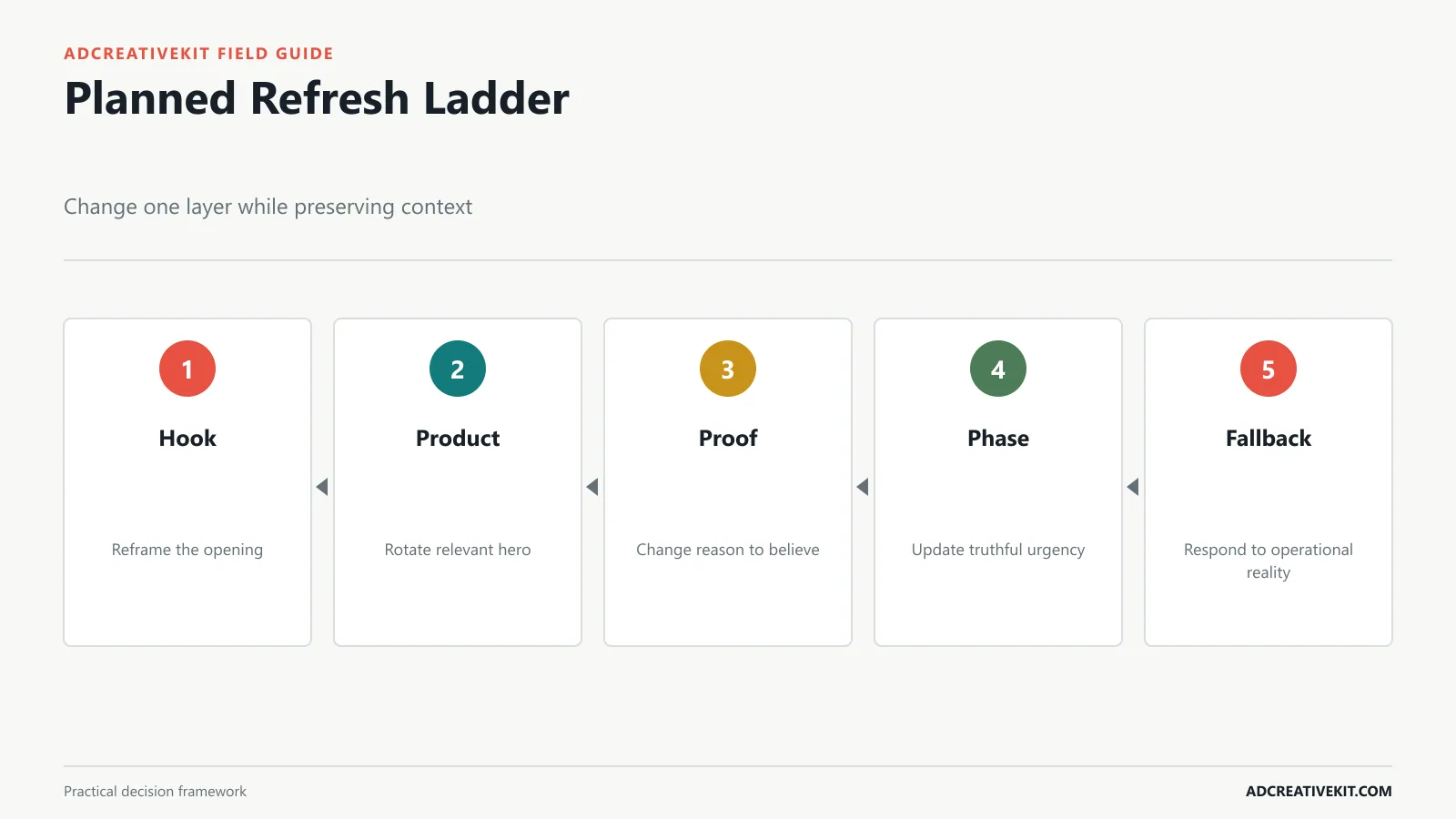
Prepare a refresh ladder before launch. Hold the offer and audience stable while changing one layer: opening hook, hero product, proof, product set, or deadline emphasis. Move to a new phase when the calendar or operational reality changes. Keep approved fallback assets for sold-out products, delayed fulfillment, rejected ads, and extended inventory.
Fatigue is not proven by one weak day. Compare frequency, reach expansion, cost, click quality, conversion, and the campaign phase. A creative may appear weaker because the easiest demand has already converted or the product set changed. Record context before declaring the visual exhausted.
Use a learning log that links each asset to its hypothesis and result. The repeatable ad testing system explains how to preserve control, variable, and decision history across campaigns.
Run the BFCM Launch QA
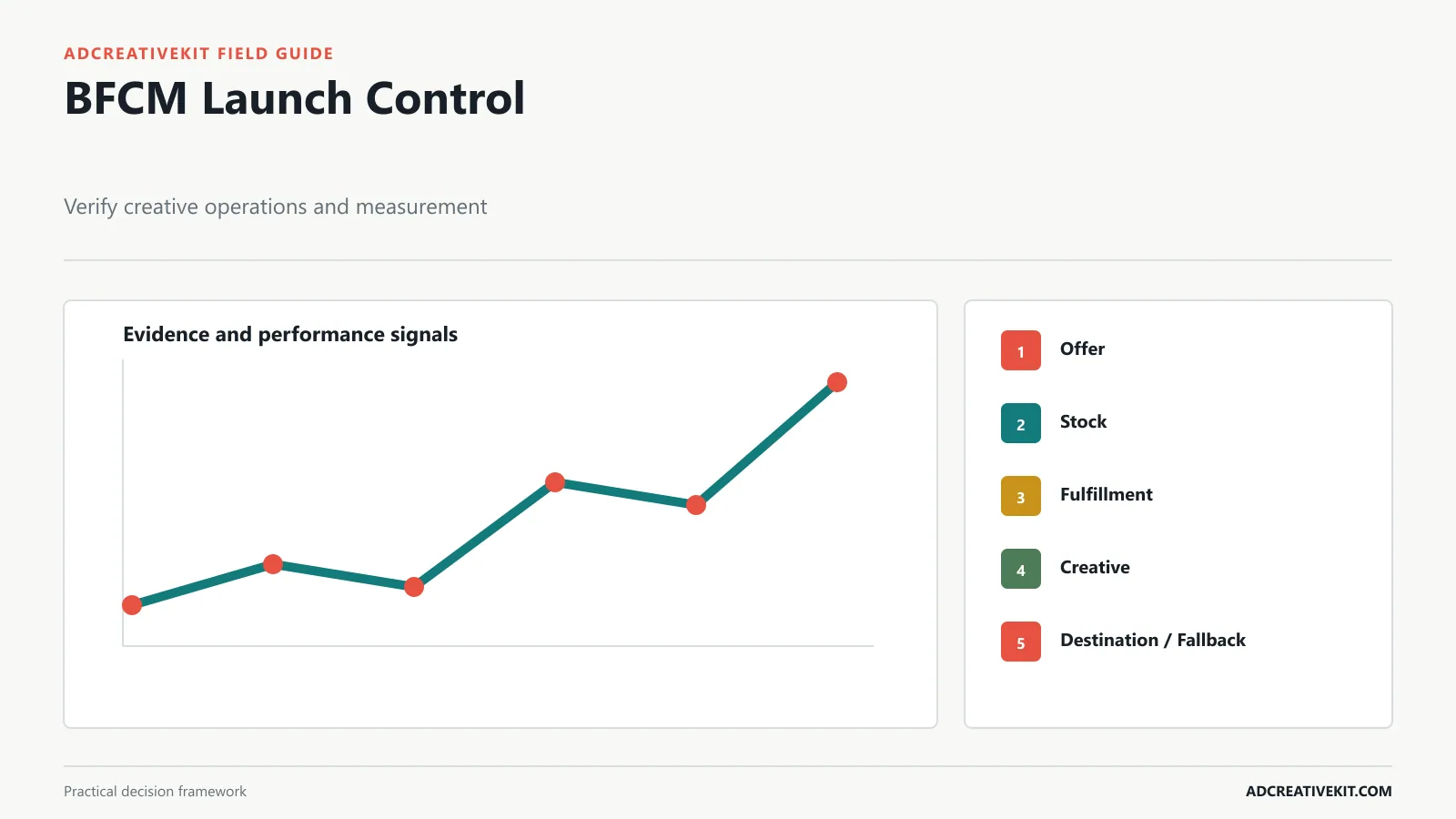
- Offer: saving, scope, code, conditions, exclusions, start, end, and time zone agree.
- Inventory: promoted products, gifts, and bundles have owners and alternatives.
- Fulfillment: delivery promises reflect actual capacity and regions.
- Creative: mobile crops, product accuracy, contrast, claims, and phase labels pass.
- Destination: price, eligibility, stock, code behavior, and checkout repeat the promise.
- Policy: ad accounts, destinations, disclosures, and review time are accounted for.
- Measurement: campaign parameters, conversion events, margin inputs, and annotations are validated.
- Fallback: sold-out, expired, rejected, and operational-incident assets are ready.
Assign evidence and a decision owner to every critical item. “Checked” is weaker than a screenshot, test order, inventory report, or approved claim file. Define conditions that pause a product, channel, or campaign before launch-day pressure makes the decision harder.
Measure Profitable BFCM Performance
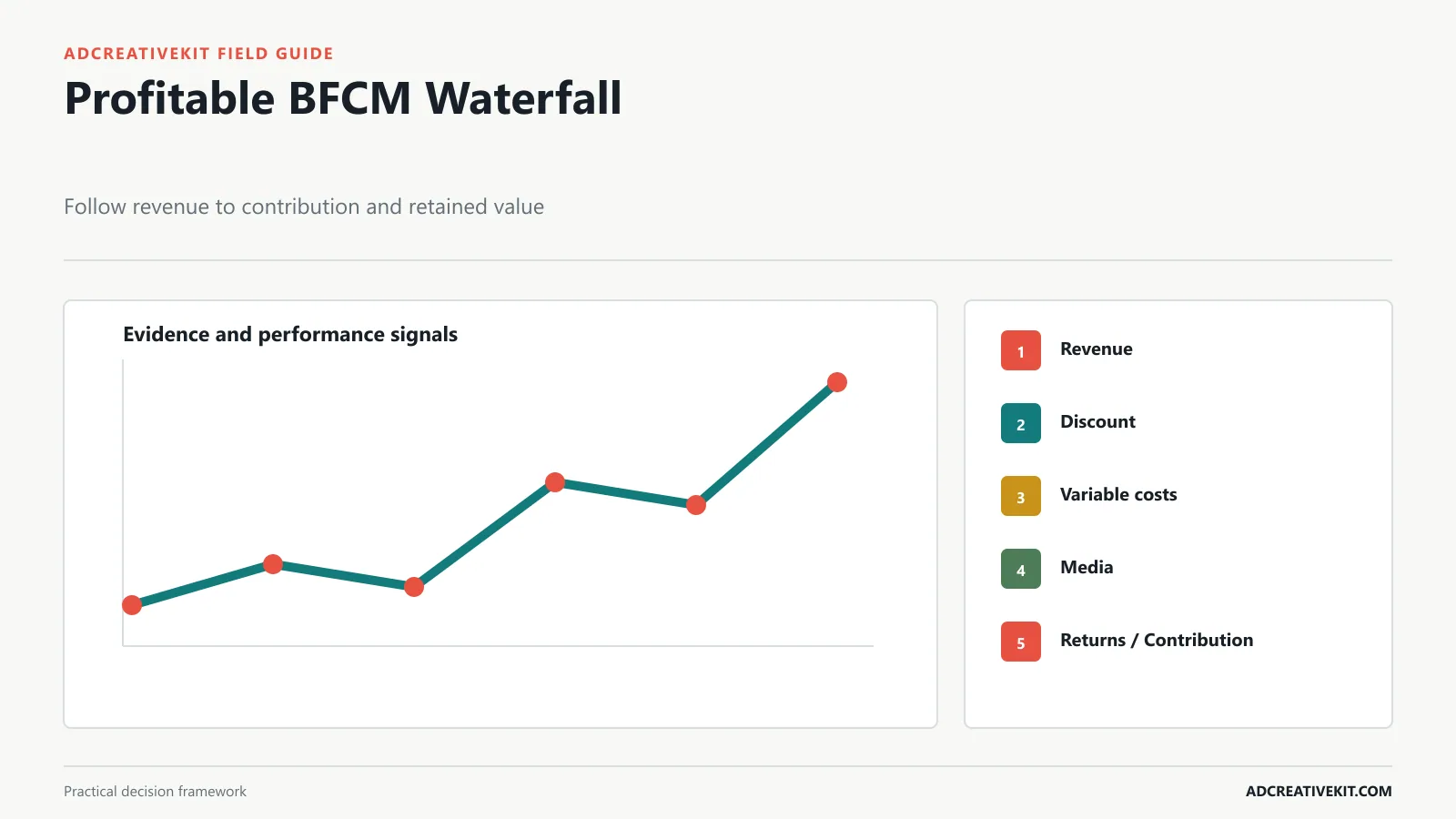
Build a waterfall from gross revenue to discounts, cost of goods, shipping support, payment costs, media, returns, incremental labor, and contribution. Add average order value, units per order, new-customer share, product mix, stockouts, support contacts, return reasons, and post-promotion retention. Compare with an appropriate baseline while acknowledging that Black Friday demand is not an ordinary week.
Creative metrics still matter diagnostically. Delivery and thumb-stop behavior indicate access and attention. Click quality and landing engagement indicate message match. Conversion and product mix indicate commercial relevance. Contribution and downstream customer behavior determine whether scaling the pattern is sensible.
Worked example: sequence a bundle across BFCM
Imagine a cookware brand promoting a three-piece starter bundle. Teaser creative reveals the product silhouette and early-access date without inventing scarcity. The customer email explains access and the included pieces. On Black Friday, a bundle layout shows all three products, normal combined price, promotional price, exact end time, and destination. Weekend creative rotates to a cooking use case and verified review while preserving the offer.
Cyber Monday creative may emphasize online ordering and the final active deadline, provided those claims are true. If one pan sells out, the team activates an approved substitute bundle or removes the asset; it does not leave the pictured configuration live. The control and each refresh keep a shared naming root so performance can be interpreted as one evolving campaign family.
Preserve BFCM learning after the rush
Complete a phase-by-phase record rather than one blended summary. For teaser, early access, live sale, weekend, Cyber Monday, and final call, capture active offer, audience, products, creative family, spend, inventory events, conversion quality, contribution, and operational exceptions. This prevents the strongest day from obscuring a weak phase or fulfillment problem.
Separate reusable insight from event-specific effect. A proof format may remain useful after Cyber Week; a countdown response depends on a real deadline. A bundle may have performed because its products stayed available while alternatives sold out. Label every conclusion with the evidence and context supporting it.
Prepare next year from verified records
Archive approved terms, source files, placement exports, rejected concepts, fallback assets, and the decision log. Update the next offer model, production calendar, stock thresholds, review deadlines, and stop conditions. Record which assets were difficult to adapt and which claims required late approval.
Do not duplicate the prior campaign and replace the year. Product mix, platform behavior, customer expectations, media cost, and fulfillment capacity may have changed. Reuse the operating structure, then rebuild assumptions from current evidence.
BFCM stop and substitution rules
Pause a product asset when availability becomes too low to support the paid audience, when price or code behavior differs from the ad, or when fulfillment can no longer support the stated promise. Replace it with an approved alternative that has its own accurate image, terms, and destination. Do not silently swap products inside an existing file if the change makes prior proof or value language inaccurate.
Pause the wider campaign when a checkout defect, systemic pricing error, unsupported claim, or severe delivery problem affects customers across products. Keep a reduced-scope option ready: owned channels only, selected regions, available categories, or a different offer. The command plan should identify who can make that decision and how every channel will be updated.
One final operating check: reconcile the active ad list with the offer sheet at every phase handoff. Confirm which products remain promoted, which deadlines appear, which codes work, and which destinations are live. A short scheduled reconciliation prevents a strong but expired asset from continuing after the commercial reality has changed.
Frequently asked questions
When should Black Friday ads start?
Start when the phase has a truthful job, such as awareness, early access, or live promotion. Do not create false availability or urgency simply to begin earlier.
Should Black Friday and Cyber Monday use different templates?
They may share a system, but each phase should accurately reflect the active offer, deadline, inventory, and channel context.
How often should BFCM creative be refreshed?
Prepare refreshes in advance, then deploy them from phase changes and evidence. Avoid redesigning so many variables that the result loses meaning.
For gifting, delivery cutoff, last-minute rescue, and post-holiday self-purchase campaigns, continue with the broader seasonal playbook.