Retargeting Ad Templates for Ecommerce: Cart, Product, and Repeat Buyer Examples
Retargeting ads work because the audience has already shown intent. The creative should not repeat a cold prospecting message. It should answer the question that likely stopped the shopper from buying.
Sections
- Why retargeting creative is different
- Templates by audience behavior
- A practical retargeting sequence
- The four objections retargeting must handle
- Mistakes that waste retargeting budget
- FAQ
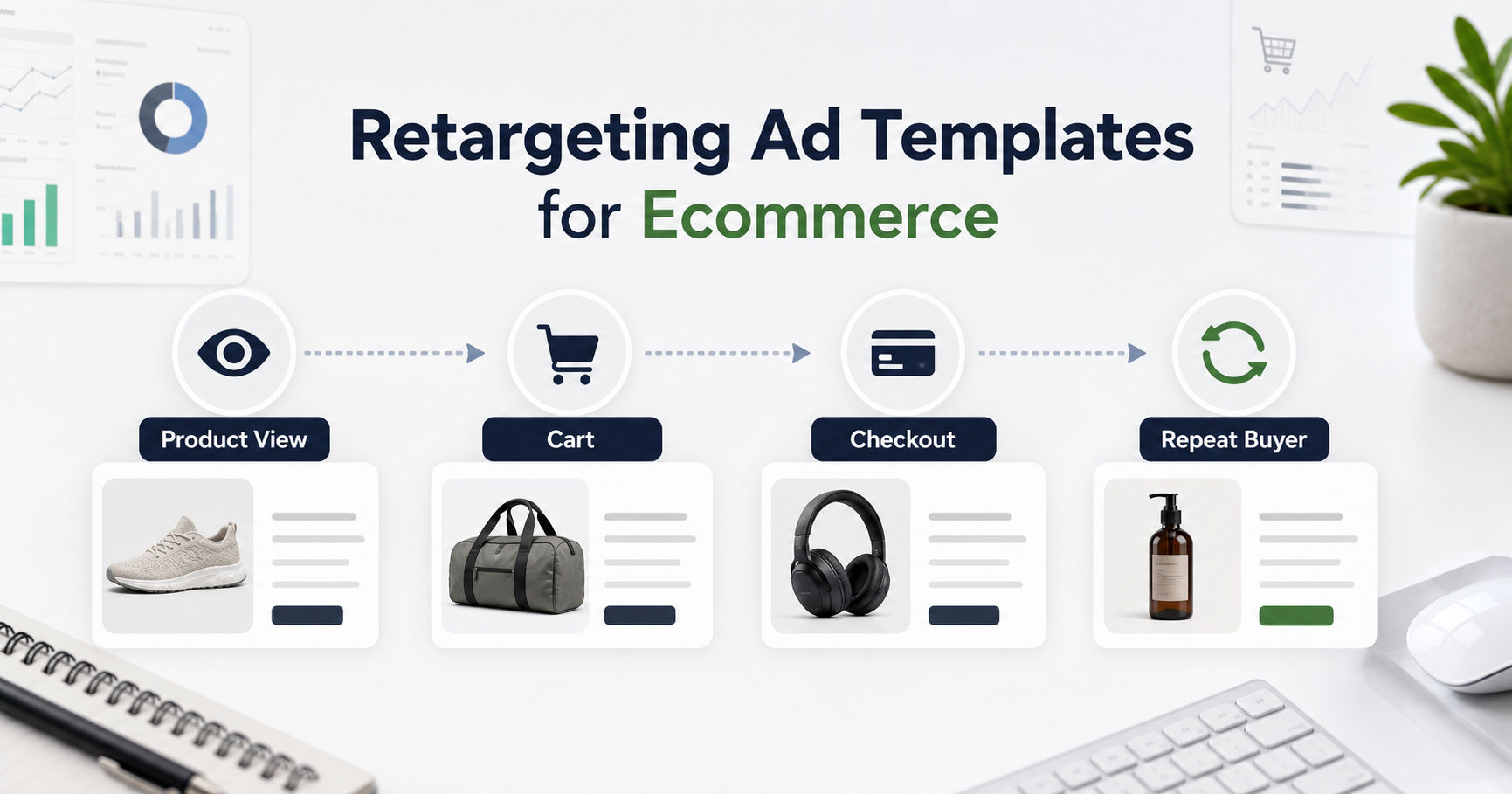
TL;DR: Strong ecommerce retargeting ads match the creative to the shopper’s behavior. Product viewers need clarity. Cart abandoners need reassurance. Checkout abandoners need trust. Previous buyers need a relevant next offer.
The biggest mistake in ecommerce retargeting is showing everyone the same “come back and shop” ad. That message might work occasionally, but it ignores the most valuable thing retargeting gives you: context.
A person who viewed one product is not the same as a person who added a bundle to cart. A first-time visitor is not the same as a repeat buyer. The ad should reflect that difference.
Why Retargeting Creative Is Different
Cold ads establish relevance. Retargeting ads remove friction. The shopper already knows something about the product or brand. Your job is to identify what might still be missing: price confidence, trust, timing, clarity, or a reminder.
| Audience | Likely question | Best creative angle |
|---|---|---|
| Product viewer | Is this right for me? | Use case or benefit proof |
| Add-to-cart visitor | Should I finish buying? | Cart reminder and reassurance |
| Checkout abandoner | Can I trust this? | Shipping, guarantee, support, reviews |
| Content visitor | What should I do next? | Educational next step |
| Past customer | What should I buy next? | Replenishment, upgrade, or cross-sell |
Templates by Audience Behavior
1. Product Viewer Template
Product viewers need more context. They clicked because something interested them, but they did not yet see enough value to act.
Structure: remind them of the product, clarify the use case, add one proof point, then send them back to the product page.
- “Still comparing ? Here is what makes useful for [use case].”
-
Uncategorized
1,300+ Viral Video Hooks
Original price was: $ 29,00.$ 9,00Current price is: $ 9,00. Add to cart
-
- “Not sure if fits [audience]? Start with [specific benefit].”
- “See how solves [recognizable problem].”

2. Cart Abandonment Template
Cart abandoners usually need reassurance, not a brand introduction. Keep the message direct and remove anything that does not help them finish.
- “Your is still in your cart.”
- “Still thinking it over? Here is what is included.”
- “Complete your order and get [specific delivery/access/benefit].”
3. Checkout Abandonment Template
Checkout abandoners are closest to purchase, so the creative should reduce risk. Mention shipping, access, returns, secure checkout, support, or social proof where relevant.
- “Almost done. Your order is ready when you are.”
- “Questions before checkout? Here is how delivery and access work.”
- “Finish checkout and get instant access to [specific product/resource].”
4. Past Customer Template
Previous buyers should not see the same first-purchase ad forever. Give them a reason to return that matches what they bought or used.
- “Planning your next [campaign/restock/launch]? Here is the next useful asset.”
- “Already have ? Add [related product] for [next outcome].”
- “Restock before [moment].”
A Practical Retargeting Sequence
| Window | Audience | Message | CTA |
|---|---|---|---|
| Days 1-3 | Product viewers | Use case and benefit clarity | View product |
| Days 4-7 | Cart abandoners | Reminder and included items | Complete checkout |
| Days 8-10 | Warm visitors | Review, proof, or objection answer | See examples |
| Days 11-14 | Still warm | Offer, bundle, or FAQ answer | Get started |
This sequence is only a starting point. Higher-priced products often need a longer consideration window. Low-ticket impulse products may need fewer steps. The point is not the exact day count; it is matching the message to the shopper’s level of intent.
The Four Objections Retargeting Must Handle
Price
Use bundles, savings, free shipping, or value breakdowns. Do not discount automatically if the product’s value is unclear.
Trust
Use reviews, customer photos, creator demonstrations, guarantees, or transparent details. Trust ads should feel calm, not desperate.
Timing
Use deadlines only when they are real. False urgency damages trust quickly, especially in retargeting.
Distraction
Sometimes the shopper simply got interrupted. A clean reminder ad with the product, one benefit, and one CTA may outperform a complicated offer.
Mistakes That Waste Retargeting Budget
- Showing the same ad to product viewers, cart abandoners, and past buyers.
- Using discount as the only objection handler.
- Sending cart abandoners back to the homepage instead of the cart or product page.
- Retargeting customers with the exact item they already bought.
- Changing the offer, image, copy, and audience at the same time.
Retargeting Message Map by Funnel Stage
The biggest upgrade you can make to retargeting creative is to stop treating every visitor as the same kind of warm lead. Retargeting works best when the message reflects the exact behavior that brought the shopper into the audience.
| Behavior | Likely Friction | Creative Message | Template Type |
|---|---|---|---|
| Viewed product once | Not enough relevance or clarity | Show the use case and main benefit | Benefit reminder |
| Viewed product multiple times | Interested but undecided | Add proof, comparison, or review evidence | Proof-led retargeting |
| Added to cart | Price, timing, shipping, or confidence | Reassure and simplify the next step | Cart recovery |
| Started checkout | Trust, payment, delivery, or policy concern | Show guarantee, delivery clarity, and support | Checkout reassurance |
| Past buyer | Needs a relevant next reason to return | Cross-sell, replenishment, bundle, or loyalty offer | Repeat buyer offer |
Example 7-Day Retargeting Sequence
A simple retargeting sequence can teach more than a single evergreen ad. The goal is to move from reminder to reassurance to decision support.
- Day 1: Product reminder. Show the exact product or category the shopper viewed with a clear benefit.
- Day 2-3: Proof ad. Use customer reviews, product close-ups, before-and-after context, or creator proof.
- Day 4-5: Objection ad. Address price, sizing, shipping, guarantee, quality, or fit.
- Day 6-7: Offer clarity. Present the bundle, limited bonus, free shipping threshold, or deadline if one is real.
This sequence gives the shopper a different reason to return each time. It also prevents ad fatigue from repeating the same message to people who already ignored it.
Retargeting Creative QA Checklist
- Does the ad match the audience behavior?
- Does the image or video remind the shopper what they were interested in?
- Does the message answer a likely objection instead of repeating a cold prospecting promise?
- Is the CTA appropriate for the buyer’s stage?
- Does the landing page continue the same message?
- Is the frequency reasonable, or is the audience seeing the same ad too often?
Retargeting is not just about following people around the internet. It is about returning with a better answer than the one they saw the first time.
Retargeting Frequency and Message Rotation
Retargeting creative should rotate by behavior and time. A product viewer needs education or proof. An add-to-cart shopper needs confidence and urgency. A repeat buyer needs replenishment, cross-sell, or VIP logic. If every warm audience sees the same discount, the campaign becomes noisy and less useful.
Use testimonial templates for proof, product promotion templates for offer logic, and the ad testing matrix to decide which retargeting angle deserves another iteration.
FAQ
What is an ecommerce retargeting ad template?
It is a reusable ad structure for people who already interacted with your store, product, content, or checkout.
What should cart abandonment ads say?
They should remind the shopper what they left behind, repeat the value, reduce hesitation, and send them back to the right page.
Should retargeting ads always include discounts?
No. Discounts can work, but proof, reassurance, product education, and bundles often solve the real hesitation more profitably.
Conclusion
Retargeting is not about following people around with a louder version of your cold ad. It is about responding to intent. Match the template to the behavior, answer the likely objection, and keep the next step simple.