Promotional Templates: Build Offers Customers Understand
Promotional templates are often chosen after someone decides that a campaign needs to “look like a sale.” That reverses the useful order. The offer mechanic affects margin, average order value, inventory, customer expectations, and the message a shopper must understand. Design should make that commercial decision clearer, not hide its complexity behind a badge.
Quick answer: Choose the promotion mechanic from the business objective and constraint. Express the value, qualification, conditions, deadline, exclusions, and action clearly. Adapt the same offer for each customer segment and channel, test the commercial mechanic separately from its presentation, and review both operational accuracy and customer quality.
Choose the Promotion Mechanic Before the Template
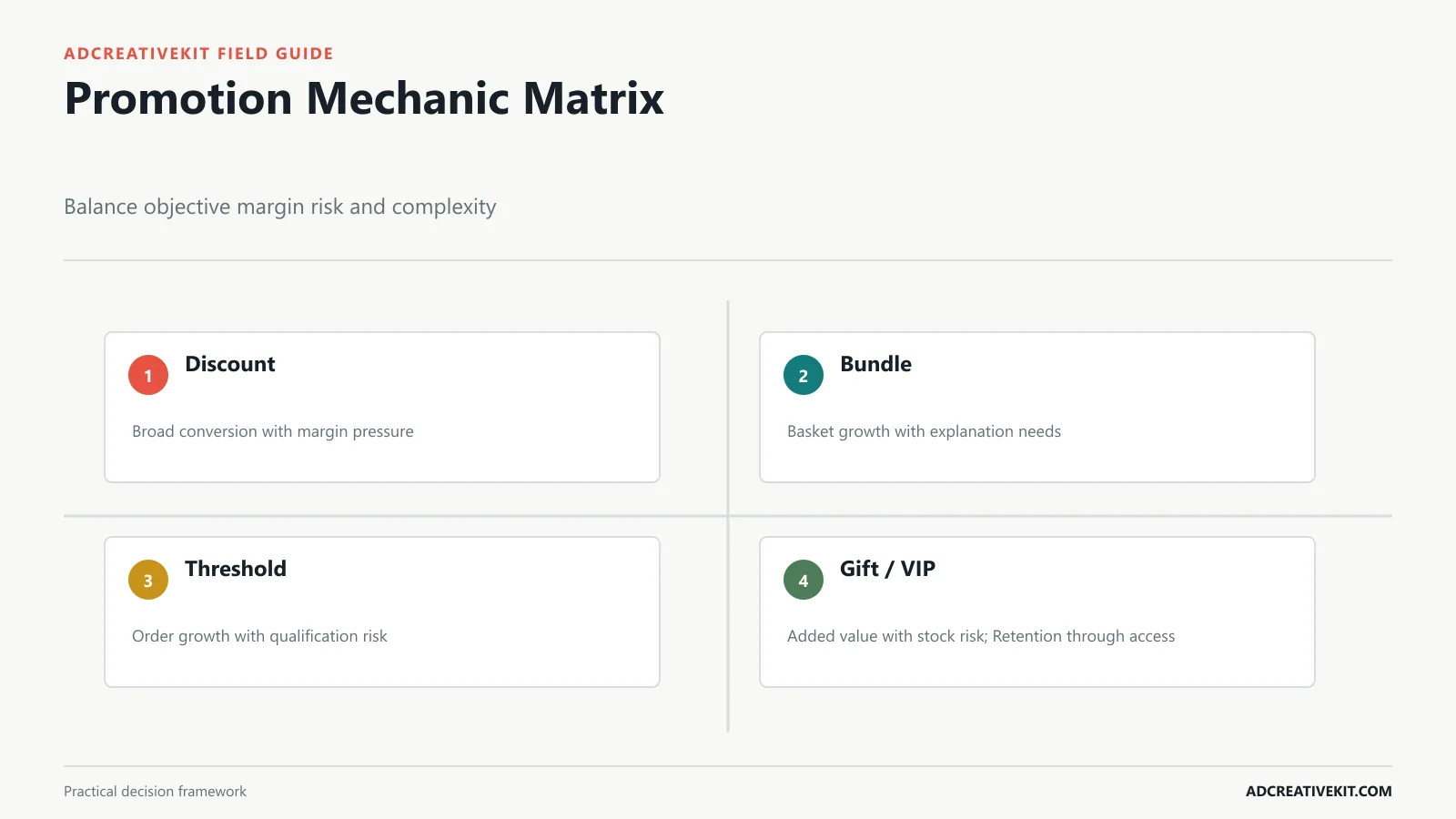
A percentage discount is easy to recognize but can compress margin across every qualifying item. Fixed savings can feel concrete when the base price is understood. Bundles can increase basket size and introduce complementary products, but the combined value must be obvious. Threshold offers can lift order value while frustrating shoppers who are just below the requirement. Gifts can preserve price integrity, provided the gift is desirable and fulfillment can support it. Loyalty and early-access offers reward a defined group rather than discounting publicly.
| Mechanic | Best objective | Main risk | Template must clarify |
|---|---|---|---|
| Percentage off | Broad conversion push | Margin and reference-price erosion | Scope, exclusions, end time |
| Fixed saving | Concrete value communication | Weak meaning without price context | Original price and qualification |
| Bundle | Basket growth or product discovery | Complexity and unwanted items | Contents and combined value |
| Threshold | Higher order value | Customer frustration | Required spend and reward |
| Gift | Value without lowering price | Stock and perceived gift quality | Gift, eligibility, availability |
| VIP access | Retention and recognition | Unclear eligibility | Audience and access method |
Model the likely unit economics before creative production. The template cannot repair an offer that attracts unprofitable baskets or trains customers to wait for discounts. For seasonal mechanics, the holiday sale campaign guide adds timing, gifting, and fulfillment considerations.
Use the Offer Clarity Framework
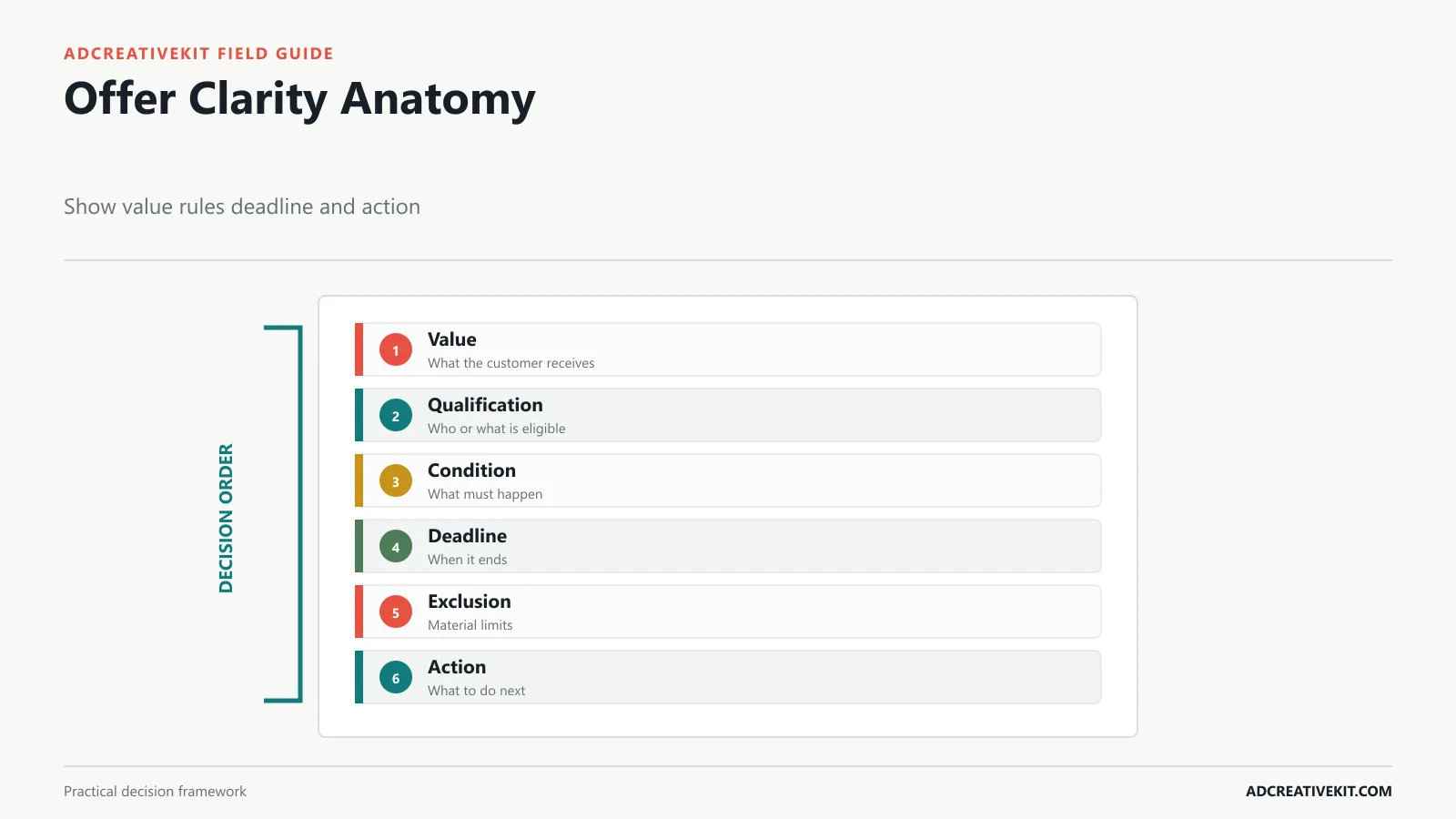
Every promotion should answer six questions: What value is offered? Who or what qualifies? What condition must be met? When does it end? What important exclusions apply? What should the shopper do next? Not every answer needs equal visual weight, but none should be difficult to find.
Use a decision order: lead with the sale reason or outcome, show the relevant product or category, state the value, reveal the most important condition, give a truthful deadline, and provide the action. Put longer terms near the creative or on the destination, but never use fine print to reverse the main impression.
Check the offer in plain language with someone outside the campaign. Ask them to explain it back. If they confuse “up to 50%” with “50% off everything,” assume customers can too. Google Merchant Center’s current Promotions policies are a useful operational reference for eligibility, redemption requirements, product scope, and codes, while the FTC’s truth-in-advertising guidance reinforces that the overall impression must be truthful and supported.
Match Promotional Templates to Customer Segments
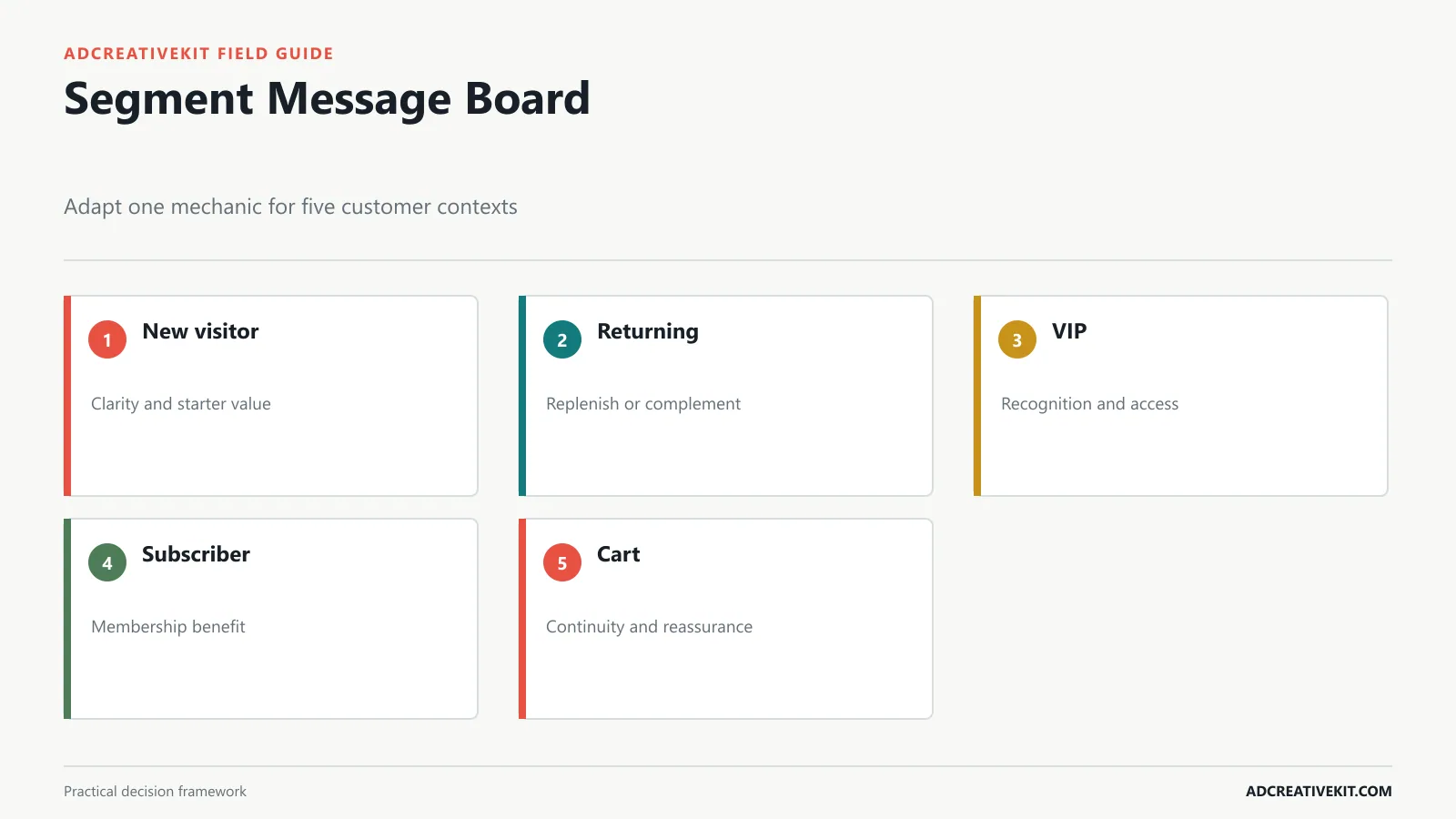
New visitors need product and category clarity before a discount has meaning. Returning customers may respond to replenishment, a complementary item, or recognition of prior behavior. VIPs may value access, exclusivity, service, or a better threshold. Subscribers need a clear benefit for belonging. Cart abandoners need continuity with the item they considered and reassurance about the remaining objection.
Do not change so many elements that each segment receives a different offer, design system, and landing experience by accident. Preserve the underlying mechanic and adapt the hook, product selection, proof, or access message to the segment. A new-customer template might lead with the problem and starter bundle; a customer template might lead with “complete your routine” and compatible products.
Segment claims must match eligibility. If an ad says “members get early access,” the destination should recognize membership and explain access. If personalization is uncertain, use wording that remains truthful even when identification fails. The retargeting ad templates guide covers product-view, cart, and repeat-buyer messages in more depth.
Build the Complete Cross-Channel Asset Set
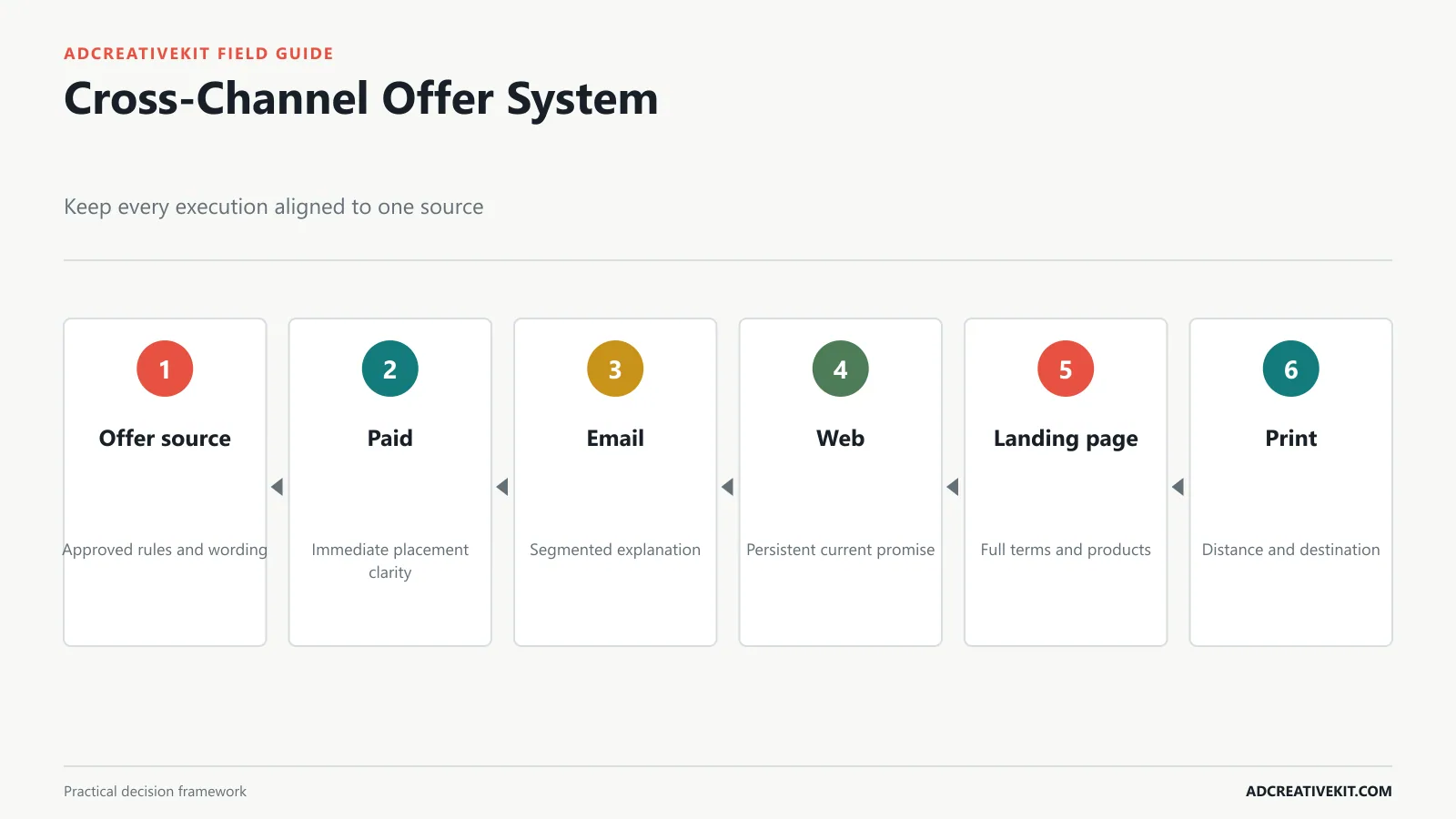
Create an offer source sheet containing approved wording, products, exclusions, code, start and end times with time zone, destinations, tracking, inventory owner, and fallback. Every channel should inherit from it. This prevents an email from promising one deadline while the website banner shows another.
Paid social needs immediate context and placement variants. Organic content can educate and answer questions. Email can segment the message and explain more detail. The website announcement bar should communicate the shortest useful version. Hero banners can show product scope and value. The landing page must carry complete conditions and a coherent product set. Print or signage needs a viewing-distance check and a destination such as a memorable URL or scannable code.
Plan lifecycle states as part of the asset set: teaser, live, reminder, final call, ended, and fallback. Expired promotions should not continue circulating because someone forgot a scheduled post or display asset. Use the ecommerce marketing templates guide to coordinate sale, email, retargeting, and onsite assets.
Write Promotional Copy That Explains the Deal
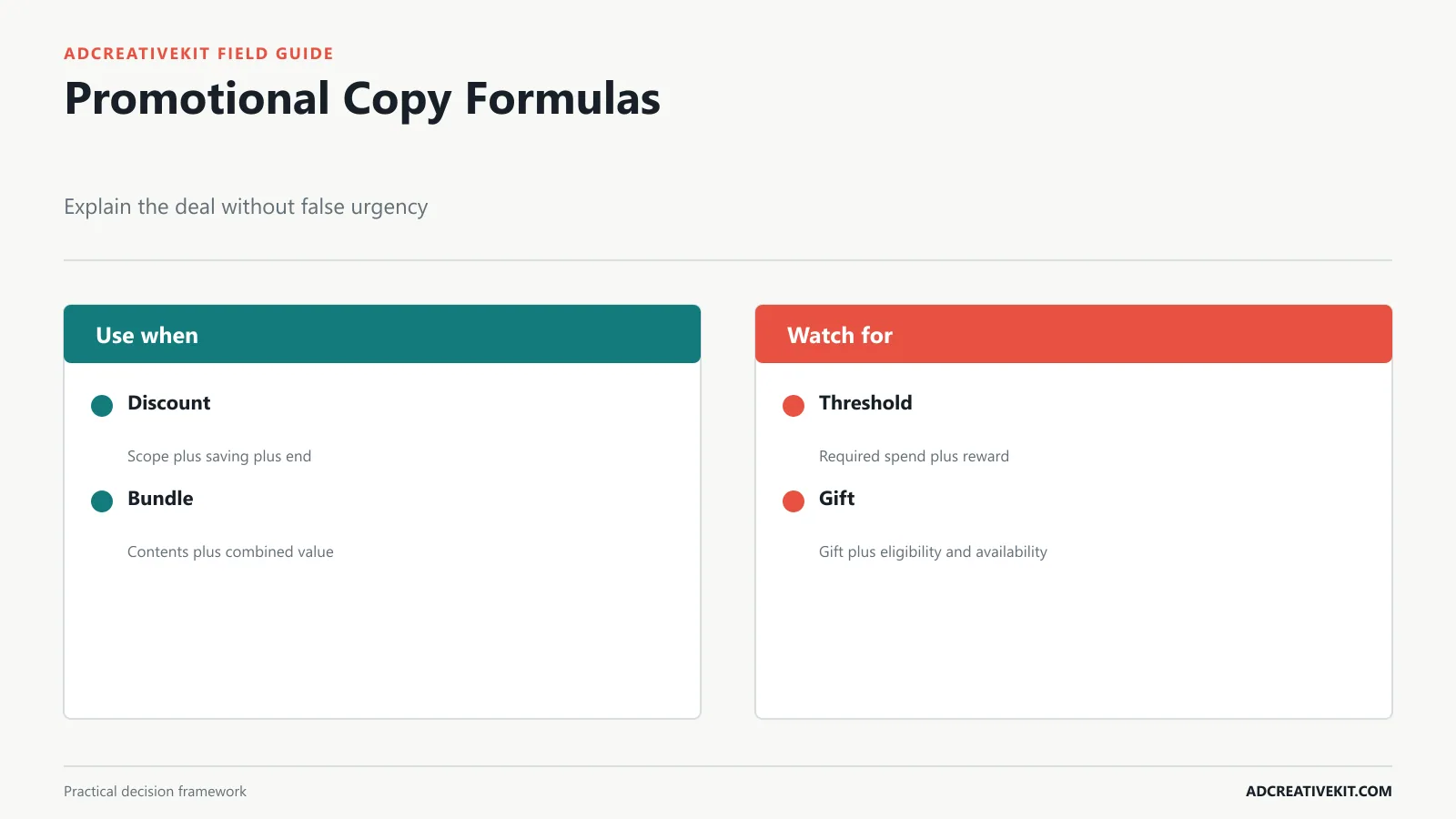
Use a modular formula: context or audience + specific value + qualification + deadline + action. A bundle example could read: “Build the complete morning routine: choose any three eligible products and save $20 through Sunday.” A threshold example could read: “Free standard shipping on orders over $60 through August 4.” These structures explain the benefit and the rule.
Avoid generic headlines such as “Huge savings inside” when the actual offer can be named. Avoid urgency words when there is no real constraint. Avoid stacking “sale,” “deal,” “limited,” “exclusive,” and “last chance” into one headline. Use supporting copy for one material condition, then place full terms where they can be read before purchase.
Match the CTA to the shopper’s task: “Shop eligible bundles,” “Choose your gift,” “Unlock member access,” or “See clearance styles” is often more informative than “Learn more.” For a wider library of opening structures, use the ecommerce ad copy templates.
Preserve Brand and Product Clarity
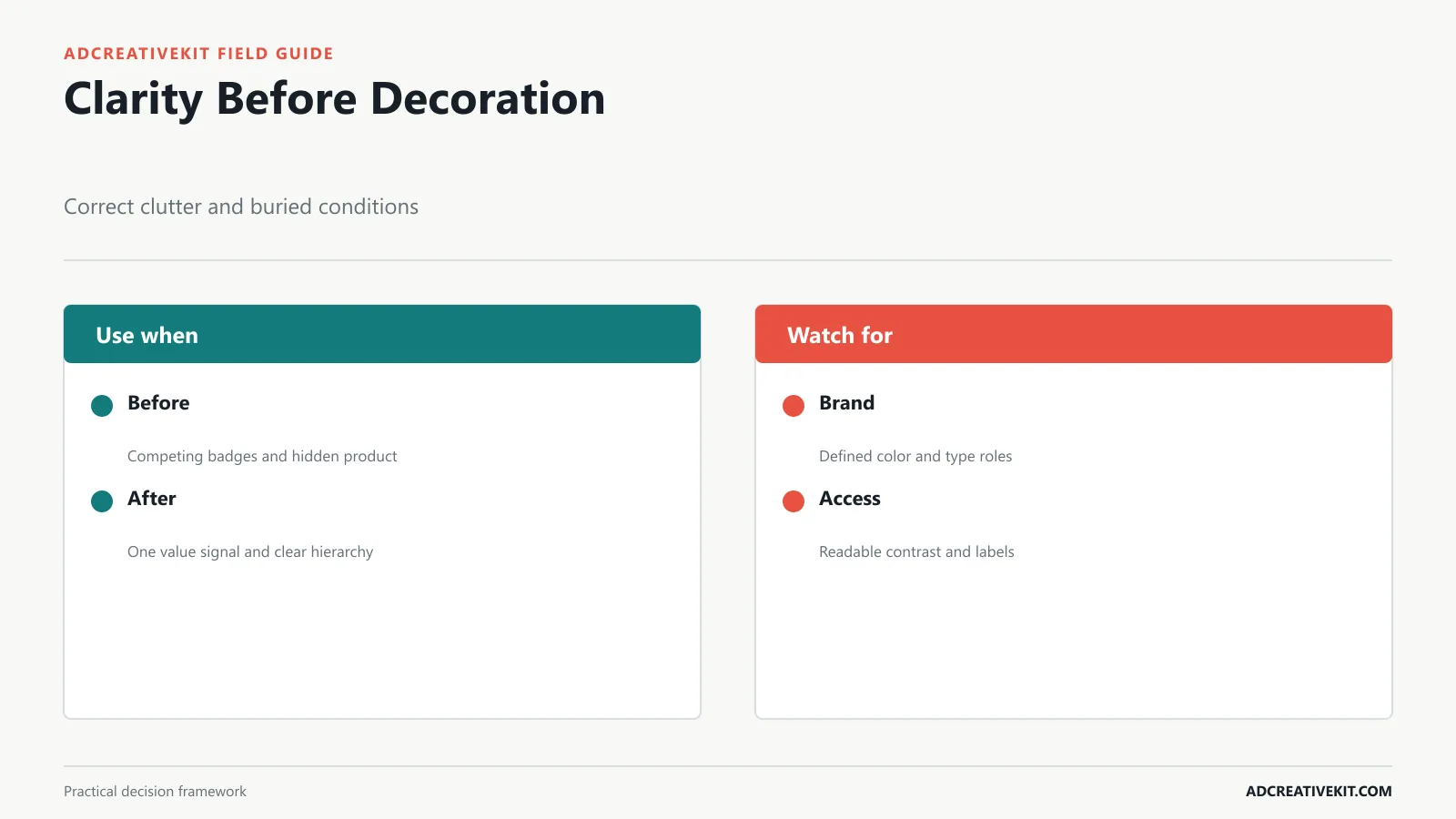
Use badges for information, not decoration. One badge can name the value or deadline; five badges compete with the product. Keep the product large enough to recognize and avoid covering functional details. Seasonal colors should have defined roles rather than turning the whole campaign into an unfamiliar brand.
Set a hierarchy for headline, value, condition, and CTA. Use sufficient contrast, readable type, and more than color alone to distinguish states or categories. W3C’s accessibility design tips provide practical guidance on contrast, spacing, labels, and predictable presentation.
Review the creative beside normal brand touchpoints. It should feel promotional but still recognizably yours. Review at mobile thumbnail size and in grayscale. If the discount remains prominent but the product and brand disappear, the layout may generate attention without building useful demand.
Test the Promotion and the Creative Separately
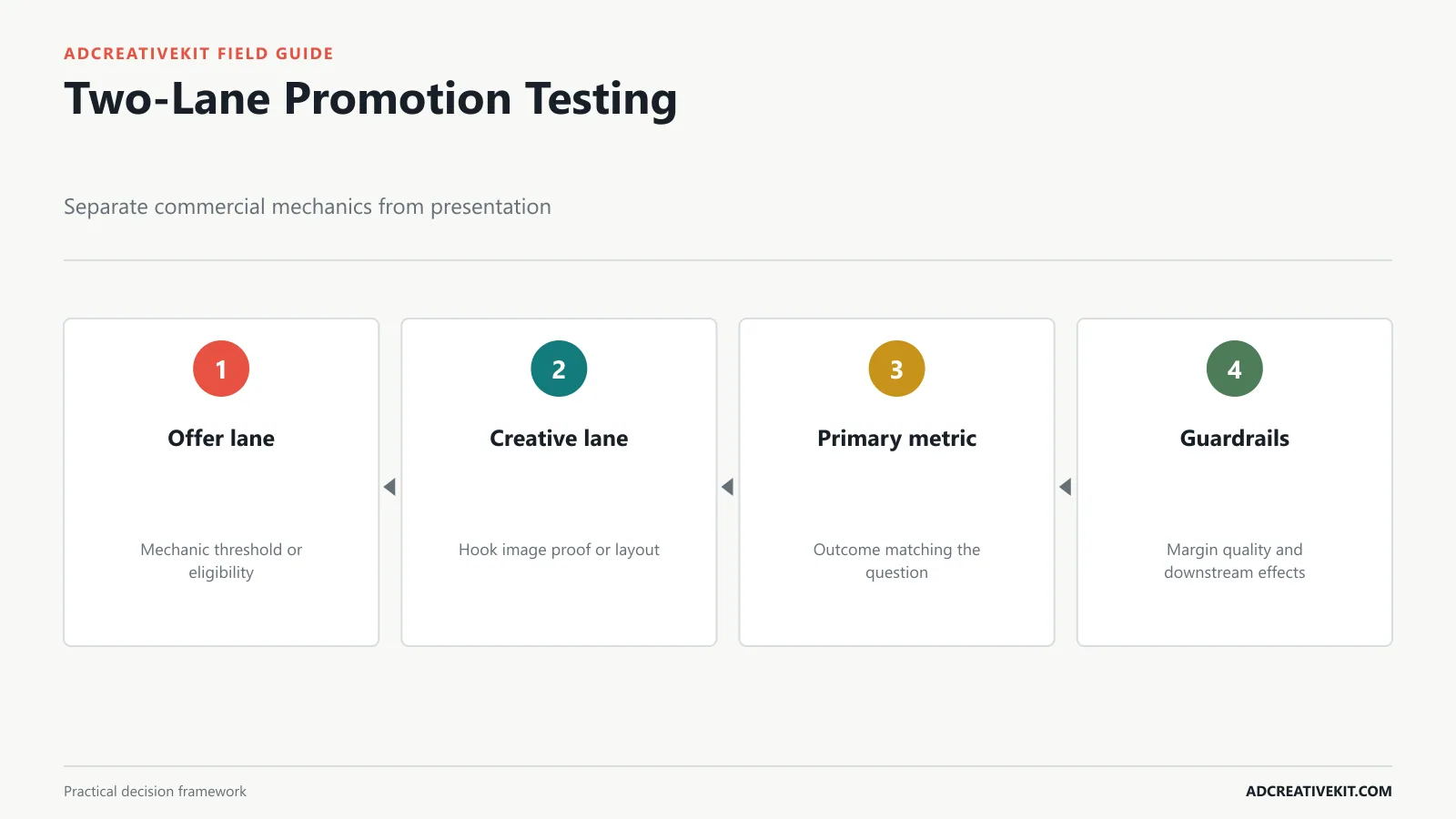
An offer test compares mechanics: percentage versus bundle, threshold levels, gift versus discount, or member access versus public sale. A creative test keeps the mechanic stable and changes presentation: product image, headline angle, proof, layout, or deadline emphasis. Combining both lanes makes the result difficult to interpret.
Define the hypothesis before production. “A bundle will increase average order value among returning customers without reducing contribution per order below our guardrail” is a commercial hypothesis. “Showing all bundle contents will increase qualified landing-page visits because customers understand the value sooner” is a creative hypothesis.
Choose metrics that match the question. Click-through rate can diagnose communication, but conversion, average order value, contribution, new-customer mix, return rate, and future purchasing protect the business interpretation. Document the campaign context and avoid declaring a universal winner from one audience or season.
Run a Promotion QA and Measurement Review
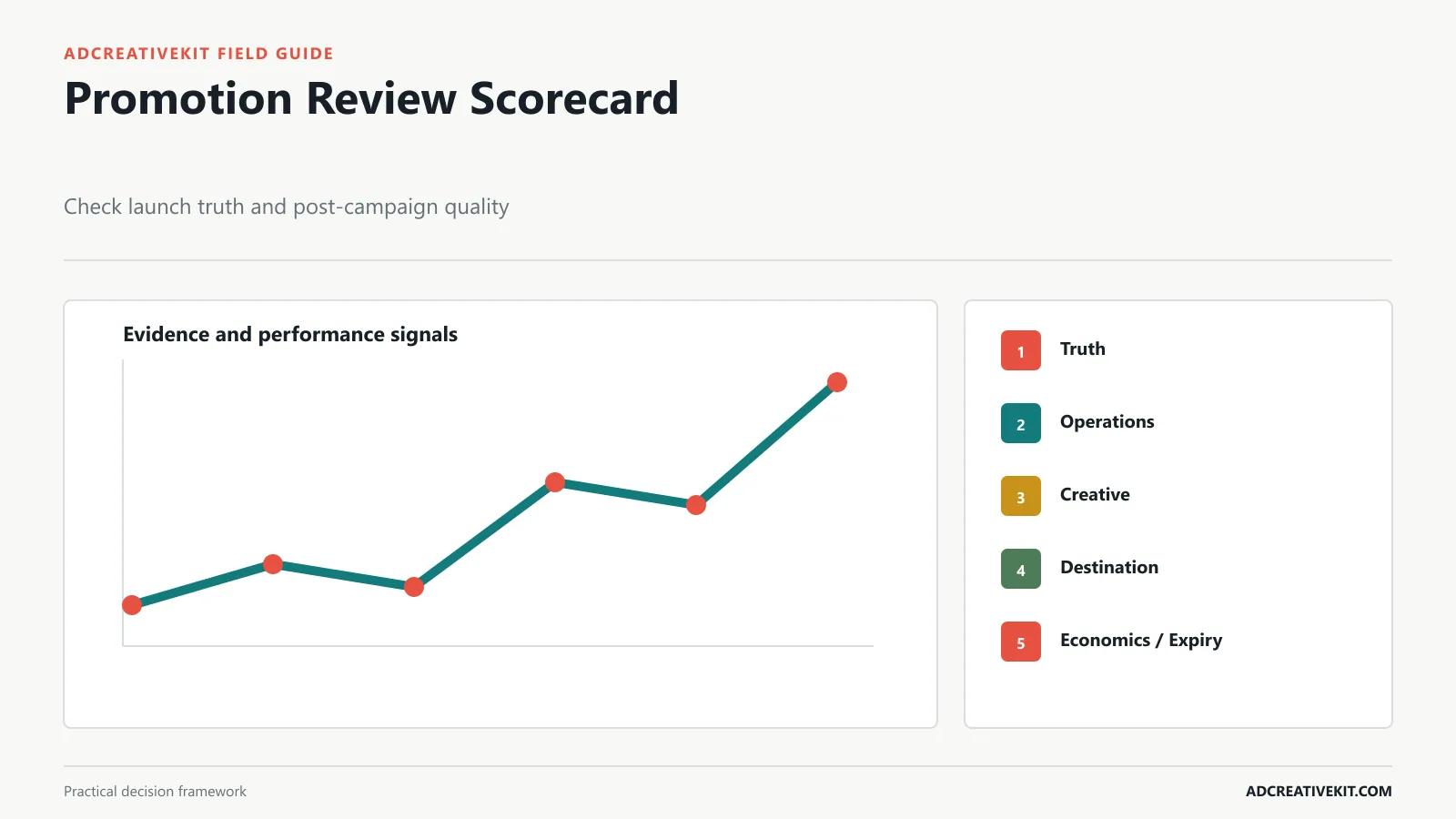
- Offer truth: price, savings, code, eligibility, dates, time zone, and exclusions agree.
- Operations: inventory, fulfillment, support, returns, and fallback are ready.
- Creative: product, value, condition, CTA, contrast, mobile crop, and brand are clear.
- Destination: the page repeats the offer and shows eligible products without friction.
- Tracking: channel, creative, audience, and conversion signals are validated.
- Economics: margin, average order value, acquisition cost, and customer quality have guardrails.
- Expiry: ended assets, codes, banners, and scheduled messages have owners.
Worked example: compare a discount with a bundle
Suppose a skincare store wants to increase complete-routine purchases. A 20 percent sitewide discount may produce broad demand but gives away margin on customers who would have purchased one item. A cleanser, serum, and moisturizer bundle can make the routine easier to understand and increase units per order, but only if shoppers value all three products.
The offer test should keep audience and period comparable and define contribution per order as a guardrail. The discount creative states scope, value, and deadline. The bundle creative shows all contents, combined value, and who the routine suits. This is a mechanic test, so do not also give the bundle a radically better proof story and landing page.
Once the mechanic is chosen, run a separate presentation test. For the bundle, compare a product-grid image with an ordered routine image while preserving price, copy, and page. Product interaction, bundle conversion, average order value, and returns can reveal whether the sequence clarified use or merely attracted curiosity.
Document a promotion after it ends
Close the campaign with an offer record, not a screenshot folder. Capture the mechanic, customer segments, dates, product scope, eligibility, creative families, destinations, inventory events, operational exceptions, and economic result. Note every change made after launch so analysts do not attribute a revised threshold or stock mix to design.
Summarize what the promotion attracted. Did it increase complete bundles, bring purchases forward from loyal customers, move low-priority stock, or create low-margin one-time orders? Record support questions and customer misinterpretations; they reveal where the clarity framework failed. Preserve approved wording that reduced confusion and remove modules that repeatedly required manual explanation.
Turn the record into new defaults
Feed findings into the next promotion brief. Change standard thresholds, exclusion placement, channel timing, or QA ownership only when evidence supports it. Add successful segment messages to a reusable library with their eligibility rules. Mark offer modules with dates and dependencies so an old code or saving cannot be reused accidentally.
This makes the template collection commercial memory rather than a gallery of past discounts. The goal is faster, more accurate decisions, not simply faster graphic production.
Promotion decision rules
Use a discount when price is the actual barrier and margin can support it. Prefer a bundle when products form a credible solution and basket growth matters. Use a threshold only when customers can reach it with relevant items. Choose a gift when it adds perceived value without confusing fulfillment. Reserve loyalty treatment for audiences whose qualification can be recognized reliably.
If customers require a calculator to understand the benefit, simplify the mechanic or provide an interactive explanation on the destination. If the most important condition cannot remain legible in the smallest placement, choose a less compressed format. If a promotion wins clicks but worsens contribution or returns, treat it as a warning about demand quality, not a creative victory.
Frequently asked questions
What should a promotional template include?
Include the product or category, value, material condition, truthful deadline, action, and brand. Add proof only when it helps the current decision.
Which promotional offer is best?
There is no universal best mechanic. Choose based on objective, margin, inventory, basket behavior, customer segment, and operational complexity.
How do I avoid making promotions look cheap?
Preserve product quality, spacing, typography, image direction, and brand roles. Let the offer be prominent without turning every element into an urgency signal.
For a reusable creative review process that checks claims, hierarchy, mobile readability, and destination match before spend begins, continue with the full checklist.